



21700 vs 18650 Cells for E-Bike Batteries
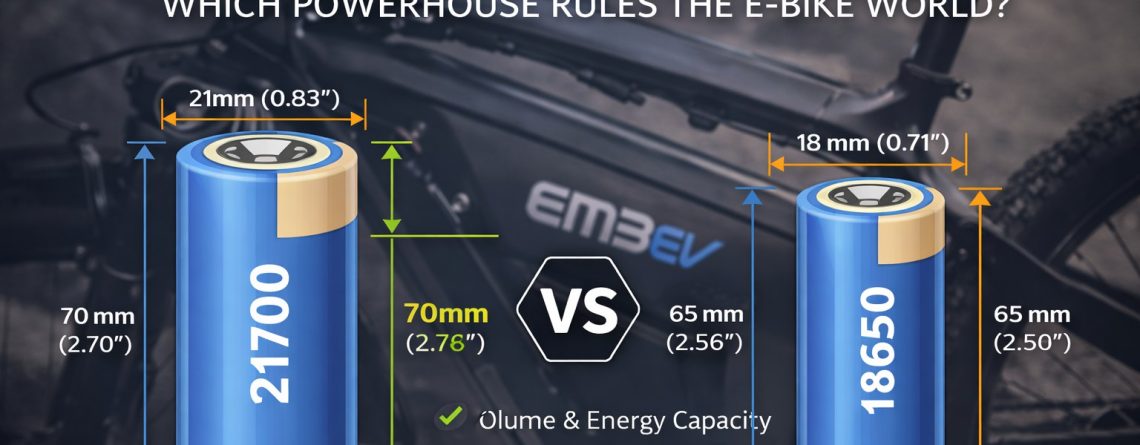
When comparing 21700 vs 18650 batteries, start with physical size: a 21700 cell is about 21 × 70 mm, while an 18650 is about 18 × 65 mm. Many 21700 models offer more capacity per cell, while 18650 cells can support slimmer pack layouts. Neither format automatically guarantees more range, lower heat or longer life; compare the exact cell datasheet and the completed pack’s watt-hours, current rating, BMS and dimensions.
Fast Comparison:
- Consider 21700 for: Higher capacity per cell or high-current designs when the exact cell and pack are rated for the controller load.
- Consider 18650 for: Compact frames, proven cell options and pack layouts where space is limited.
- Key verdict: There is no automatic winner. The better battery is the pack whose cells, BMS, current capability, watt-hours and fit match the bike.
Quick Verdict: 18650 vs 21700 Difference
The primary difference is physical size. A 21700 cell is larger than an 18650 cell, and many modern 21700 models offer higher capacity per cell. In an eBike battery, this can allow designers to reach a target capacity with fewer parallel cells, depending on the specific cell model, pack design and current requirements.
Decoding the Numbers: 18650 vs 21700 Size Comparison
If you are new to lithium battery cell sizes, the names might seem like random codes. They are actually simple measurements in millimeters. An 18650 is 18mm wide and 65mm long. A 21700 is 21mm wide and 70mm long.
The larger 21700 can gives cell manufacturers more internal volume to work with, but physical size alone does not determine chemistry, internal resistance or discharge capability. Compare individual models rather than assuming that every 21700 cell outperforms every 18650 cell.
Why 21700 Cells Became Popular
The 21700 format became more visible after large electric-vehicle programs adopted it, and cell makers now offer many high-capacity and high-current 21700 models. For an e-bike, that can mean fewer parallel cells for a target capacity, but it does not automatically simplify the BMS or improve reliability. Pack architecture, cell selection, interconnects, thermal design and quality control remain decisive.
Beyond 21700: 26650 and 4680 Formats
Other cylindrical formats include 26650 and 4680, but a larger diameter does not by itself establish energy density, current capability or cooling performance. These formats can also be harder to package in standard downtube cases. For any format, compare the exact cell specifications and the finished battery’s dimensions before choosing it for an e-bike. At EM3ev, we focus on the 21700 format as it currently provides the absolute “sweet spot” for power-to-weight ratio without sacrificing e-bike frame compatibility.

Visualizing the 5mm and 3mm difference that changes e-bike performance.
| Technical Spec | 18650 Standard | 21700 Performance | What to Check |
|---|---|---|---|
| Diameter / Length | 18mm x 65mm | 21mm x 70mm | 21700 is physically larger |
| Single Cell Weight | ~45 – 48 grams | ~60 – 72 grams | Compare total pack weight |
| Internal Resistance | Varies by cell model and condition | Varies by cell model and condition | Compare manufacturer datasheets |
| Typical Capacity | Often about 2.5–3.5 Ah | Often about 4.0–5.0 Ah | 21700 often has higher capacity per cell |
| Cycle Life | Varies by cell chemistry, temperature, charge rate and depth of discharge | Varies by cell chemistry, temperature, charge rate and depth of discharge | Depends on the specific cell and use |
How Cell Choice Affects E-Bike Battery Performance
Cell format matters less than the specifications of the exact cell and pack. Under load, voltage sag and heat depend on internal resistance, current per cell, state of charge, temperature, age, parallel configuration and conductor design. A suitable 21700 may outperform a lower-current 18650, but the reverse can also be true.
Why Some 21700 Cells Can Run Cooler Under Load
Heat is an important factor in lithium battery performance and lifespan. Some modern 21700 cells are designed for strong current delivery and can perform efficiently in high-load eBike packs. Whether a 21700 cell runs cooler than an 18650 depends on the exact cell models, discharge rate, pack layout, cooling and ambient temperature. Lower internal resistance and lower heat under a given load can help reduce voltage sag and long-term cell stress.
EM3ev Engineering Note: In high-power battery designs, suitable 21700 cells can provide strong current capability with fewer parallel cells. Actual performance depends on the specific cell model, pack configuration, BMS, temperature and discharge requirements.
Advanced Analysis: Internal Resistance and Voltage Sag
Beyond size, Internal Resistance (IR) is one of the key factors that affects voltage sag and heat under load. Some modern 21700 cells are designed for high current and may maintain voltage more effectively than lower-current 18650 models, but this is not a rule for every cell. Compare the exact cell specifications, current demand, pack configuration, temperature and BMS limits when evaluating performance. Lower resistance generally means less voltage drop and less heat at the same current.
Understanding Energy Density
The term energy density describes how much energy can be stored for a given weight or volume. Cell format alone does not determine the winner: chemistry and cell model matter. A well-designed 21700 pack can use fewer cells and simpler current paths for a given capacity, while a compact 18650 pack may still fit smaller frames more easily.
Choosing Your EM3ev Solution: 36V, 48V, or 52V?
Choose the completed battery around the bike and route: system voltage, controller current, required watt-hours, case dimensions, connector and charger. Cell format is one input, not the final buying decision.

EM3ev 52V Battery Options Using 21700 Cells
For a compatible 52V system, a pack using suitable 21700 cells can combine high per-cell capacity with strong current capability. Confirm the exact cell option, continuous discharge rating, BMS limit, watt-hours, connector and frame fit before ordering.
- Current capability: Use the continuous rating stated for the exact pack configuration; do not infer it from cell size.
- Range: Compare usable watt-hours and expected Wh per mile rather than cell format alone.
- Best for: Compatible builds whose controller load, range target and frame space match the pack.
EM3ev 36V 18650 Series
An 18650-based pack can remain a practical choice for a commuter or compact frame. Judge the finished pack by its dimensions, watt-hours, current rating, construction and warranty rather than assuming that the format alone makes it lighter or more reliable.
- Portability: Slimmer profile fits smaller frames.
- Weight: Easiest to carry into the office.
- Best For: Urban commuting and flat roads.
Visualizing the device compatibility and space requirements.
Comparing 52V 21700 and 48V 18650 Packs
A 52V 21700 pack and a 48V 18650 pack differ in more than cell size. Voltage, watt-hours, controller settings, current limits, state of charge and motor speed constant all affect the ride. A 52V pack may provide more voltage headroom on a fully compatible system, but it is not a drop-in upgrade for every 48V bike.
When comparing Samsung 21700 vs 18650 cells, use the manufacturer datasheets for the exact models and compare capacity, maximum continuous current, DC internal resistance, charge limits and cycle-life test conditions. A Samsung 50GB and a Samsung 35E target different design needs, so format alone is not enough to predict the finished pack’s voltage curve.
Power Matching: What the Battery Must Support
Match the battery’s verified continuous current capability to the controller’s maximum battery current, with appropriate margin and compatible wiring, connectors and BMS settings.
| Motor System | Cell and Pack Requirement | Selection Check |
|---|---|---|
| Bafang BBS02 (750W) | Cells and pack rated for controller current | Verify voltage, current, connector and fit |
| Bafang BBSHD (1000W+) | High-current cells in a compatible pack | Verify the BBSHD controller version and pack rating |
| Hub Motors (35A+ Controller) | Pack rated above the controller’s continuous demand | King Shark 21700 Series |
What Kind of Range Can You Expect?
Changing to a larger cell format does not create a fixed range increase. Estimate range from usable pack watt-hours divided by typical energy consumption in Wh per mile or Wh per kilometre, then allow for hills, speed, wind, temperature, tyre pressure and battery age.
On steep climbs, current demand and heat rise. The relevant checks are the exact cell’s discharge capability, current per parallel group, voltage sag, pack temperature and BMS limit. A well-matched pack can reduce losses, but the result must be demonstrated for the specific design.
Building a Battery Pack: Behind the Scenes
A reliable battery pack depends on more than cell choice. Cell verification, electrical insulation, interconnect sizing, fusing strategy, BMS configuration, mechanical support, sealing and quality control all affect safety and performance.
- Interconnect design: Conductor material and cross-section must be sized for the verified pack current; cell diameter alone does not set the requirement.
- Cell verification: Cells should be authenticated, inspected and grouped using documented acceptance limits for capacity, voltage and resistance.
- BMS integration: Protection thresholds and current limits must match the chemistry, series count, cells, wiring and intended controller load.
How We Build Safer Batteries
Safer pack design combines suitable cells with correctly sized conductors, insulation, mechanical protection, fusing and a properly configured BMS. A BMS helps protect against conditions such as overcharge, over-discharge, overcurrent and short circuit, but it cannot compensate for incompatible parts, physical damage or poor construction.
How to Match a Charger to an E-Bike Battery Pack
For a complete e-bike battery pack, charger compatibility is determined by pack chemistry, series count, full-charge voltage, connector, polarity and permitted charge current—not by whether the cells are 18650 or 21700.
Use the charger supplied or explicitly approved for the exact pack. Confirm output voltage, connector, pin polarity and charge current. A faster charger is appropriate only when both the battery maker and charger maker approve that rate; higher current can add heat and cell stress.
FAQ: Everything You Need to Know
Can I use the same charger after changing from 18650 to 21700 cells?
For an e-bike battery pack, cell format is not the deciding factor. The charger must match the pack’s chemistry, full-charge voltage, connector, polarity and approved charge current. Do not use a charger merely because the plug fits.
Which battery lasts more years?
Neither format automatically lasts longer. Service life depends more on the exact cell model, operating temperature, charge rate, depth of discharge and current demand. A correctly specified 18650 pack can outlast a poorly matched 21700 pack, and vice versa.
Are 21700 batteries safe?
No lithium battery is risk-free. Risk is reduced when reputable cells, suitable insulation, correct fusing, mechanical protection and a matched BMS and charger are used, and when the pack is undamaged and operated within its specified limits.
Is a 21700 battery significantly heavier?
A 21700 cell is usually heavier than an 18650 cell, but finished pack weight depends on cell model, series-parallel layout, case, conductors, BMS and hardware. Compare published weight for complete packs at similar usable watt-hours rather than assuming the total weight or cooling benefit.
Why is 18650 vs 21700 vs 26650 important for DIY?
For DIY builders, cell size affects the physical footprint, but safe current capability comes from the exact cells and the complete electrical and mechanical design. Building or rebuilding lithium packs requires appropriate training, equipment and hazard controls.
Tips for Storing Your Battery
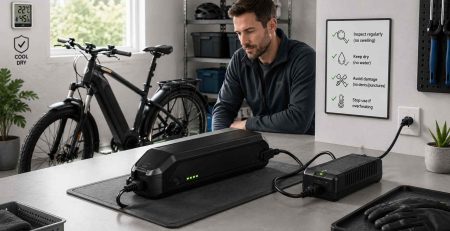
For storage, follow the battery manufacturer’s specified state-of-charge and inspection interval. Many lithium-ion pack makers recommend a partial charge rather than leaving the pack near empty or fully charged for an extended period.
Store and charge the pack only within the battery maker’s specified temperature and state-of-charge limits. If it is cold-soaked, let it warm naturally into the approved charging range before connecting the charger. These steps reduce avoidable stress but do not replace the product manual or inspection of a damaged pack.
Ready to Upgrade Your Ride?
Compare EM3ev battery options by system voltage, watt-hours, verified current rating, cell option and case dimensions. Choose a 21700-based pack only when those specifications match your bike and riding load.
EM3ev Technical Team
Battery information for e-bike owners and builders. Confirm all specifications against the current product page and manufacturer documentation.
Content updated: 2026-08-16


LEAVE A COMMENT