




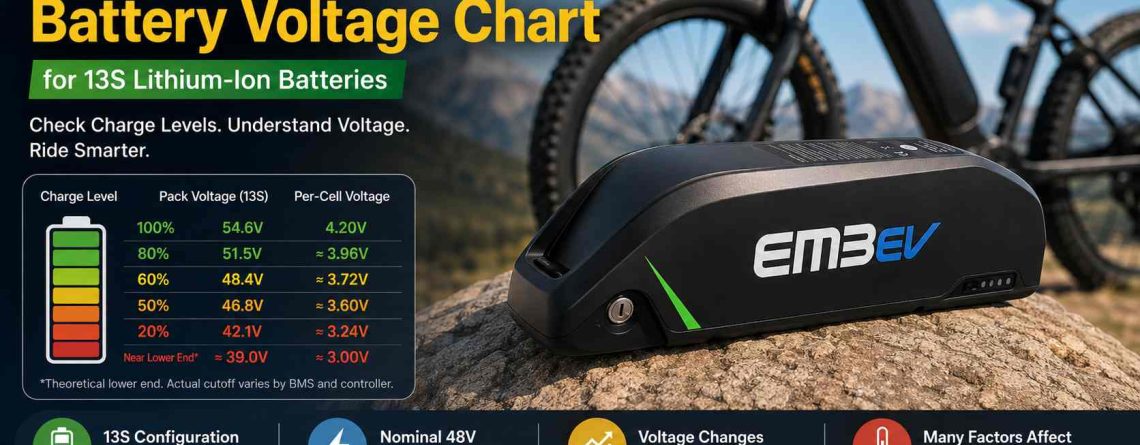
48V Battery Voltage Chart for eBikes: 13S Charge Levels
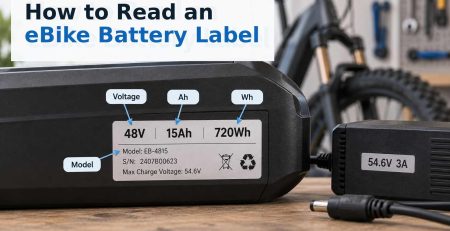
This 48V battery voltage chart shows the approximate charge levels of a typical 13S lithium-ion eBike battery, which reaches about 54.6V when fully charged. As the battery discharges, its voltage falls. The percentages below are based on resting voltage and should be treated as estimates rather than exact state-of-charge measurements.
Quick Answer
- A typical 48V lithium-ion eBike battery is a 13S pack.
- Full charge is about 54.6V, or 4.2V per cell group.
- 48V is the nominal battery class, not its fixed operating voltage.
- Voltage should ideally be checked after the battery has rested with little or no load.
- Loaded voltage can temporarily fall because of voltage sag.
- Low-voltage cutoff varies by battery BMS and controller, so there is no universal empty-voltage setting.
48V Battery Voltage Chart
For a typical 13S lithium-ion eBike battery, 54.6V represents a full charge, while voltage gradually falls as stored energy is used.
| Approx. Charge Level | 48V / 13S Battery Voltage | Per-Cell Voltage |
|---|---|---|
| 100% | 54.6V | 4.20V |
| 90% | 53.0V | ≈4.08V |
| 80% | 51.5V | ≈3.96V |
| 70% | 49.9V | ≈3.84V |
| 60% | 48.4V | ≈3.72V |
| 50% | 46.8V | ≈3.60V |
| 40% | 45.2V | ≈3.48V |
| 30% | 43.7V | ≈3.36V |
| 20% | 42.1V | ≈3.24V |
| 10% | 40.6V | ≈3.12V |
| Near theoretical lower end* | ≈39.0V | ≈3.00V |
*Important: Do not use 39.0V as a universal low-voltage cutoff. Actual controller and BMS cutoff settings vary. Follow the specifications for your battery and eBike system.
This table is a reference for common 13S lithium-ion packs using cells charged to 4.2V per series group. It is not a calibrated state-of-charge meter. Lithium-ion discharge curves are not perfectly linear, so a voltage reading cannot identify the exact remaining percentage in every battery.
Why Is a 48V Battery 54.6V When Fully Charged?
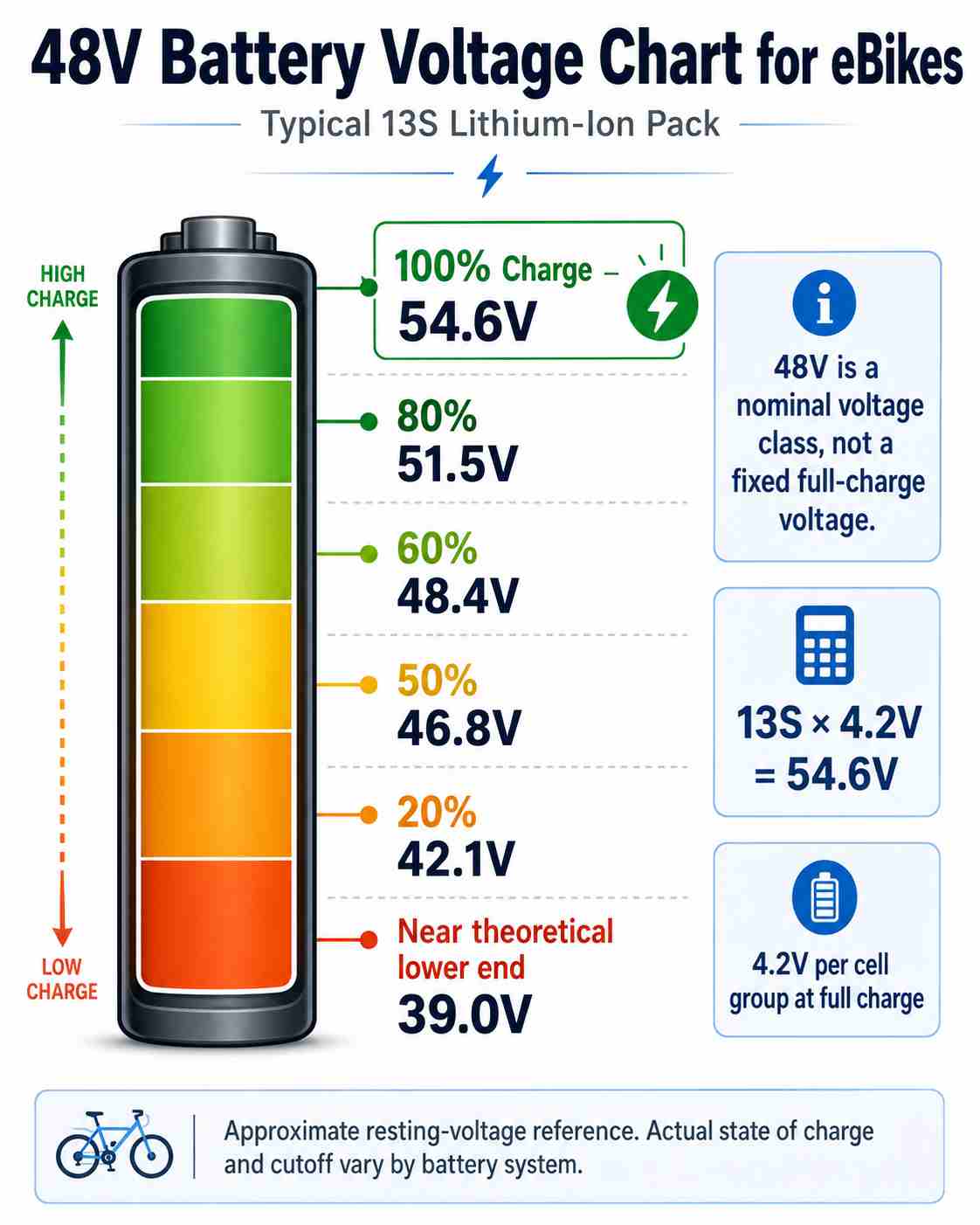
“48V” is the nominal system name; the actual pack voltage changes throughout the charge and discharge cycle.
A typical 48V eBike battery has 13 cell groups connected in series. Standard lithium-ion cells are commonly charged to about 4.2V per cell, so when each of the 13 series groups reaches this voltage:
13 × 4.2V = 54.6V
That is why a standard 48V/13S lithium-ion eBike battery normally uses a 54.6V charger.
Seeing more than 48V on a charged battery is therefore normal. The battery is still called a 48V pack because 48V describes its nominal voltage class, not its maximum voltage.
If you want to compare how 36V, 48V, 52V, and 72V systems are defined, see our eBike battery voltage guide.
Why Does Battery Voltage Drop When You Accelerate?
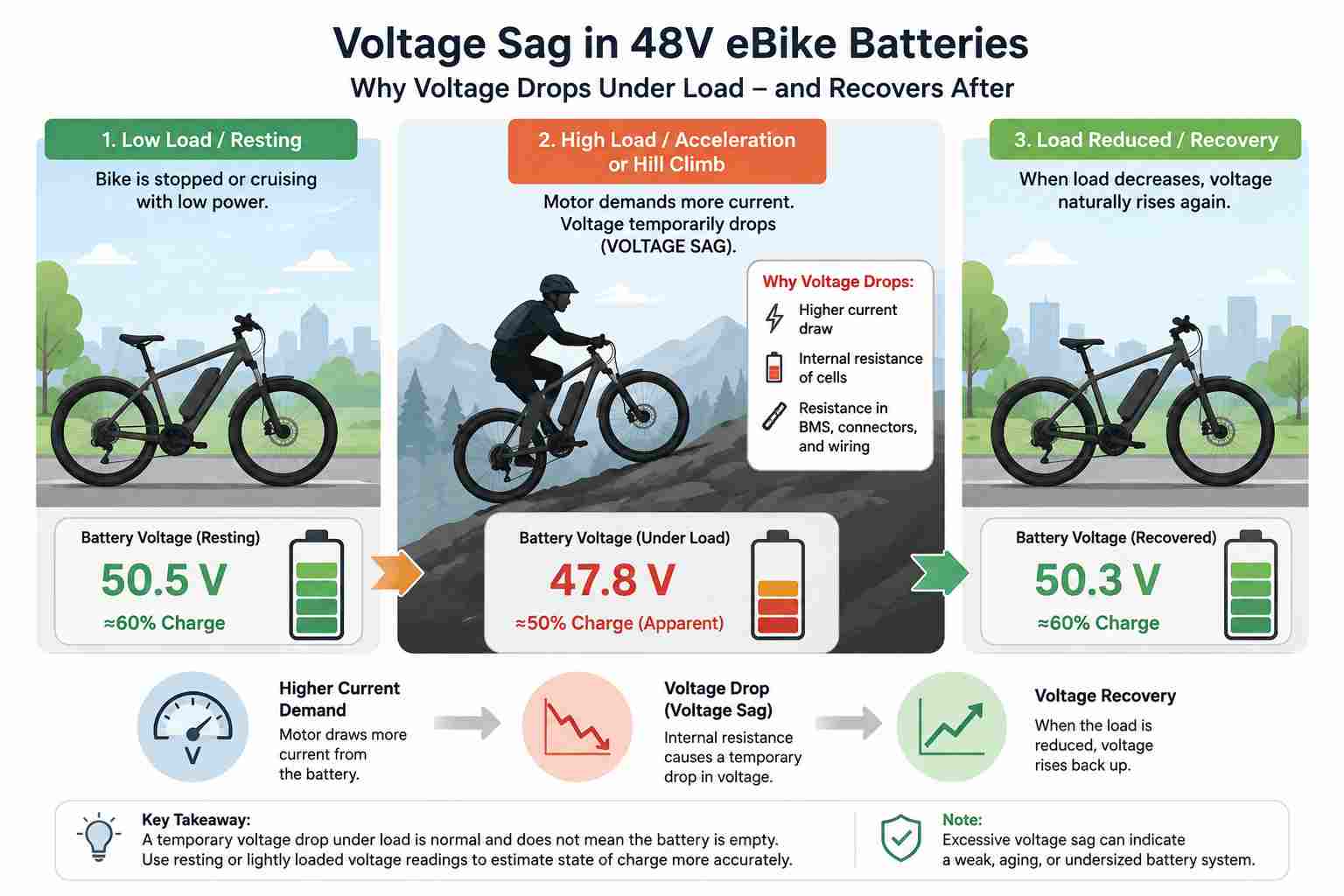
A temporary voltage drop under acceleration or climbing is called voltage sag and does not automatically mean the battery is empty.
When the controller requests more current, internal resistance in the cells, BMS, connectors, and wiring causes the measured pack voltage to fall.
Once the load is reduced, voltage normally rises again.
This is why you may see a lower voltage while climbing a hill than when the bike is stopped a few seconds later.
Battery age, low temperature, higher current demand, cell condition, and electrical resistance can all increase voltage sag.
For estimating charge level with this chart, a resting or lightly loaded voltage is more useful than a reading taken during hard acceleration.
Why Your Voltage May Not Match the Chart Exactly
Small differences from a voltage chart are normal because real battery voltage changes with the cells and operating conditions.
Your reading can be affected by:
- Cell chemistry and discharge curve
- Battery temperature
- Battery age and condition
- Recent charging or riding
- Current being drawn from the pack
- Display or meter accuracy
- BMS and controller behavior
For this reason, do not treat a difference of a few tenths of a volt as proof that a battery is faulty.
Look for repeatable behavior instead. A pack that shows unusually heavy voltage sag, loses usable voltage quickly, or repeatedly triggers protection deserves further diagnosis.
How to Check a 48V eBike Battery Voltage
The safest first option is to use a voltage reading provided by the eBike display or battery-management interface.
If your system provides battery voltage on the display, let the bike rest before comparing the reading with the chart.
A digital multimeter can also measure pack voltage, but only use accessible terminals or test points identified for your battery. Set the meter to DC voltage and avoid allowing the probes to bridge positive and negative contacts.
Do not open a sealed lithium-ion battery pack just to measure its voltage.
What If a 48V Battery Does Not Reach 54.6V?
A full 13S pack is designed around approximately 54.6V, but one lower reading does not automatically prove that the battery has failed.
Check whether the charger is the correct 54.6V charger for the battery. Also consider display accuracy, charger settings, battery temperature, BMS behavior, and whether the battery has rested after charging.
Do not try to force the battery above the charging voltage specified for the pack.
If the battery repeatedly finishes charging well below its expected voltage or its usable range has fallen sharply, stop guessing from the chart and have the charger and battery checked.
Frequently Asked Questions
What voltage is a fully charged 48V eBike battery?
A typical 48V/13S lithium-ion eBike battery reaches about 54.6V when fully charged because 13 series groups at 4.2V each equal 54.6V.
Is 48V really 48 volts?
48V is the nominal voltage class. The actual battery voltage changes as the battery charges and discharges and can be well above 48V when the pack is full.
What voltage is 50% on a 48V battery?
A simple 13S reference chart places roughly 50% around 46.8V, but this should only be treated as an estimate. Real state of charge depends on the cells, temperature, age, load, and resting time.
What is the lowest voltage for a 48V eBike battery?
There is no universal low-voltage cutoff for every 48V battery. The BMS and controller determine the actual protection limits. Follow the specifications for your specific pack rather than using one chart value as a cutoff setting.
Why does my 48V battery voltage drop on hills?
Higher motor current causes temporary voltage sag. Voltage should rise again when the load falls. Excessive sag can also be associated with a cold, aging, high-resistance, or undersized battery system.
Final Answer
A 48V battery voltage chart is best used as a quick reference, not an exact fuel gauge.
For a typical 13S lithium-ion eBike battery, about 54.6V represents full charge. Voltage then falls as the battery discharges, but load, temperature, cell type, and battery condition can shift the reading.
Use resting voltage to estimate charge level, and let the battery’s BMS and controller—not a generic chart—determine the safe low-voltage limit.
If you need a replacement pack for a compatible 48V system, you can also review 48V eBike battery options.



LEAVE A COMMENT