





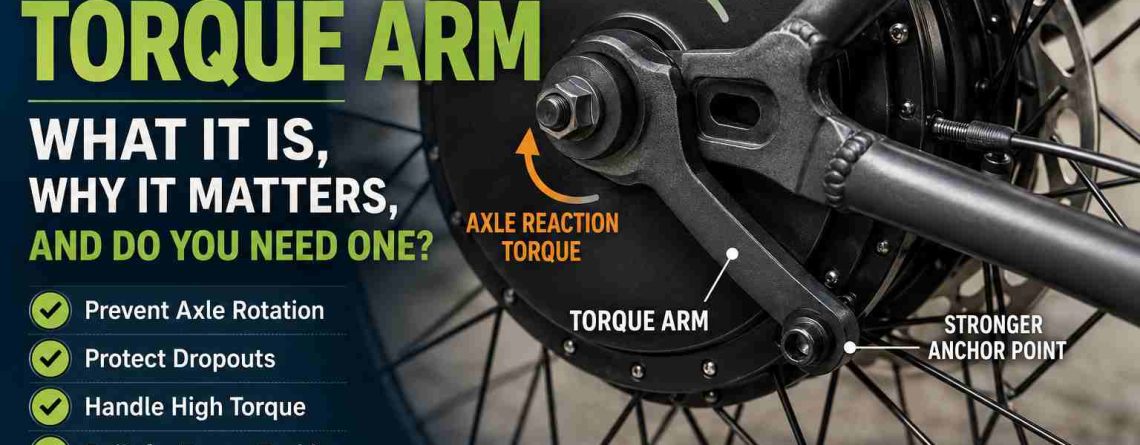
What Is an eBike Torque Arm, and Do You Need One?
An eBike torque arm is an anti-rotation part used with a hub motor to help stop the motor axle from twisting inside the bicycle dropout. It fits around the axle flats and transfers reaction torque into a stronger part of the fork or frame. Whether you need one depends on the motor torque, dropout design, frame material, installation, and whether the system uses regenerative braking.
Quick Answer
- A torque arm protects the fork or frame dropout from hub-motor axle rotation.
- It is mainly relevant to hub-motor eBikes and conversion kits.
- Higher motor torque, weak or thin dropouts, front-hub installations, and regenerative braking deserve extra attention.
- One well-designed torque arm may be enough for some systems; others may require two or a stronger torque plate.
- Do not choose or install one by motor wattage alone.
- Axle size, axle-flat fit, dropout geometry, anchor location, and installation direction all matter.
A hub motor can look like a normal bicycle wheel with a larger center. Mechanically, however, it puts a type of load on the fork or frame that a normal bicycle hub does not.
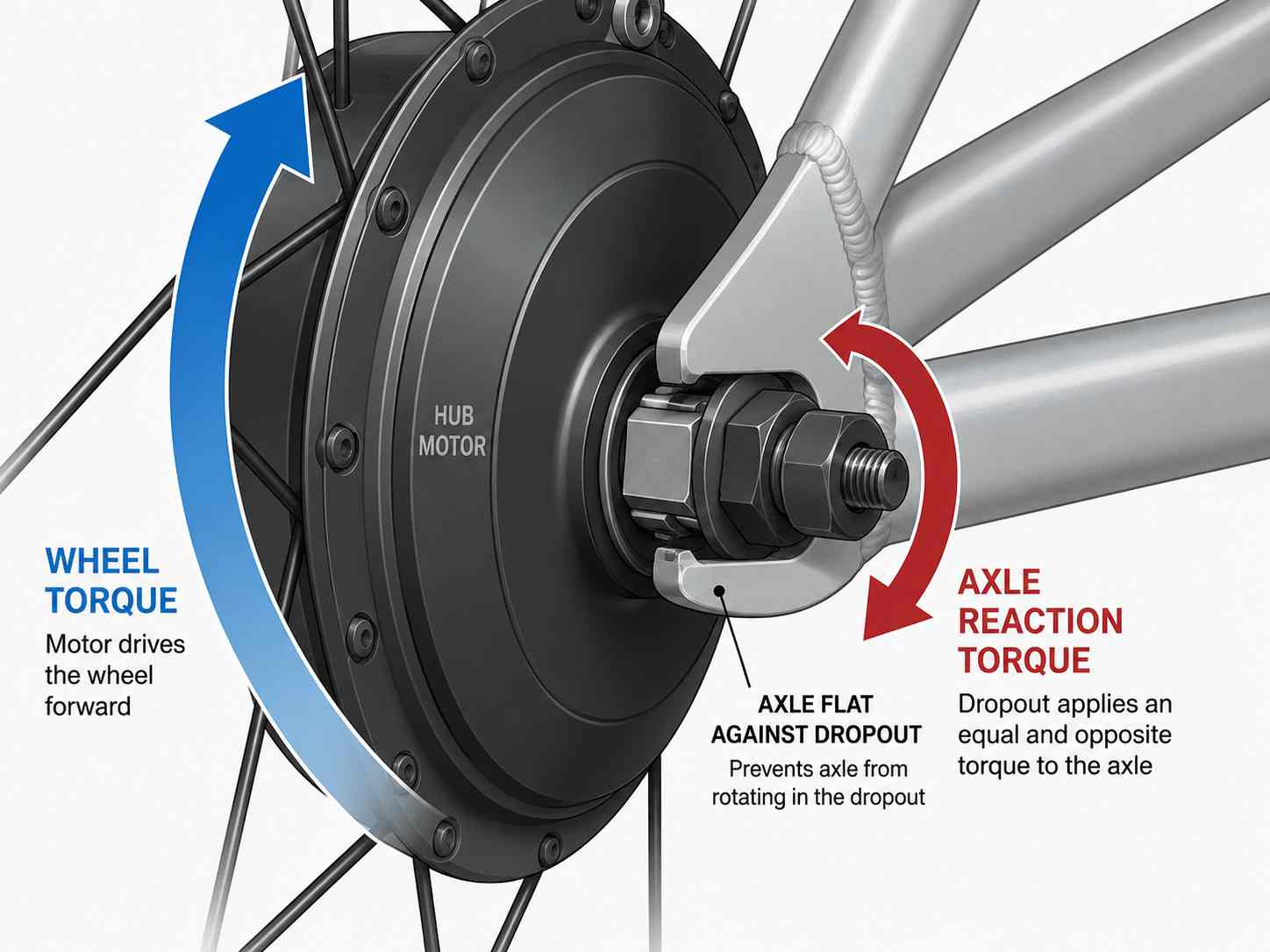
When the motor pushes the wheel forward, the axle reacts in the opposite direction. The flat sides of the motor axle press against the bicycle dropouts to stop that rotation.
Sometimes the dropout can handle the load. Sometimes repeated motor torque can spread, deform, crack, or enlarge the dropout slot.
That is where an eBike torque arm comes in.
What Does an eBike Torque Arm Actually Do?
A torque arm gives the hub-motor axle a stronger mechanical path for resisting rotation instead of asking the dropout slot to carry the full reaction load.
Most conventional hub-motor axles are not completely round. They have flat sections that fit into slotted bicycle dropouts.
Those flats are important because the axle itself wants to rotate in the opposite direction from the driven wheel.
Without enough anti-rotation support, the axle flats press against the sides of the dropout. With enough torque, the slot can begin to deform.
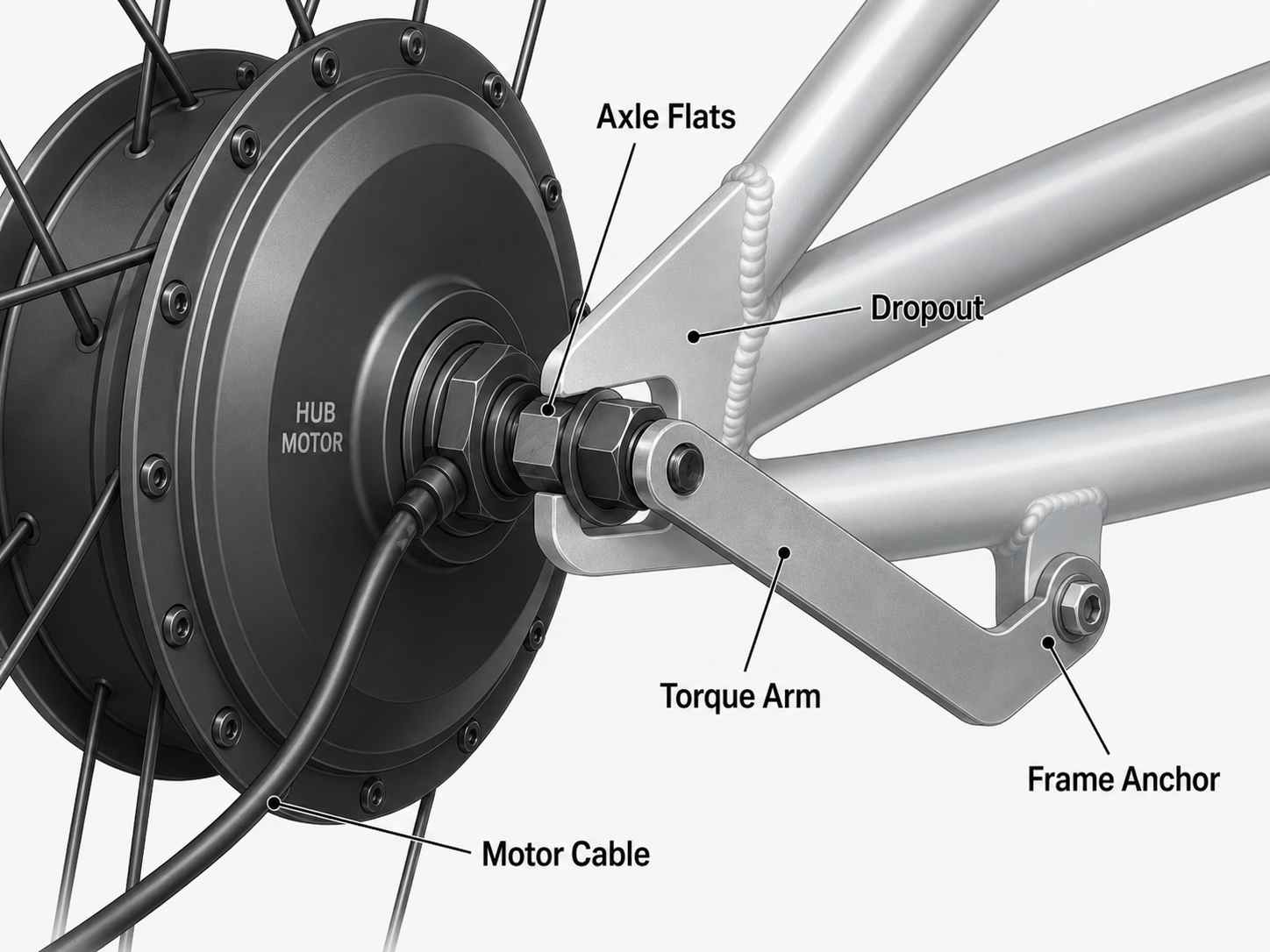
A torque arm fits closely over the axle flats. The arm then extends away from the axle and attaches to a stronger location on the fork or frame.
This increases the distance over which the reaction force is resisted and reduces the stress concentrated at the dropout slot.
| Part | Main Job |
|---|---|
| Axle nuts | Clamp and retain the motor wheel in the dropout |
| Axle flats | Provide basic resistance to axle rotation |
| Torque washer | Adds local anti-rotation support on some systems |
| Torque arm | Transfers axle reaction torque farther into the fork or frame |
| Torque plate | Provides a larger or more integrated anti-rotation structure |
A torque arm does not replace correct axle nuts, washers, or wheel installation. It is one part of the complete wheel-retention and anti-rotation system.
Why Can a Hub Motor Damage a Dropout?
A bicycle dropout can be damaged when the motor’s axle reaction torque exceeds the dropout’s ability to hold the axle flats without spreading or cracking.
Imagine trying to turn a wrench while someone holds the wrench handle in place. The turning force still has to go somewhere.
A hub motor works in a similar way.
The motor creates torque that rotates the wheel forward. An equal reaction torque acts through the motor axle in the opposite direction.
The distance between the axle center and the contact surface of the dropout is small. That means even normal-looking motor torque can create a large force where the axle flats contact the dropout.
The exact risk varies with:
- Motor torque
- Controller current
- Axle dimensions
- Dropout thickness
- Dropout material
- How tightly the axle fits the slot
- Whether the motor is mounted front or rear
- Whether regenerative braking reverses the axle load
This is why a simple rule such as “all 500W motors need one” or “anything below 1000W is safe without one” is not reliable enough.
Motor wattage can provide context, but mechanical torque and the actual dropout installation matter more.
Do You Need a Torque Arm on Your eBike?
If the motor, conversion-kit, fork, or frame instructions require a torque arm, use one; otherwise evaluate the mechanical risk rather than relying on wattage alone.
A torque arm deserves stronger consideration as more risk factors appear in the same build.
| Installation Condition | Torque-Arm Priority | Why |
|---|---|---|
| Manufacturer requires one | Required | The system was designed around that anti-rotation hardware |
| High-torque hub motor | High | More axle reaction torque reaches the dropout |
| Front hub motor | High attention | Fork geometry and dropout strength require careful evaluation |
| Thin or weak dropout | High | Less material is available to resist axle rotation |
| Regenerative braking | High | Axle reaction can alternate direction |
| Low-torque system with strong, well-fitted dropout | System dependent | A properly engineered dropout may already provide sufficient support |
Do not interpret this table as permission to ignore the instructions supplied with your motor or bike.
The safest rule is simple: when the manufacturer specifies an anti-rotation device, install the specified device.
Front Hub vs Rear Hub: Does Torque-Arm Need Change?
Both front and rear hub motors create axle reaction torque, but the correct torque-arm design depends on the fork or rear-dropout structure around the motor.
A front hub motor transfers its reaction torque into the fork dropouts. A rear motor transfers it into the rear frame dropouts.
Those structures can have very different thickness, shapes, eyelets, axle clearances, and materials.
For this reason, a torque arm that fits one location correctly may not fit another.
Front installations deserve a conservative approach because a poor axle fit or damaged fork dropout can create a serious wheel-retention problem.
Rear dropouts can be stronger in some frames, but that does not mean every rear hub can safely operate without additional anti-rotation support.
This article intentionally does not compare the handling, traction, or performance of front and rear hub motors. Those are separate motor-selection questions.
The important issue here is whether the chosen torque arm creates a secure mechanical path between the motor axle and the structure supporting it.
Do You Need One Torque Arm or Two?
The correct number depends on the torque-arm design and the complete motor installation; two arms are not automatically better than one properly engineered arm.
A strong torque arm with a close-fitting axle interface may be designed to carry the required reaction torque on one side.
Other systems may specify two arms, two torque plates, or anti-rotation hardware on both sides.
The decision becomes more important when:
- Motor torque is high
- The dropout structure is relatively weak
- The torque-arm plate is thin
- The installation has play around the axle flats
- The system uses regenerative braking
- The manufacturer specifies reinforcement on both sides
Do not simply install two poorly fitted torque arms and assume the problem is solved.
Fit quality matters.
If the axle can rotate several degrees before the torque arm begins carrying load, that movement can still damage the dropout or loosen hardware over time.
Why Regenerative Braking Changes the Torque-Arm Load
Regenerative braking can reverse the direction of axle reaction torque, so play in the axle-to-arm interface becomes more important.
During normal motor acceleration, the axle reaction acts in one direction.
During regenerative braking, the motor operates as a generator and braking torque acts through the wheel. The reaction load at the axle can then reverse direction.
If the axle has free play inside the dropout or torque arm, repeated acceleration and braking can make it rock back and forth.
That movement can contribute to hardware loosening and wear.
A regenerative system therefore needs an anti-rotation design that is suitable for alternating torque, not simply a loose plate that happens to fit over the axle.
Follow the motor and torque-arm instructions for regenerative operation. Do not assume every universal torque arm is designed for it.
How to Choose the Right eBike Torque Arm
Choose a torque arm by axle fit, dropout geometry, anchor method, motor load, and installation direction—not by appearance alone.
Before ordering, check these five areas.
1. Axle and Flat Dimensions
The anti-rotation opening must match the motor axle closely enough to engage the axle flats.
A hole that is too small will not seat correctly. A large or loose opening can allow excessive rotation before the arm begins carrying load.
2. Dropout Geometry
Look at the area around the axle.
Check whether washers and the torque-arm plate can sit flat. Some dropouts have raised lips, recessed surfaces, unusual angles, or nearby hardware that can prevent full contact.
3. Anchor Location
The outer end of the arm needs a secure load path into the frame or fork.
Depending on the design, this may use a suitable eyelet, clamp, bracket, or integrated mounting point.
Do not attach the arm to a weak or moving component merely because it is convenient.
4. Front or Rear Fit
Confirm that the selected arm is intended for the installation location and can be oriented correctly without contacting the disc rotor, spokes, cable, rack, fender, or frame.
5. Regenerative Braking
If your system uses regen, confirm that the arm and mounting method are designed to control torque in both directions.
eBike Torque Arm Installation Principles
A safe installation fully seats the motor axle, closely engages the axle flats, and anchors the torque arm so motor reaction pushes against a strong part of the frame or fork.
There is no universal washer order, mounting angle, or axle-nut torque that applies to every hub motor.
Use the instructions for your exact motor and torque-arm hardware.
However, the general installation sequence is consistent:
- Power the eBike off. Remove the battery if the service instructions require it.
- Inspect the dropouts. Do not install a motor into a cracked, stretched, heavily worn, or damaged dropout.
- Seat the axle fully. Both axle flats should sit in the intended dropout position.
- Fit the torque arm to the axle. The anti-rotation section should engage the flats securely.
- Place washers correctly. Make sure all hardware sits flat and does not interfere with the dropout.
- Orient the arm correctly. It must resist the actual direction of axle reaction torque.
- Secure the anchor. Use the hardware and mounting point specified for the arm.
- Tighten axle hardware to specification. Do not invent a universal torque value.
- Check clearance. The arm and hardware must not touch spokes, rotor, tire, cable, chain, or moving suspension parts.
- Inspect again after initial use. Look for movement, loosening, or marks around the dropout.
Never rely on a torque arm to compensate for an axle that is not seated correctly.
Common Torque-Arm Installation Mistakes
Most torque-arm problems come from poor fit, incorrect orientation, weak anchoring, or using the arm to hide an already damaged dropout.
Avoid these mistakes:
- Installing the arm backwards. The load direction matters.
- Allowing excessive play around the axle flats.
- Clamping the arm to an unsuitable structural point.
- Stacking washers so the axle nut no longer sits correctly.
- Letting the motor cable become pinched between hardware.
- Using a torque arm that contacts the rotor or spokes.
- Assuming tighter axle nuts eliminate the need for proper anti-rotation hardware.
- Installing a motor into an already cracked or widened dropout.
- Copying another bike’s hardware order or tightening value without checking your own system.
Do not remove frame or fork material simply to make a torque arm fit unless the approved installation procedure specifically calls for that work.
How to Check a Torque Arm After Installation
A correctly installed torque arm should remain seated with no visible axle movement, dropout deformation, or loosening of its mounting hardware.
After the first short rides, inspect the area while the bike is powered off.
Look for:
- Movement marks around the axle flats
- A torque arm that has shifted position
- Loose axle nuts
- Loose clamp or mounting hardware
- Fresh metal marks around the dropout
- Elongation of the dropout slot
- Cracks near the axle
- Damage to the motor cable
If the axle or torque arm is moving, stop riding until the installation is corrected.
A torque arm is preventative hardware. It should not be used as a repair for a dropout that has already lost its structural integrity.
Torque Washer vs Torque Arm vs Torque Plate
All three can resist axle rotation, but they transfer torque over different areas and are not automatically interchangeable.
A torque washer is compact. Its tab or shaped section engages locally with the dropout.
A torque arm extends away from the axle and transfers the reaction load to another point on the bicycle structure.
A torque plate is usually a larger or more integrated structure around the dropout area.
Which design is appropriate depends on the motor, frame, axle, torque level, and manufacturer requirements.
If the hub motor or frame already has a properly engineered integrated anti-rotation system, adding a generic external arm may not be necessary or appropriate.
Choosing an EM3ev Torque Arm for a Hub-Motor Build
If your hub-motor installation requires additional anti-rotation support, confirm physical fit before choosing the torque arm.
EM3ev Torque Arm
Designed as additional anti-rotation hardware for compatible hub-motor installations. Before ordering, check the motor axle, dropout geometry, available mounting area, and the requirements of your conversion setup.
If you are still choosing the motor or complete conversion system, see the eBike motor kit guide. This page stays focused specifically on axle torque and dropout protection.
Frequently Asked Questions
What is an eBike torque arm?
An eBike torque arm is an anti-rotation device used with a hub motor. It fits around the motor axle and transfers axle reaction torque away from the small dropout slot into a stronger part of the bicycle structure.
Do all eBikes need a torque arm?
No. Torque arms apply mainly to hub-motor systems, and some motors or frames already have engineered anti-rotation features. Follow the requirements of the motor and frame. High torque, weak dropouts, front-hub installations, and regenerative braking increase the need for careful anti-rotation design.
Does a rear hub motor need a torque arm?
It may. Rear dropouts can be strong, but motor torque, axle design, dropout thickness, material, controller settings, and regenerative braking still matter. Do not assume rear placement makes a torque arm unnecessary.
Does a front hub motor need a torque arm?
Front-hub installations deserve extra caution because the motor axle loads the fork dropouts directly. Use the torque arm or anti-rotation system required for the specific motor and fork.
Is one torque arm enough?
Sometimes. A single well-designed arm may be sufficient for a compatible installation. Other systems may specify two arms or a stronger torque plate. Follow the specifications for the actual motor, frame, and torque-arm design.
Can I use two torque arms?
Yes when the installation supports them and the manufacturer allows it. However, two loose or poorly anchored arms are not automatically safer than one correctly fitted, engineered arm.
Does regenerative braking require a different torque arm?
Regenerative braking reverses motor torque during braking, so the axle can be loaded in both directions. Use an anti-rotation system confirmed to handle that reversing load with minimal axle play.
Can a torque arm fix a damaged dropout?
No. A cracked, stretched, badly worn, or deformed dropout should be inspected and repaired or replaced as appropriate before the motor is used again. A torque arm is not a structural repair patch.
Final Answer
An eBike torque arm protects a hub-motor installation by preventing the motor axle from rotating inside the bicycle dropout and transferring that reaction torque into a stronger part of the frame or fork.
Whether you need one depends on the complete mechanical system—not only the watt rating printed on the motor.
Check motor torque, axle fit, dropout design, material, mounting location, controller setup, and regenerative braking. If the motor or frame manufacturer specifies a torque arm, install the specified hardware.
When choosing an arm, focus on tight axle-flat engagement, a strong anchor point, correct load direction, and proper clearance.
And if the dropout is already cracked, widened, or damaged, stop riding. Fix the structural problem before treating a torque arm as the next step.





LEAVE A COMMENT