




Amp Hours vs Watt Hours eBike Battery: What’s the Difference?
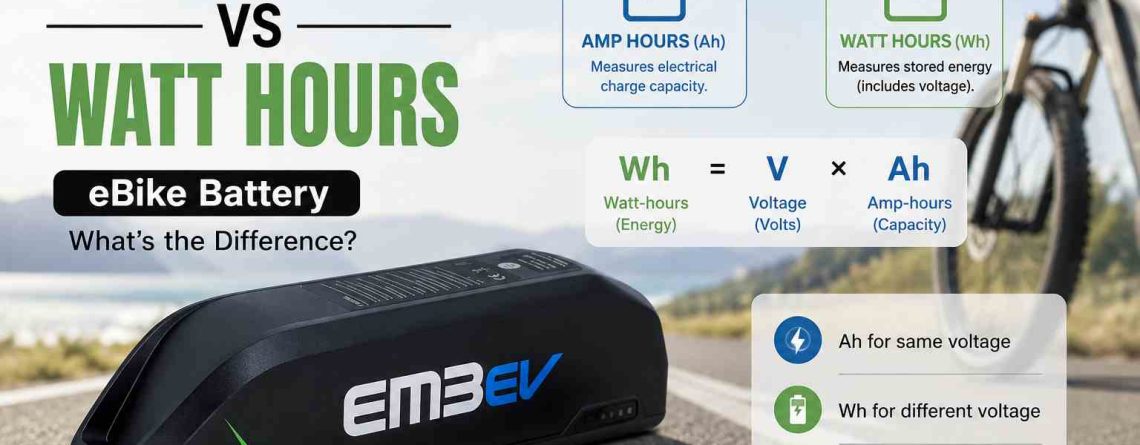
Amp hours vs watt hours eBike battery ratings describe different parts of battery capacity. Amp-hours (Ah) measure electrical charge, while watt-hours (Wh) describe stored energy by combining Ah with battery voltage. For comparing eBike batteries with different voltages, Wh is usually the more useful number.
Quick Answer: Ah vs Wh on an eBike Battery
- Ah measures the battery’s electrical charge capacity.
- Wh measures stored energy and includes battery voltage.
- The basic formula is Wh = Volts × Ah.
- Ah works well when comparing batteries with the same voltage.
- Wh gives a clearer comparison when battery voltages are different.
Battery labels often show several numbers at once: 36V, 48V, 52V, 15Ah, 20Ah, 720Wh, and so on. If you are comparing two packs, it is easy to focus on Ah because it looks like the simplest measure of battery size.
That works only up to a point. Two eBike batteries can have the same Ah rating but store different amounts of energy if their voltages are different. Understanding the relationship between Ah, voltage, and Wh makes battery labels much easier to compare.

What Do Ah and Wh Mean on an eBike Battery?
Ah describes electrical charge capacity, while Wh describes the total nominal energy stored in the battery.
They are related measurements, but they are not interchangeable. Ah does not include voltage, so looking at Ah alone can give an incomplete picture of an eBike battery’s energy capacity. Wh combines both values and is therefore easier to use when different battery voltages are involved.
What Does Ah Mean on an eBike Battery?
Amp-hours, usually written as Ah, describe how much electrical charge a battery can supply. When two eBike batteries have the same nominal voltage, Ah is a useful way to compare their capacity. For example, within the same 48V system, a higher Ah rating also means a higher nominal Wh capacity.
The problem comes when the voltage changes. A 15Ah battery at one voltage does not necessarily store the same amount of energy as a 15Ah battery at another voltage. This is why Ah should not be used by itself for every battery comparison.
What Does Wh Mean on an eBike Battery?
Watt-hours, or Wh, describe the battery’s nominal stored energy. Because the calculation includes voltage, Wh gives you a common reference for comparing eBike battery capacity across different voltage systems.
It is important to keep that definition narrow. Wh describes energy capacity. It does not tell you everything about battery quality, current capability, compatibility, or the exact distance an eBike will travel.
How Do You Calculate Watt Hours From Amp Hours?
Multiply the battery’s nominal voltage by its Ah rating: Wh = V × Ah.
Watt-hours (Wh) = Nominal Voltage (V) × Amp-hours (Ah)
For example, a nominal 48V battery rated at 15Ah has a nominal energy capacity of 720Wh:
48V × 15Ah = 720Wh
You can also reverse the formula when you know Wh and voltage:
Ah = Wh ÷ V
When doing this calculation, use the battery’s nominal voltage rather than its fully charged voltage. Nominal voltage is the standard reference used to describe an eBike battery system and gives you a consistent basis for comparison.

Should You Compare eBike Batteries by Ah or Wh?
Use Ah for batteries at the same nominal voltage; use Wh when comparing batteries with different voltages.
This distinction prevents one of the most common battery comparison mistakes. If two batteries are both 48V, comparing their Ah ratings gives you a quick idea of which one has more nominal energy. Since voltage is the same, the battery with the higher Ah value will also have the higher Wh value.
If the battery voltages differ, compare Wh instead. A higher Ah number does not automatically mean more stored energy when one battery is 36V and another is 48V or 52V. If you are comparing those two common systems, our 48V vs 52V eBike battery guide explains the differences in more detail.
eBike Battery Ah vs Wh Comparison
| Measurement | What It Tells You | Includes Voltage? | Best Used For |
|---|---|---|---|
| Ah | Electrical charge capacity | No | Comparing packs at the same voltage |
| Wh | Nominal stored energy | Yes | Comparing energy across different voltages |
A Simple Comparison Process
- Check the nominal voltage on both battery labels.
- Check the Ah rating of each pack.
- Calculate Wh if it is not already listed.
- Use Wh to compare stored energy when voltage differs.
- Check battery compatibility separately before choosing a replacement.
This keeps two different questions separate: How much energy does the battery store? and Will this battery work correctly with the eBike? Ah and Wh mainly help answer the first question.
Do Higher Ah or Wh Ratings Mean More eBike Range?
More Wh means more nominal stored energy, but it does not guarantee a specific riding range.
Within the same voltage system, increasing Ah also increases Wh. That means the battery has more energy available for riding. However, actual eBike range is affected by much more than the number printed on the battery label.
Rider weight, terrain, speed, wind, tire pressure, assist level, temperature, motor efficiency, and riding style can all change energy use. For this reason, Wh is best treated as an energy-capacity measurement rather than a fixed mileage prediction.
This article should also not be used to decide how large a battery you personally need. Battery sizing is a separate question that depends on your bike and riding requirements. If that is what you are trying to work out, see our guide on what size battery you need for an eBike.
How to Check Ah and Wh on a Battery Label
Read voltage, Ah, and Wh together instead of judging the battery from one number.
Start with nominal voltage and Ah. If Wh is also printed on the label, you can check whether it roughly follows the relationship V × Ah = Wh. This is a simple way to understand what each figure represents and to compare specifications more consistently.
After that, keep capacity separate from other battery specifications. Wh does not describe the full current capability of the cells or BMS, and a higher-capacity battery is not automatically suitable for another eBike system.
Simple rule to remember:
- Same voltage → Ah is useful for comparing capacity.
- Different voltage → compare Wh.
- Replacing a battery → check compatibility before choosing by capacity.
Compare eBike Batteries by Voltage and Capacity
Once you understand how Ah and Wh relate, you can compare battery options by voltage, capacity, fit, and system compatibility.
Frequently Asked Questions
What does Ah mean on an eBike battery?
Ah means amp-hours and describes electrical charge capacity. It is most useful when comparing eBike batteries with the same nominal voltage because Ah alone does not include voltage.
What does Wh mean on an eBike battery?
Wh means watt-hours. It describes nominal stored energy and is calculated from battery voltage and Ah. This makes Wh useful when comparing eBike batteries with different nominal voltages.
How do you convert Ah to Wh on an eBike battery?
Multiply the battery’s nominal voltage by its Ah rating. The formula is Wh = V × Ah. A nominal 48V 15Ah battery, for example, has a nominal capacity of 720Wh.
Is Wh more important than Ah?
It depends on what you are comparing. Ah is useful for batteries at the same voltage. Wh is more useful when voltage differs because it includes both voltage and charge capacity.
Can two batteries with the same Ah have different Wh?
Yes. If their nominal voltages are different, two batteries with the same Ah rating can store different amounts of energy and therefore have different Wh ratings.
Does a higher Wh battery always mean a better battery?
No. Higher Wh means more nominal stored energy. It does not automatically mean better quality, greater power capability, better compatibility, or better overall performance for a particular eBike.
Conclusion
Ah and Wh are both useful, but they answer different questions. Ah describes electrical charge capacity, while Wh combines voltage and Ah to describe nominal stored energy. If you are comparing batteries at the same voltage, Ah can be a convenient reference. If the voltages are different, Wh gives you a clearer comparison.
When reading an eBike battery label, check voltage, Ah, and Wh together. Then treat battery compatibility, current capability, and real-world range as separate factors rather than assuming that a larger Ah or Wh number automatically makes one battery the better choice.








LEAVE A COMMENT