




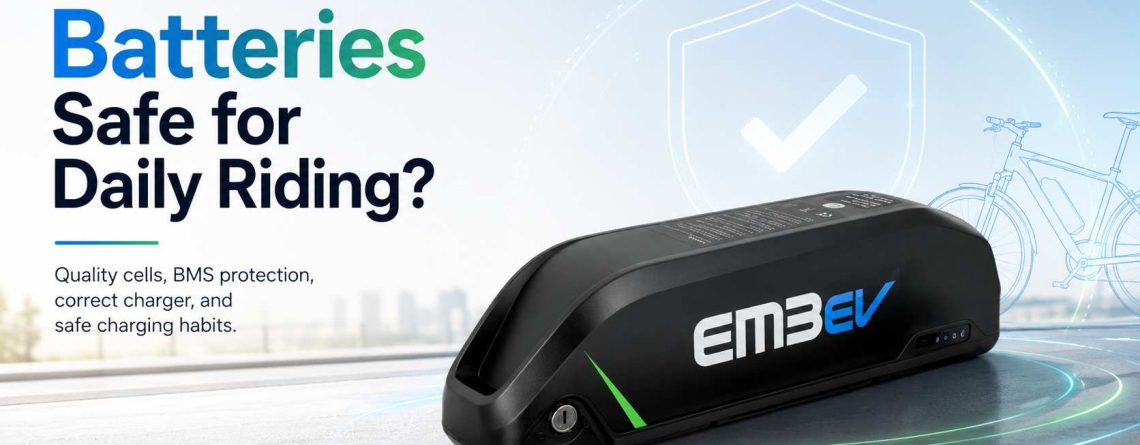
Are E-Bike Batteries Safe?
Are ebike batteries safe? In most cases, a well-built ebike battery can be safe for daily riding when it uses quality cells, a properly matched BMS, the correct charger, safe wiring, and good charging habits. The real risk usually comes from poor-quality packs, wrong chargers, physical damage, unsafe repairs, or batteries used outside their intended limits.
An electric bike battery stores a lot of energy, so buyers should take safety seriously. Voltage, amp hours, and range are important, but they are not the only things to compare. Cell quality, BMS protection, charger compatibility, discharge current, connector quality, and physical condition all affect safety.
This guide explains what makes an ebike battery safe, what warning signs to watch for, how to charge and store a lithium ebike battery, and what to check before buying a replacement ebike battery.
If you are still comparing voltage, capacity, BMS, discharge current, and fitment, start with our full guide on how to choose an ebike battery.
If you already know your voltage, frame space, and riding needs, you can compare EM3ev ebike battery options.
What Makes an Ebike Battery Safe?
A safer ebike battery starts with good design. The pack should use suitable lithium cells, a properly rated BMS, correct wiring, safe connectors, and a charger made for the battery voltage.
The BMS, or battery management system, helps protect the battery from overcharge, over-discharge, overcurrent, short circuit, and other risks. It is not the only safety feature, but it is one of the most important parts of the battery pack.
A safe battery is also one that matches the bike. A pack designed for low-current commuting may not be suitable for a high-power controller, steep hills, cargo use, or heavy throttle riding. When a battery is pushed beyond its design limits, heat, voltage sag, and BMS cut-offs become more likely.
To understand this part better, read our guide to ebike battery BMS protection.

Why Some Ebike Batteries Become Unsafe
Common risk factors include poorly documented or incompatible packs, physical damage, the wrong charger, unsafe wiring or repairs, water intrusion and use beyond the battery’s specified voltage, current or temperature limits.
Common risk factors include:
- Using a charger that does not match the battery voltage.
- Buying a low-cost pack with unclear cell quality or BMS specs.
- Using a battery after a crash, water damage, or physical impact.
- Charging near flammable materials.
- Using unsafe adapters or loose connectors.
- Drawing more current than the battery or BMS can support.
- Trying to repair or rebuild a lithium battery without proper knowledge.
A battery that looks fine from the outside can still have internal damage after a crash or severe impact. If a battery becomes swollen, hot, smells unusual, leaks, sparks, or behaves strangely during charging, stop using it and get professional advice.
Cell Quality Matters for Battery Safety
Cell quality affects safety, range, performance, and cycle life. Two ebike batteries may have the same voltage and amp-hour rating, but they can behave very differently if they use different cells or pack construction.
Low-quality cells may have more voltage sag, shorter life, weaker current handling, and less consistent performance. In high-load riding, weak cells can heat up more easily and may put extra stress on the battery pack.
A better battery usually provides clearer specifications. Buyers should look for details such as cell type, voltage, capacity, watt hours, continuous discharge current, BMS rating, charge current, and connector type.
If you are comparing specifications, documentation and support, read our guide to choosing the best e-bike battery for your system.
Use the Correct Charger
Charger compatibility is one of the simplest but most important battery safety rules. A 48V ebike battery and a 52V ebike battery require different charger voltages. A charger should match the battery voltage, chemistry, charge port, and charge current.
Never choose a charger only because the plug fits. Two chargers can use similar connectors but have different output voltages. Using the wrong charger can damage the battery and create safety risks.
When buying a replacement ebike battery, check whether the charger is included or clearly specified. If you are upgrading from 48V to 52V, you normally need a 52V charger designed for that pack.
If you are unsure about voltage changes, read our guide on can I use a 52V battery on a 48V ebike.
Charging Habits That Improve Safety
Good charging habits can reduce risk and help extend battery life. Always charge the battery in a dry, ventilated area. Keep it away from flammable materials and avoid charging a damaged or suspicious battery.
Do not charge a battery that has been dropped, crushed, flooded, overheated, or visibly damaged. If the pack becomes hot, smells strange, makes noise, or behaves unusually during charging, stop using it.
It is also a good idea to avoid leaving the battery on the charger longer than needed. Follow the battery maker’s instructions for charging, storage, and regular use.
For a complete routine covering charger voltage, cold-weather charging, storage charge and troubleshooting, see our eBike battery charging guide.
For independent safety standards, UL Solutions explains that UL 2849 evaluates the complete e-bike electrical system, including the drive system, battery and charger combination. UL 2271 applies specifically to batteries for light electric vehicle applications. A component claim is not the same as certification of the complete system.
BMS Current Rating and Safety Under Load
Battery safety is not only about charging. It also matters during riding. When you accelerate, climb hills, carry cargo, or use throttle heavily, the motor may ask for more current from the battery.
If the BMS current rating is too low for the controller, the battery may cut off under load. If the cells are not suitable for high current, the pack may suffer from voltage sag, heat, and poor performance.
This is especially important for Bafang BBSHD, BBS02, 1000W ebike motors, high-power hub motors, cargo bikes, and hill-climbing setups. A battery should match the controller current and riding load, not just the voltage.
For high-current systems, read our high-discharge ebike battery guide. If you are choosing for a 1000W system, see our guide on choosing a battery for 1000W ebike motor builds.
Water, Impact, and Physical Damage
Ebike batteries should be protected from serious water exposure, deep submersion, impact, crushing, and unsafe modifications. Light rain exposure depends on the battery design and bike setup, but no rider should treat a lithium ebike battery as something that can be abused without risk.
After a crash, inspect the battery case, mount, charge port, discharge cable, and connector. If the battery case is cracked, the pack shifts inside the case, or cables are damaged, do not keep using it as normal.
Water damage can also create hidden issues. If a battery has been flooded or submerged, stop using it and get professional help.
EM3ev Battery Options for Safety-Conscious Buyers
For safety-conscious riders, the right battery depends on voltage, riding style, controller demand, frame fitment, and range needs. Below are two EM3ev options that fit different types of riders.
For Higher-Capacity 52V Riding

52V King Shark 14S4P – Samsung 50GB
The 52V King Shark 14S4P – Samsung 50GB is a strong option for compatible riders who want a 52V pack with more watt hours, stable daily usability, and smart BMS protection. It can be a good fit for long-range riding, mixed terrain, and compatible Bafang or DIY ebike systems.
For Daily Riding and Practical Safety
48V Super Shark 13S4P – Samsung 35E
The 48V Super Shark 13S4P is a practical downtube-style option for riders who want reliable daily power and smart BMS protection. It is a good direction for commuting, trekking, moderate-power builds, and riders who want dependable performance without moving into extreme voltage setups.
What to Check Before Buying a Safer Ebike Battery
Before buying an ebike battery, check more than price and capacity. A safer purchase starts with clear specifications and a battery that matches your system.
- Battery voltage matches your controller and charger.
- Capacity is listed in Ah and watt hours.
- BMS current rating is suitable for your controller.
- Continuous discharge current is clearly stated.
- Cell type and pack construction are clearly described.
- Connector type and charger compatibility are clear.
- The battery physically fits your frame and mounting style.
- The seller provides clear support and product information.
For a complete checklist, read our guide on what to check before buying an ebike battery.
FAQ About Ebike Battery Safety
Are ebike batteries safe to charge at home?
An undamaged battery can generally be charged at home when the manufacturer permits it, using the approved charger in a dry, ventilated area away from combustible materials and exits. Stay nearby, follow the manual, and do not charge a pack that is damaged, unusually hot, swollen, wet, leaking or producing an unusual smell or sound.
What makes an ebike battery unsafe?
Common causes include poor-quality cells, wrong chargers, damaged packs, unsafe repairs, water damage, poor wiring, and using a battery beyond its current rating.
Can the BMS prevent every battery problem?
No. A BMS helps protect the battery, but it cannot fix poor cell quality, physical damage, wrong chargers, unsafe wiring, or misuse.
Should I use an ebike battery after a crash?
Do not continue using a battery that has visible damage, cracked casing, loose wiring, swelling, unusual heat, smell, or charging problems after a crash.
Is a cheap ebike battery less safe?
Price alone does not establish safety. Treat missing cell identification, continuous-current data, charger requirements, applicable certification, warranty or supplier support as reasons to investigate before buying.
Final Thoughts
Ebike battery risk is reduced when the pack is well designed, independently evaluated where applicable, correctly matched, undamaged, properly charged and used within its specified limits. Choose by system compatibility and documented safety features—not price, voltage or capacity alone.
Focus on quality cells, BMS protection, charger compatibility, safe fitment, and clear specifications.
If you are ready to compare available options, start with the EM3ev ebike battery range.






LEAVE A COMMENT