




36V Battery Explained: What 36V Means on an eBike
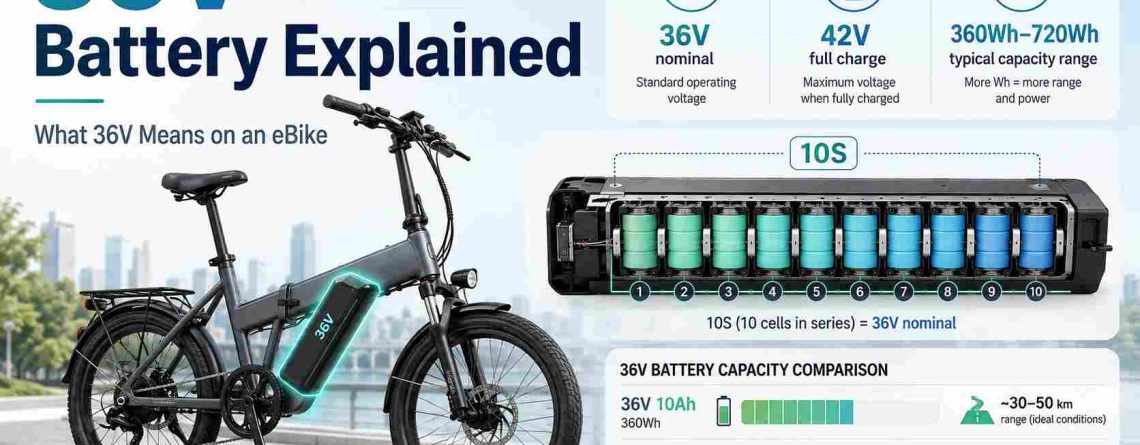
A 36V battery is one of the most common power sources used on commuter, folding, and everyday electric bikes. On a typical lithium-ion eBike pack, 36V describes the battery’s nominal voltage. It does not mean the battery stays at exactly 36 volts while you ride.
Most 36V lithium-ion eBike batteries use a 10-series, or 10S, cell configuration. A fully charged pack is normally close to 42V, while its voltage gradually falls as energy is used.
This guide explains what 36V means, how capacity affects stored energy and range, and what a 36V battery must match on an eBike.
What Does 36V Mean on an eBike Battery?
The 36V label describes the battery’s nominal voltage class.
A typical lithium-ion eBike pack uses ten cell groups connected in series. This is commonly called a 10S battery.
For a typical 10S lithium-ion pack:
| Specification | Typical Value |
|---|---|
| Nominal voltage | 36V |
| Full-charge voltage | About 42V |
| Common configuration | 10S |
| 36V × 10Ah | About 360Wh |
| 36V × 15Ah | About 540Wh |
| 36V × 20Ah | About 720Wh |

The exact operating voltage changes while riding. Temperature, load, state of charge, battery age, and voltage sag can all affect the reading.
If you want to compare 36V with other eBike voltage classes, see our eBike battery voltage guide.
How Capacity Changes a 36V Battery’s Range
Two batteries can both be rated at 36V but store very different amounts of energy.
For example, a 36V 10Ah battery stores about 360Wh, while a 36V 20Ah battery stores about 720Wh. The second pack has roughly twice the rated energy even though both belong to the same 36V system.
That does not mean a 20Ah pack will always deliver exactly twice the riding distance. Real eBike range also depends on:
- Speed and assist level
- Rider and cargo weight
- Hills and wind
- Tire pressure
- Motor efficiency
- Temperature
- Throttle use
This is why watt-hours are usually more useful than voltage alone when comparing available battery energy.

Does a 36V Battery Make an eBike Faster?
Voltage can affect motor performance, but battery voltage alone does not determine top speed.
The motor, controller, current limits, wheel size, load, and bike settings all matter. A larger Ah rating mainly increases stored energy; it does not automatically make a 36V eBike faster.
Moving from a 36V system to a higher voltage is also not a simple battery swap. The controller and other electrical components must support the higher full-charge voltage.
For system-voltage changes, see our eBike battery upgrade guide.
How Long Does a 36V Battery Last?
This question can mean two different things.
If you mean range per charge, the answer depends mainly on watt-hours and riding conditions. A 36V 20Ah pack contains more rated energy than a 36V 10Ah pack, but real distance still varies with terrain, speed, rider load, temperature, and assist level.
If you mean battery service life, cell quality, temperature, charge cycles, depth of discharge, current demand, and storage all matter.
For a full explanation of battery age and cycle life, see how long an eBike battery lasts.
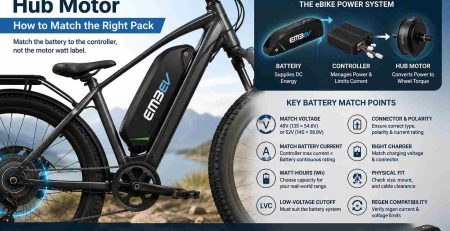
What Must Match a 36V eBike Battery?
Seeing “36V” on two batteries does not automatically make them interchangeable.
Before using a battery, confirm:
- The controller supports the battery’s voltage range.
- The BMS can safely support the controller’s current demand.
- The charger matches the battery chemistry and required charge voltage.
- Connector type and polarity are correct.
- The battery case and mount fit the bike correctly.
If you are replacing or selecting a complete battery pack, see our guide to choosing an eBike battery for the full compatibility process.
Why Does a 36V Battery Use a 42V Charger?
A typical 36V lithium-ion eBike battery is a nominal 10S system. Its voltage rises to about 42V when fully charged.
That is why a compatible charger for this type of battery normally has an output close to 42V.
Voltage is not the only charger requirement. Chemistry, connector, polarity, and charging current must also match the battery.
For those checks, use our 36V battery charger guide.
Is 36V Good for an Electric Bike?
A 36V system can work well for commuting, folding bikes, city riding, and other moderate-power applications when the motor and controller are designed for it.
Whether 36V is right for a particular bike depends on the complete electrical system and the rider’s performance requirements. Higher voltage is not automatically better.
Looking for a 36V eBike Battery?
If your bike already uses a compatible 36V system and you need a current replacement pack, compare our 36V eBike batteries by capacity and case style.
Do not choose a battery by voltage alone. Check controller compatibility, current requirements, charger, connector, and physical fit before ordering.
FAQ
Is a 36V battery actually 42V when fully charged?
A typical 10S lithium-ion eBike battery rated as 36V reaches about 42V when fully charged. The 36V figure is its nominal voltage.
Does a higher-Ah 36V battery give more range?
Usually it provides more rated stored energy when the voltage stays the same. For example, 36V × 20Ah is about 720Wh, compared with about 360Wh for 36V × 10Ah. Real riding range still depends on riding conditions.
Can I put a 48V battery on a 36V eBike?
Do not assume that you can. A 48V battery has a higher operating and full-charge voltage. The controller, display, motor electronics, charger, and other voltage-sensitive components must be designed for it.
Is every 36V battery compatible with every 36V eBike?
No. Voltage is only one requirement. Current capability, BMS rating, connector, polarity, charger, dimensions, and mounting system can also differ.
Final Takeaway
A 36V battery is a voltage class, not a fixed voltage reading or a complete compatibility specification.
For a typical lithium-ion eBike system, a 36V battery is commonly a 10S pack that reaches about 42V when fully charged. Capacity determines how much rated energy the pack stores, while the motor, controller, riding conditions, and current demand influence real-world performance.
Use the 36V rating as your starting point, then check the complete electrical and physical system before choosing or replacing a battery.






LEAVE A COMMENT