




Battery Charger e Bike: 5 Proven Ways to Charge Safely
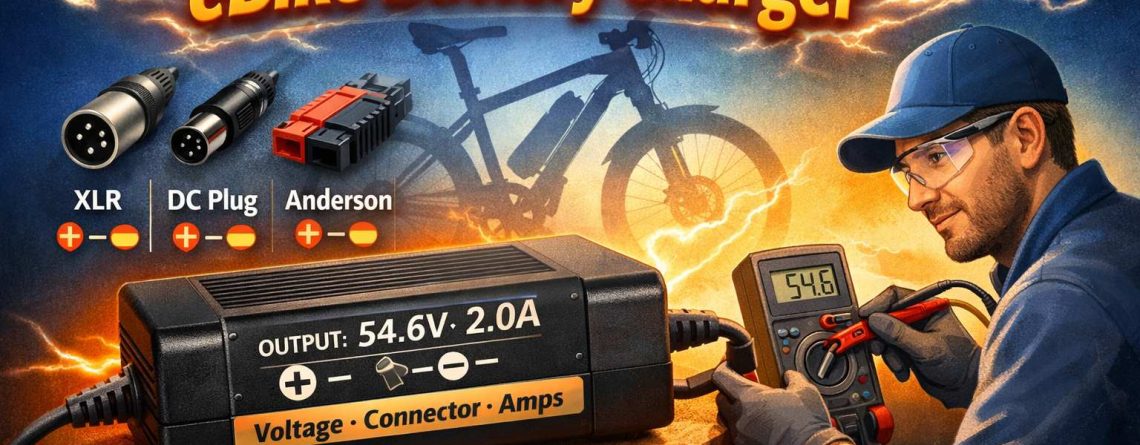
A battery charger e bike setup is essential for every rider. It is the device that converts wall power into specific fuel for your ride. To keep your battery safe, you must carefully match the charger’s voltage, plug shape, and Amps to your battery pack.
36V / 42.0V System
For standard commuters and folding e-bikes.
48V / 54.6V System
The performance standard for long-range hubs.
52V / 58.8V System
High-speed chargers for Jumbo & Super Shark packs.
Quick Answer Box: How to Buy
- Voltage Rule: A 36V battery needs a 42V charger. A 48V battery needs a 54.6V charger.
- Connection: Check the plug shape and polarity (positive/negative) carefully.
- Safety First: Connect the ebike charger to the battery before plugging it into the wall.
Nothing stops a ride faster than the wrong gear. I once knew a rider who bought a cheap charger for electric bike use online. He wanted a faster charge but ignored the specs. The result? The connector pins were reversed. He nearly destroyed an expensive battery pack. Finding a reliable electric bike charger is about safety first, and speed second.

Essential Li-ion Battery Charger eBike Safety Protocol
Choosing a high-quality li-ion battery charger ebike unit involves more than just matching plugs. To prevent thermal runaway, ensure your charger features an integrated Smart BMS communication protocol or at least a CC/CV (Constant Current/Constant Voltage) charging curve. High-performance lithium cells require precision cut-off at their peak voltage (e.g., exactly 54.6V for 48V packs) to maintain chemical stability over hundreds of cycles.
- Compatibility Check: Verify that the Amperage does not exceed 1C of your battery’s capacity unless explicitly supported.
- Cell Protection: Proper chargers prevent oxidation by stopping the current flow immediately once the battery reaches 100% capacity.
How to choose the right battery charger for an eBike
To pick the correct unit, you must match the output voltage to your battery’s chemistry. You also need to verify the physical plug and ensure the Amps (current) are safe for your system.
1. The Compatibility Checklist
Before you click “buy” on a new charger electric bicycle unit, check these four points:
- Voltage Match: A “36V” battery is empty at 30V and full at 42V. You need a charger that outputs exactly 42V.
- Plug Type: Does your port look like a microphone plug (XLR) or a barrel? Visual matches matter.
- Amp Rating (A): A standard e bike battery charger is usually 2A or 3A. Higher Amps charge faster but generate heat.
- Environment: Only use your electric bike charger in a cool, dry place.
2. Voltage Guide: 36V vs 48V Options
This is where most mistakes happen. An e bike battery charger 36v must output 42V. If you plug a 48 volt e bike battery charger (which outputs 54.6V) into a 36V battery, you risk a fire. Never mix voltages.
| Battery Type | Required Charger Output | Common Connector | Common Mistake |
|---|---|---|---|
| 36V Battery | 42.0V | DC Barrel / XLR | Using a 48V charger |
| 48V Battery | 54.6V | GX16 / Anderson | Loose connections |
| 52V Battery | 58.8V | XT60 / XLR | Confusing with 48V |
3. Our Safety Verification Workflow
How do we ensure e bike battery charging is safe? Here is the process we recommend for every rider:
- Check the Label: Does the charger’s “Output Voltage” match your battery’s full charge voltage?
- Test Polarity: Use a multimeter. Make sure the Plus (+) pin on the charger goes to the Plus (+) hole on the battery.
- The “Smell” Test: Monitor the process for the first 15 minutes. If it smells like burning plastic, unplug it immediately.
- Watch the Light: The charger light should turn from Red (charging) to Green (full). If it stays Red too long, disconnect it.
Quick Checks:
Is it normal for an eBike charger to get warm?
Yes. Converting AC to DC creates heat. However, it should never be too hot to touch.
Why does my e bike battery won’t charge?
Common causes are a blown fuse, a tripped BMS protection circuit, or a mismatched charger voltage.
Maximizing Li-ion Battery Charger eBike Lifespan
Maintaining a li-ion battery charger ebike is just as important as the battery itself. To extend the life of your electric bike charger, always store it in a dust-free environment and avoid letting the unit drop. Most chargers use internal capacitors that are sensitive to shock. Furthermore, a high-quality battery charger e bike setup should never be left connected to the wall indefinitely after the light turns green, as this can wear out the internal transformer components over time.
Buying & setup decisions for an eBike charger
Lock your required voltage and connector shape first, then choose between a portable fanless model or a high-speed aluminum-case fan charger.
The Use-Case Chooser
For Daily Commuting: A 2A fanless charger is quiet and portable for office use.
For Long Range/Travel: A 4A or 5A fan-cooled charger reduces downtime significantly.
For Indoor Safety: Always choose chargers with UL or CE certifications and auto-cutoff features.
3 Checks Before You Buy
Before finalizing your purchase of an e bicycle charger, confirm these three specs: 1. Voltage (Peak Output), 2. Connector Pin-out, and 3. Max Amp rating supported by your battery.

EM3ev Standard 48V Charger (2A)
Reliable CC/CV charging with 54.6V peak output. Ideal for daily maintenance.
EM3ev High-Speed 52V Charger (5A)
Active fan cooling for 58.8V systems. Reduces charge time by 60%.
Frequently Asked Questions
No. This will overcharge the cells and could lead to a fire. Always match the voltage exactly to your battery’s peak output.
You should never attempt this using improvised wires. Only use a regulated DC power supply where you can manually set the exact voltage and current limits.
Check the charger’s fuse and the battery’s charge port for debris. If the battery was left flat for months, the BMS may have locked the port for safety.
Charging time depends on your battery’s Ah capacity and the charger’s Amp rating. For a 17Ah battery with a standard 2A charger, it takes about 8.5 hours. Using a high-speed 5A charger reduces this to approximately 3.5 hours. We recommend keeping the battery between 20% and 80% for the best cell health.
Recap: Successful battery charger e bike selection depends on matching peak voltage, verifying connector polarity, and following a safe charging sequence. For the best longevity, prioritize high-quality chargers with active thermal management. Explore the EM3ev battery collection for compatible high-performa.
Product Review: EM3ev High-Speed 52V Battery With Charger
★★★★★
4.8/5(Recommended for fast-turnaround 52V riders)
Key specs (from this guide):
- Voltage: 58.8V (for 52V packs)
- Output: 5.0A
- Feature: Active cooling for fast energy recovery
Pros
- Fast charging support (5A) helps reduce downtime between rides.
- Active cooling improves stability during higher-current charging.
- Clear fit for 52V systems when the charger peak voltage is correct.
Cons
- Not ideal for every setup—voltage class, connector type, and polarity must match exactly.
- Higher current can generate more heat; always charge in a ventilated, safe area.
- If you want a quieter/portable option, a lower-amp fanless charger may suit commuting better.
Summary
If your priority is faster turnaround on a 52V pack, this active-cooled 58.8V/5A setup is a strong pick. Just follow the core rule from this guide: match voltage exactly, verify connector/polarity, and keep charging safety-first.



LEAVE A COMMENT