



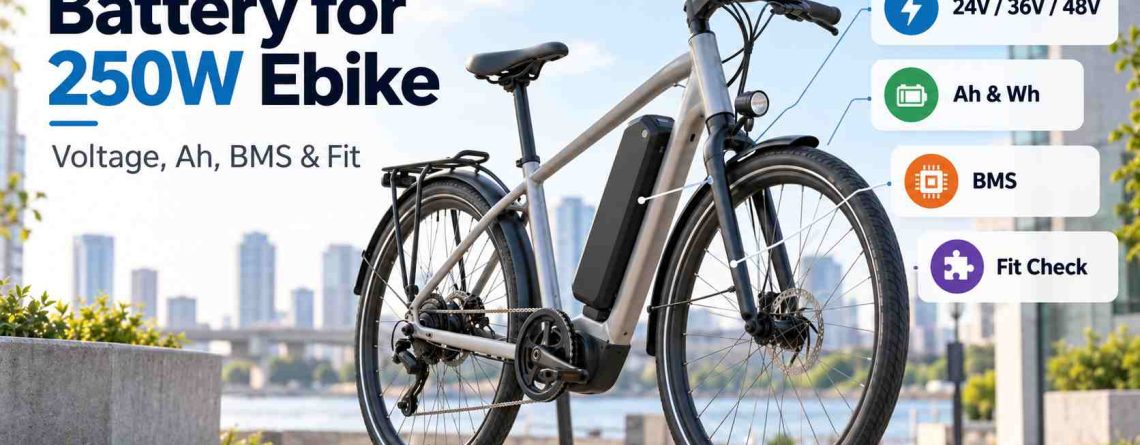
Battery for 250W Ebike: Voltage, Ah, BMS & Fit
A battery for 250w ebike use is a lithium-ion pack matched to the bike’s controller voltage, current demand, charger, connectors, and physical mount. Most modern 250W commuter systems are 36V, while some older bikes use 24V and some factory systems use 48V. Capacity determines stored energy, not motor compatibility.
Quick answer
- Match voltage first: use the voltage specified for the controller and complete system.
- Choose capacity by watt-hours: 36V 13.6Ah equals about 490Wh; 36V 17Ah equals 612Wh.
- Size the BMS to the controller: continuous discharge must cover maximum battery-current demand.
- Verify the hardware: check the case, rail, connector, polarity, cable, and charger.
If assistance cuts out on a hill while the display still shows charge, the cause may be voltage sag, an aging pack, a BMS limit, or a poor connection. A replacement battery for 250w electric bike use must match the complete system; a larger Ah number alone is not a fix.

36V, 24V, or 48V: Match the Controller, Not the Motor Sticker
A 36V battery is common on modern 250W commuters, but use only the voltage approved for the controller, display, motor system, and charger.
A 24v battery for 250w ebike motor system may still be found on older or lightweight bicycles. Do not replace it with 36V simply because 36V is more common. A 36v battery for 250w ebike setup using a 10-series lithium-ion pack charges to 42.0V and needs a compatible 42V charger.
Can you put a 48V battery on a 250W eBike?
Only when every component supports 48V. A 13-series pack reaches 54.6V when full. A 36V-only controller may shut down or be damaged; connected electronics may also have lower limits.
If you ask, “can I use a bigger battery on a 250W eBike?” separate capacity from voltage. More Ah at the same approved voltage is often possible if the case fits. Higher voltage changes the electrical system.
Battery for 250W Ebike: Five Compatibility Checks
Check the controller label, battery energy, BMS output, physical installation, and charger before ordering; the motor’s nominal watt rating is not enough.
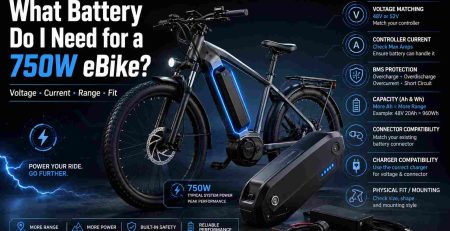
- Confirm voltage. Compare the original battery, controller, display, and charger; do not infer it from “250W.”
- Read maximum battery current. Although 250W ÷ 36V is about 6.9A, this is not a BMS sizing rule. Use the controller specification.
- Choose stored energy. Compare Wh. More energy usually means more potential range, size, and weight.
- Inspect the installation. Measure the frame, rail, key access, cable path, connector, polarity, and removal clearance.
- Match the charger. Output voltage, charge profile, connector, and polarity must suit the pack.
For general sizing, see EM3ev’s eBike battery size guide. Here, the controller remains the deciding specification for a bike labeled 250W.
Choose Ah and Wh for Your Route
Capacity depends on the route and reserve; compare Wh for range planning and use Ah only alongside voltage.
Watt-hours (Wh) = nominal voltage (V) × amp-hours (Ah)
For example, 36V × 13.6Ah is about 490Wh, while 36V × 17Ah is 612Wh. The latter stores more energy without changing voltage. It suits the question “how many amp hours for 250w ebike commuting?” when a longer route justifies more size and weight.
Range also changes with load, hills, wind, temperature, speed, assist level, and efficiency. Estimate the range of a 250w ebike battery pack by dividing usable Wh by your measured Wh per mile or kilometer, then keep a reserve. See Ah vs Wh for eBike batteries for the general calculation.
| Example pack | Energy | Relative range | Main trade-off | Best use |
|---|---|---|---|---|
| 36V 10Ah | 360Wh | Shorter | Lower capacity | Short, predictable trips |
| 36V 13.6Ah | About 490Wh | Moderate | Balanced size and energy | Everyday commuting |
| 36V 17Ah | 612Wh | Longer | Larger and heavier | Longer routes or more reserve |
| 48V 13.6Ah | 636.5Wh | Longer | 48V compatibility required | Factory 48V systems only |

Check the 250W eBike Battery Discharge Rate and BMS
The BMS must support maximum controller battery current without nuisance cutoffs; motor wattage does not reveal that limit.
Find “maximum current,” “battery current,” or an equivalent controller specification. The battery’s continuous-discharge rating must meet or exceed it. Check any stated peak value and duration too; controllers on nominal 250W bicycles are not all identical.
A high-discharge lithium battery pack for 250w hub motor use does not force excess current through the motor. The controller determines demand; the battery rating provides capability. Voltage and controller settings must still be correct.
Mounting and Replacement Fit
A downtube pack supports balanced handling, but suitability depends on measured clearance and mounting details.
Fast fit decision: Favor a compact downtube pack when frame space and removal matter most. Add capacity only after checking rail length, case clearance, bottle bosses, key access, and removal path. An integrated battery may require manufacturer-specific parts.
Before buying a lightweight battery pack for 250w commuter ebike use, make a full-size case template. Check crank, cable and suspension clearance, then verify the connector and polarity before connection.
Compatible EM3ev Options for 250W Commuters
For a verified 36V system, the Super Shark 1004 offers a lighter everyday option, while the 1005 adds energy reserve; the 48V 1304 is only for verified 48V systems.

EM3ev Super Shark 1004 (36V 13.6Ah)
36V · 13.6Ah · 490Wh
Samsung 35E cells, 10S4P, 40A temperature-protected smart BMS, IP65-rated enclosure, Super Shark rail, and approximate weight of 2.8kg.
Best for: compatible 36V commuters prioritizing lower weight.
EM3ev Super Shark 1005 (36V 17Ah)
36V · 17Ah · 612Wh
Samsung 35E cells, 10S5P, 40A temperature-protected smart BMS, IP65-rated enclosure, Super Shark rail, and approximate weight of 3.75kg.
Best for: compatible 36V commuters needing more reserve.
Compatibility note: BMS ratings show capability; they do not mean a 250W system will draw that current. Confirm compatibility before ordering
Frequently Asked Questions About 250W eBike Batteries
How far will a 250W eBike go on one charge?
Motor wattage alone cannot predict range. Divide battery Wh by your measured Wh per mile or kilometer, then allow reserve for hills, load, weather, speed, and high assist.
What happens if I connect a 48V battery to a 36V 250W bike?
A full 48V lithium-ion pack can reach 54.6V. A 36V-only controller, display, light, or accessory may shut down or be damaged. Do not connect it without explicit 48V approval.
How many amp-hours do I need?
Choose Ah after voltage. At 36V, 13.6Ah provides about 490Wh and 17Ah provides 612Wh. Select enough energy for your route and reserve, then confirm fit and weight.
Can I use a high-discharge battery with a 250W motor?
Yes, when the system is compatible. Battery current rating is capability, not current forced into the motor; the controller limits demand.
When should I replace the battery?
Replace or assess it when capacity no longer covers the route, voltage sag causes repeated cutoffs, the case or connector is damaged, the pack overheats, or the BMS reports persistent faults.
What charger should I use?
Use the charger approved for the pack chemistry and series count. For additional safety guidance, see the e-bike battery charging guidance from the U.S. CPSC, which recommends using only the charger provided with or recommended by the device manufacturer. EM3ev’s 36V 10S lithium-ion packs require a compatible 42V charger; its 48V 13S packs require a compatible 54.6V charger. Match connector, polarity, and permitted charge current.
Final Selection Checklist
Voltage is the gate; watt-hours, current capability, fit, connectors, and charger determine daily suitability.
When selecting a battery for 250w ebike riding, begin with the controller rather than the motor label. Keep the approved voltage, choose enough Wh, verify BMS headroom against controller current, and measure the installation. This is more reliable than choosing by Ah or advertised range alone.





LEAVE A COMMENT