




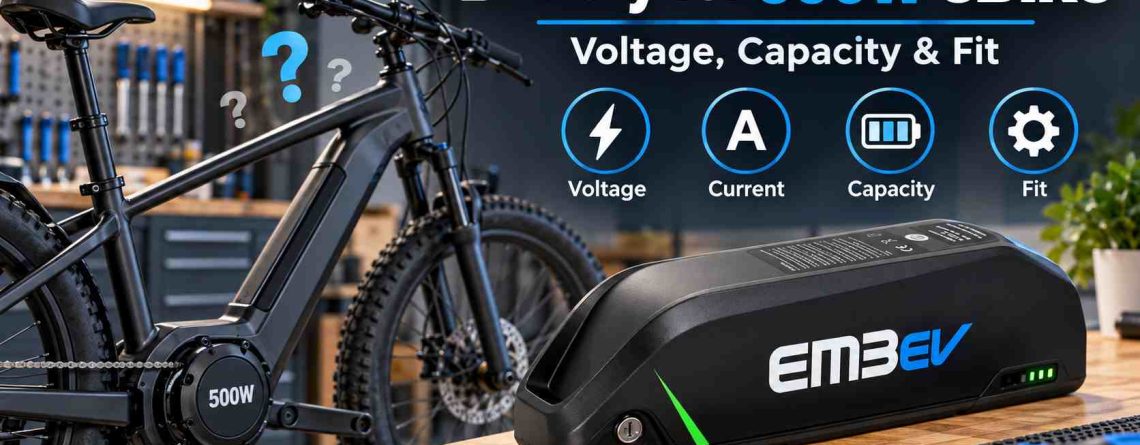
Battery for 500W eBike: Voltage, Capacity & Fit
A suitable battery for a 500W eBike matches the bike’s voltage, controller current demand, charger, and physical interface. The motor’s watt rating alone cannot determine battery voltage, amp-hours, or discharge capability. Choose a compatible pack first, then select enough usable energy for your rides.
Quick answer
- Confirm system voltage from the bike’s documentation.
- Match pack output to the controller’s battery-current limit.
- Choose usable Wh around your route and charging access.
- Check the mount, connectors, polarity, charger, and communication.
Imagine shopping for a replacement with only “500W” written on a note. Search results show both 36V and 48V packs. Both claim motor compatibility. Which should you buy? First, photograph your old battery and controller labels. Those details help narrow the choice far more than the motor sticker.

For the wider selection process, see how to choose an eBike battery. Here, start with the missing details behind that 500W label.
Battery for 500W eBike: Match Voltage and Current First
Confirm system voltage and the controller’s battery-current limit before choosing a pack; the motor label cannot supply either answer.
When can you use 36V or 48V?
Either may be suitable for a particular 500W system. Check the original battery and controller documentation, including full-charge voltage and low-voltage cutoff. Neither voltage is a universal choice.
If the old battery is missing, ask the bike or kit supplier to identify the system. A connector that fits does not prove electrical compatibility. Do not assume a higher-voltage pack is an upgrade.
Match pack output, BMS, and controller demand
The controller limits battery current. Motor phase current is a different measurement. Dividing 500W by nominal battery voltage does not establish the pack rating you need: the motor label does not describe every operating condition or battery input demand.
Check the complete pack’s continuous discharge rating. A brief peak rating or BMS trip threshold is not permission to draw that current continuously. Cells, wiring, connectors, and the battery management system (BMS) must all support the intended use.
For more detail, see our hub-motor battery matching guide.
A practical verification process
- Collect labels: Record the original battery, controller, charger, and bike model.
- Check voltage: Confirm the allowed working range, full-charge voltage, and low-voltage cutoff.
- Find battery current: Use the controller’s battery-side limit, not phase current.
- Check pack output: Match its continuous discharge rating to demand under the stated operating conditions.
- Check interfaces: Verify polarity, connectors, communication, mount, removal space, and charger requirements.
- Record the result: Mark each check confirmed, incompatible, or unresolved. Ask the supplier about critical unknowns before ordering.
This is a document-and-fit review. Do not open the pack or bypass protection to make it work.
Choose Capacity Around Your Rides
A 500W rating does not set the required Ah; choose usable Wh around route demands, charging opportunities, and the weight you can carry.
What do Ah and Wh tell you?
Amp-hours describe charge capacity; watt-hours describe energy. A 500W motor rating is not a 500Wh battery specification. Compare energy alongside voltage, rather than judging different packs by Ah alone.
Picture a short commute with stairs at home. A bulky pack may add carrying effort you rarely need. A longer return trip with no charging stop places more value on energy reserve.
| Riding scenario | Energy-reserve priority | Sustained-load attention | Weight sensitivity |
|---|---|---|---|
| Short, flat trips; frequent carrying | Low | Low | High |
| Mixed daily commuting | Med | Med | Med |
| Frequent hills or heavy loads | High | High | Check payload limit |
| Long rides; limited charging | High | Route-dependent | Rider-dependent |
These labels describe planning priorities, not battery ratings. Performance depends on pack/BMS/conditions; every scenario still requires the electrical checks above.
What changes with a higher-capacity pack?
More Ah at the same voltage can provide more energy, but does not guarantee more speed or higher current capability. Check added weight, case size, mounting support, and charger requirements.
For range planning, use reliable energy-use records from your route when available. Note load, assistance, temperature, and terrain. Compare usable energy under relevant conditions; avoid promises based only on the motor rating.
Filter Options by Your Confirmed System
Exclude incompatible packs first, then compare energy, weight, and fit within the options your bike supports.
Decision guide
- Confirmed 36V: Compare compatible 36V packs and their output ratings.
- Confirmed 48V: Compare compatible 48V packs, then capacity and mounting.
- Only “500W” is known: Gather labels and ask the supplier first.
- Proprietary system: Check approved replacements and required communication.
Image 3 — Choose the correct category
Image brief: Start a decision diagram with “System specifications confirmed?” Branch into “Confirmed 36V,” “Confirmed 48V,” and “More information needed.” Connect confirmed systems to their respective categories without implying cross-voltage interchangeability.
Suggested ALT: battery for 500w ebike: selecting battery options for a confirmed electrical system

EM3ev 36V Battery Options
For: Systems confirmed to support the selected 36V pack.
Check: Continuous output, full-charge voltage, mount, connector polarity, charger, and any communication requirements.
EM3ev 48V Battery Options
For: Systems confirmed to support the selected 48V pack.
Check: Continuous output, full-charge voltage, mount, connector polarity, charger, and any communication requirements.
These are category starting points, not universal replacements. Confirm the exact configuration before ordering.
Common Battery Selection Questions
The motor label starts the search; system compatibility and riding needs determine the final pack.
Does a 500W eBike need a 36V or 48V battery?
Check the bike’s specified system voltage. Different 500W systems can use different voltages. Neither option is universally correct, and the motor rating does not authorize a voltage change.
Is there a minimum Ah requirement for every 500W eBike?
No. Required capacity depends on usable energy and riding needs. Ah alone also cannot tell you whether a pack can support the controller’s current demand.
What continuous discharge current should the battery support?
The complete pack must support the controller’s battery-current demand under its rated operating conditions. Verify the supplier’s continuous rating rather than relying on peak output or a BMS protection threshold.
Can a higher-capacity pack replace the original at the same voltage?
Possibly, but voltage alone is insufficient. Check discharge capability, charger requirements, mounting, polarity, connectors, and communication. Extra capacity may also mean more weight or less removal clearance.
Why does the 500W rating not determine range?
Battery draw changes with speed, hills, assistance, and load. Range depends on usable energy and energy consumed over the route, not constant operation at the motor’s labeled power.
Can I keep my original charger?
Only if the battery supplier confirms that it matches the replacement battery’s chemistry, charging voltage, current, polarity, and interface. A matching plug or nominal voltage label is not enough. The U.S. Consumer Product Safety Commission advises eBike users to use chargers provided with or approved for their device .
Before choosing your pack, gather the battery, controller, and charger labels, plus mounting measurements. Share those details to learn more about compatible options.



LEAVE A COMMENT