





Battery in Freezer: The Ultimate Safety Guide
Does Putting a Battery in Freezer Storage Work?
The short answer is no; putting a battery in freezer storage will not recharge it or magically extend its life. While the “freezer trick” was once debated for old alkaline cells, it is a dangerous chemical fallacy for modern lithium-ion systems. Extreme cold triggers internal mechanical failure, potentially cracking separators and compromising the battery’s safety once it returns to room temperature.

Figure 1: While an old household myth, freezing modern lithium batteries can cause irreversible damage.
The Origins of the Freezer Myth
You might remember seeing AA household batteries stored in the refrigerator next to the butter. Years ago, people believed the cold air kept them fresh and stopped them from losing their charge. For simple alkaline chemistry, there was some truth to this logic. Heat is the enemy of energy retention.
However, modern technology has changed. The advice for disposable cells does not apply to the high-tech rechargeable batteries used in e-bikes today. You might wonder, “If it worked for AAs, should I put my e-bike pack in the cold?” The answer is a definitive no.
Does the Freezing Method Work?
For recharging purposes, no, it does not work. For storage, it is risky and unnecessary.
Why the Myth Persists
The idea comes from a misunderstanding of basic chemistry. Inside any unit, a chemical reaction produces electricity. Even when sitting on a shelf, a slow “self-discharge” occurs.
Technically, cold temperatures do slow down these reactions. However, this was more effective for older Nickel-Cadmium (NiCd) cells. People confused “preserving charge” with “recharging.” They believed cooling the cells could revive a dead unit. This is false. It simply results in a cold, dead battery.
How Cold Affects Lithium-Ion
Lithium-ion packs are delicate. When you subject them to freezing temperatures (below 32°F / 0°C), physical changes occur. These changes negatively affect battery health.
The Condensation Killer: This is the biggest risk. When you move a cold unit into a warm room, moisture forms on the terminals. Water prevents the electronics from functioning correctly, which is not how batteries work best.
Electrolyte Issues: The liquid inside becomes thicker. This makes it harder for ions to move. As a result, this limits how well batteries perform when you start your ride.
Lithium Plating: If you try to charge a frozen pack, metallic lithium can plate onto the anode. This is permanent damage.
Comparison: Freezer vs. Room Temp Storage
Technical Impact of Sub-Zero Storage
| Technical Parameter | Freezer (-18°C) | Room Temp (15°C) | E-Bike Impact |
|---|---|---|---|
| Voltage Sag Risk | Severe (Critical) | Minimal (Optimal) | Cold causes voltage to drop under load. |
| BMS Protection | May malfunction | Stable | Condensation can short the management system. |
| Electrolyte State | Crystallization | Liquid (Stable) | Increased resistance prevents ion flow. |
| Lithium Plating | High Risk | Zero Risk | Charging frozen cells causes permanent shorts. |
| Capacity Loss | 5-15% Permanent | Baseline (Stable) | Structural damage is non-reversible. |
Note: Exposing cells to temperatures below 0°C significantly increases internal resistance, leading to immediate performance drops during discharge
Better Ways to Store Your Battery
Is storing an electric bike battery in the freezer ever a good idea? No.
In my experience, no manufacturer recommends this. Brands like Bosch, Shimano, and Specialized explicitly warn against it.
Imagine you have stored your $600 pack in the icebox for winter. Spring arrives. You pull it out. The plastic casing, now brittle from the cold, might crack if you bump it. As it sits on your counter, water droplets form on the connectors. If you plug that wet unit into your charger, you could short the BMS (Battery Management System). It is simply not worth the risk.
Instead, follow this proven checklist for winter storage:
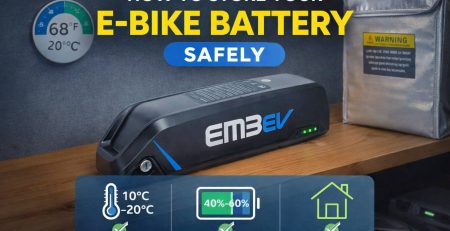
- Check the Charge: Do not store it 100% full or 0% empty. Aim for 40%–60% charge. This is the most stable state for the internal chemistry.
- Find the Right Spot: A closet inside your house is usually perfect. Look for a dry, temperature-controlled area. Avoid unheated sheds if temperatures drop well below freezing.
- Monthly Check: Monitor the voltage once a month. If it drops too low, give it a quick top-up charge, but do not fill it completely.
Don’t Freeze Old Batteries—Upgrade Them
If you were hoping the freezer would revive a dying battery, we have bad news: chemistry doesn’t work that way. Once a lithium cell is dead, it is a safety hazard, not a DIY project.
Instead of risking a fire with “life hacks,” consider replacing your old pack with a high-quality battery built for longevity.

EM3ev 52V Super Shark
A safe, high-performance replacement. Features a Smart BMS that balances cells automatically, preventing the need for “storage tricks.”
Why it’s better: Bluetooth monitoring lets you check battery health instantly.
EM3ev 52V Jumbo Shark
Built for long-range and durability. Uses a robust casing that protects cells from temperature fluctuations better than cheap packs.
Why it’s better: High-quality cells (Samsung/LG) that hold charge longer in storage
Frequently Asked Questions
1. Does the “freezer trick” work for modern lithium batteries?
No. While it once slowed self-discharge in old NiCd cells, putting lithium-ion batteries in the freezer causes electrolyte crystallization and seal failure. It will not extend life; it risks permanent capacity loss.
2. How long can you store an e-bike battery in cold conditions?
Never store it in sub-zero environments for any duration. If the pack is exposed to cold during transport, allow it to reach room temperature (at least 6 hours) before charging to avoid lithium plating.
3. Can you revive a “dead” battery by freezing it?
This is a dangerous myth. Freezing cannot add energy to a chemically depleted system. Attempting this can cause internal separators to crack, leading to potential fire hazards once warmed.
4. How exactly does cold affect battery performance?
Cold increases internal resistance, causing the voltage to “sag” or drop under load. This makes your e-bike feel less powerful and reduces the usable range until the cells warm up.
5. What is the biggest risk of storing batteries in the fridge?
Condensation is the primary killer. Moving a cold battery to a warm room creates moisture on terminals, which can short the BMS (Battery Management System) and corrode internal connectors.
6. How to store an e-bike battery in winter properly?
To ensure safety during winter, remove the battery from your bike and store it indoors. The ideal location is a dry room with a stable temperature between 15°C and 20°C. Maintain a charge level of 40%–60% to prevent cell stress. Avoid unheated garages or sheds where moisture and sub-zero temperatures can corrode the battery terminals and damage the internal chemistry.
Smart BMS: Your Defense Against Temperature Damage
High-quality e-bike packs, like those featuring an EM3ev Smart BMS, include integrated thermal sensors. These systems are designed to prevent the battery from charging if the internal cell temperature is too low. This critical safety layer prevents lithium plating, a leading cause of battery fires. Even with a Smart BMS, you should never intentionally expose your pack to freezing temperatures, as the mechanical seals on lithium cells can still shrink and fail.
Final Thoughts
So, does putting a battery in the freezer work? The answer is a resounding no.
Batteries are complex chemical devices, not leftovers. You cannot magically recharge a dead pack using cold air. While the “freezer trick” might have helped older household batteries, it is dangerous for modern e-bikes. Treating your high-energy lithium-ion packs this way is a recipe for disaster.
To ensure your batteries work for years to come, keep them cool, dry, and out of the icebox.
Disclaimer: This article provides general educational information on battery maintenance. Always refer to your specific manufacturer’s manual (Bosch, Samsung, Panasonic, etc.) for the definitive storage guidelines for your device.










LEAVE A COMMENT