




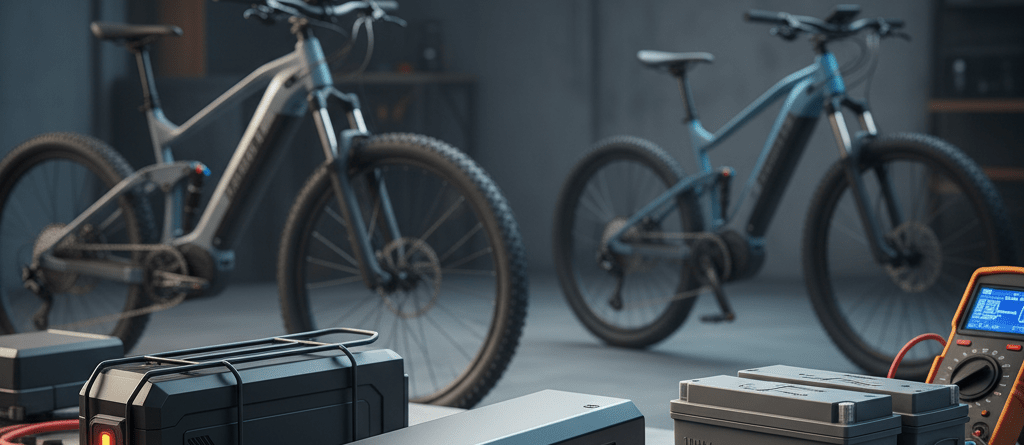
Battery of Bike: How to Boost Range & Replace Safely
The term battery of bike refers specifically to a rechargeable e-bike battery pack designed to power an electric bicycle’s motor via a controller. Unlike a starter battery, it provides deep-cycle energy (measured in Wh) and includes a Battery Management System (BMS) to regulate safety, not just simple voltage.
QUICK ANSWER: THE ESSENTIALS
- Identity: It is a traction battery (Lithium-ion usually), not a lead-acid starter battery.
- Key Match: Voltage (V) must match your controller; Capacity (Wh) determines range.
- Range: Calculated by Watt-hours (Wh), not just Amp-hours (Ah).
- Safety: Never charge a frozen pack; let it warm to room temperature first.
I still remember the sinking feeling of being ten miles from home when my power cut out completely. It wasn’t that the battery was empty—it was simply cold. I had just learned the hard way that a “battery of bike” isn’t just a box of energy; it’s a volatile chemistry set that hates winter if you don’t treat it right.
In the early days of electric transport, riders were stuck with heavy, short-lived Lead-Acid batteries—the same bricks used in cars. They were cheap, but they weighed a ton and died after a few months of daily use. Today, the standard has shifted almost entirely to Lithium-ion (Li-ion) technology. These modern packs are lighter, denser, and smarter, but they also introduce a new layer of complexity for the average rider.
Whether you are building a DIY e-bike from scratch or looking for a replacement battery pack for an electric bike that has seen better days, the terminology can get confusing fast. You might see terms like “36V 13S4P,” “48V 1000W limit,” or “Ah vs Wh” thrown around without much context. If you buy the wrong one, the best-case scenario is that the connector doesn’t fit. The worst-case scenario? You fry your controller capacitors or the battery simply shuts down the moment you try to climb a hill.
Ready to restore your range?
Don’t settle for weak cells. Browse our high-performance replacement packs designed for long-lasting power.
What “battery of bike” means for e-bike battery packs
The term strictly refers to the main traction pack powering the motor, distinct from 12V lighting or motorcycle starter batteries.
When people search for this term, they often confuse it with motorcycle batteries. However, an e-bike battery pack is a deep-cycle lithium unit meant to sustain power over an hour or more, rather than deliver a massive burst for three seconds to start an engine.
Inside the Black Box: Cells & Configuration
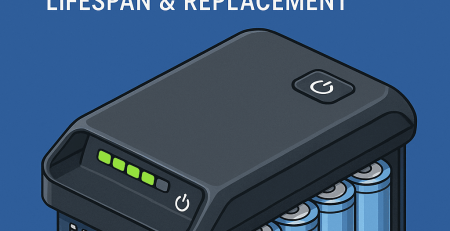
Inside that plastic or metal case, you aren’t just buying a single “battery.” You are buying a pack made of dozens of smaller cells, usually 18650 or 21700 cylinders, wired together. This is where quality matters most.
- The “S” (Series) Count: This determines voltage. A “13S” pack means 13 cells are wired in a series chain to create 48V. If one cell group fails, the whole chain fails.
- The “P” (Parallel) Count: This determines capacity (Ah). A “4P” pack has 4 cells in each group to share the load. More parallel cells mean less strain on each individual cell, leading to a longer lifespan.
The Battery Management System (BMS) is the brain that monitors these groups. It prevents the pack from catching fire by cutting power if any group gets too hot, over-discharged, or tries to charge when it’s freezing cold.
Is it the same as a bicycle battery for lights?
No. Small accessories often use standard AA or USB-rechargeable cells. The main pack runs at much higher voltages (36V to 52V+) to drive the motor.
Is it a starter battery?
No. Starter batteries (like in cars) are designed for high cranking amps. E-bike packs are designed for sustained continuous current.
Safety Check: Branded vs. Generic Cells
Not all lithium cells are created equal. When you see a cheap replacement pack on eBay for half the price of a reputable one, the difference is usually inside the case.
Top-Tier Brands (Samsung, LG, Panasonic/Sanyo, Sony/Murata):
These manufacturers allow for strict quality control. Their cells have consistent internal resistance and capacity. They are far less likely to overheat under load.
Generic / “Chinese” Cells:
Often labeled simply as “2500mAh” with no brand name. These cells often suffer from:
- Exaggerated Specs: A label might say 15Ah, but real-world tests show 10Ah.
- Voltage Sag: They lose power drastically when you climb a hill.
- Safety Risk: Higher risk of internal shorts, which can lead to thermal runaway (fire).
Advice: Always ask the seller, “What specific cells are inside this pack?” If they cannot tell you, walk away.
E-bike battery pack compatibility checklist
Compatibility is decided by voltage + controller needs + physical/connector fit; capacity comes after.
Before you even look at range or price, you have to ensure the “handshake” between the battery and the bike will work. If the voltage is wrong, the bike won’t run. If the mount is wrong, it won’t fit. Here is the detailed breakdown to avoid a return shipping nightmare.
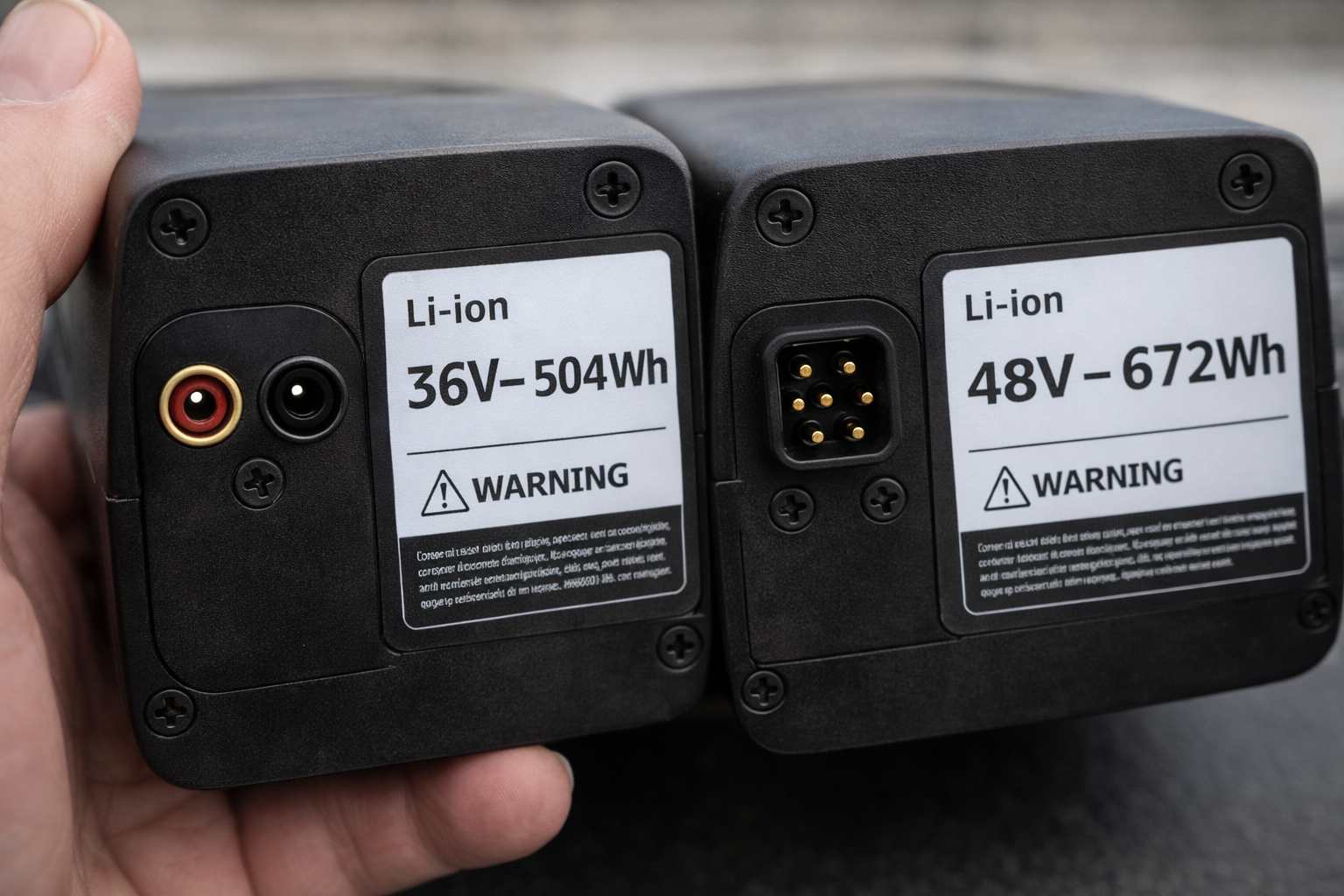
- System Voltage: A 48V controller needs a 48V pack. A 52V pack might work, but check the controller’s over-voltage limit first.
- Continuous Current: Your BMS must handle the amps your controller draws. If your controller pulls 25A but the battery BMS limits to 20A, the power will cut out every time you accelerate.
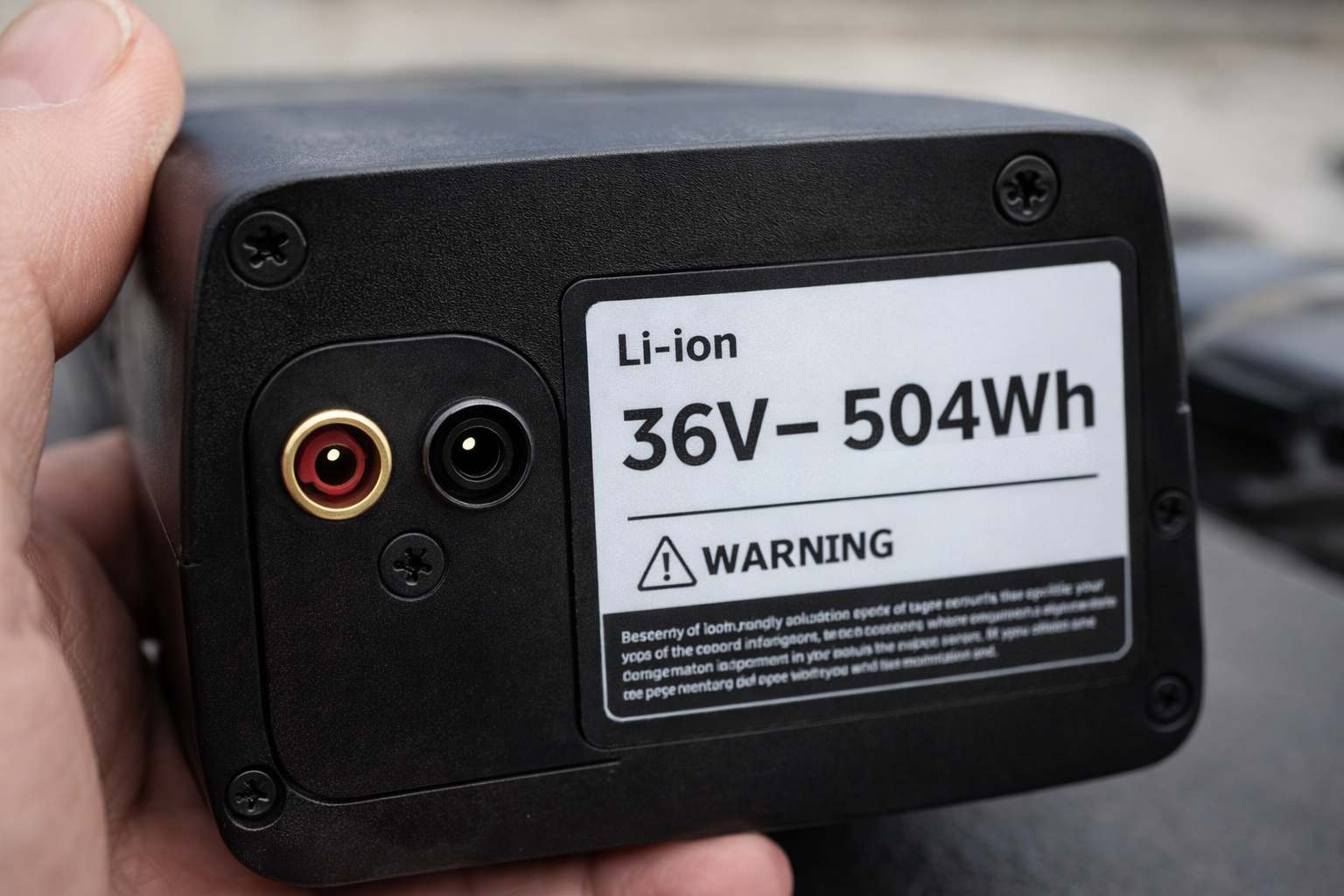
- Connector Type: This is the #1 reason for returns. Do you have an Anderson, XT60, or proprietary plug?
- Physical Form Factor: Hailong (shark), Silverfish, Rear Rack, or Integrated frame? Measure the mounting bolt distance.
The Connector Zoo: Identifying Your Plug
Manufacturers use a frustrating variety of plugs. Identifying yours visually is critical:
- Anderson Powerpole: Look for two separate plastic blocks (usually Red and Black) that slide together. Common on older kits.
- XT60 / XT90: Yellow nylon plugs. XT60 is smaller and bullet-shaped; XT90 is larger. These are the gold standard for high-power aftermarket batteries.
- Barrel Plug: A round metal tip with a plastic interior. Often used for charging ports, but rarely for the discharge port on high-power bikes due to heat risk.
- Proprietary (Bosch/Shimano/Yamaha): These often have complex multi-pin shapes and cannot be replaced with generic packs without hacking the system.
E-bike battery pack spec → what it changes
| Spec | What it determines | Common Mistake |
|---|---|---|
| Voltage (V) | Speed & System Compatibility | Using 48V on a 36V controller (fry risk). |
| Capacity (Wh) | Total Range (Distance) | Confusing Ah with total energy. |
| BMS Current (A) | Peak Power / Hill Climbing | Buying a low-amp battery for a high-power motor. |
| Connector | Plug & Play Ability | Assuming “3 pins” implies compatibility. |
| Form Factor | Physical Fit on Frame | Buying a Shark pack for a Rear Rack slot. |
Capacity and range planning (Ah vs Wh)
Prioritize Watt-hours (Wh) for a true measure of energy; Amp-hours (Ah) only makes sense if voltage is identical.
Many riders fixate on Amp-hours (Ah), but that is only half the story. A 10Ah battery at 36V has significantly less energy than a 10Ah battery at 52V. To get the real picture, you need to calculate the Watt-hours:
Voltage (V) × Amp-hours (Ah) = Watt-hours (Wh)
Real-World Range Math
Marketing claims are often exaggerated (“Up to 60 miles!”). To get a realistic estimate, use the “Wh per mile” rule of thumb:
- Throttle Only / High Speed: You will consume about 30-35 Wh per mile. A 500Wh battery will last roughly 15 miles.
- Heavy Pedal Assist (PAS 4-5): You consume about 20-25 Wh per mile. That same 500Wh battery gets you 20-25 miles.
- Eco Mode (PAS 1-2): You consume 10-15 Wh per mile. Now you might see 40+ miles.
If you want more range, look for a higher Wh number. That is the actual size of your fuel tank.
The “Voltage Sag” Effect Explained
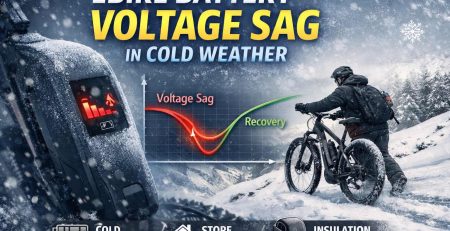
Have you ever noticed your battery bar drops from “Full” to “Half” when you accelerate hard, but then bounces back up when you stop? That is called Voltage Sag.
Think of your battery like a water bucket with a hose at the bottom:
- High Quality Battery: It has a wide hose. When you open the tap (throttle), water rushes out fast without pressure dropping.
- Low Quality / Old Battery: It has a thin straw. When you demand power, the flow struggles, and the pressure (voltage) drops immediately.
If your voltage sags too much, your controller thinks the battery is empty and cuts power, even if you still have 40% capacity left. This is why high-discharge (high “C-rate”) cells are critical for high-power motors.
Can I use a higher Wh pack on the same bike?
Yes, as long as the voltage is the same. A higher Wh pack will just be heavier and physically larger, so check the frame clearance.
Charging, storage, and cold-weather behavior
Cold reduces available performance; safe charging needs pack warming; storage routine reduces risk.
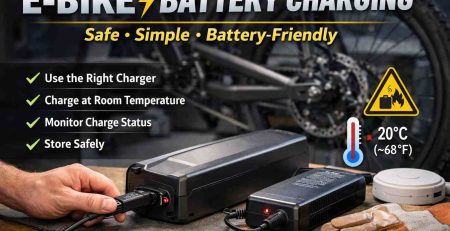
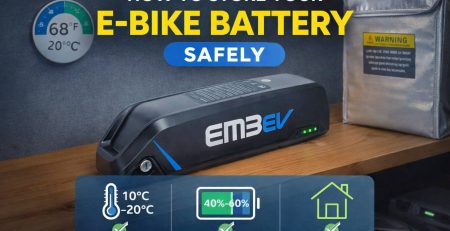
Lithium batteries are sensitive divas. If you leave your electric bicycle battery pack in a freezing garage and try to charge it, you can permanently damage the cells through a process called lithium plating. Always bring the pack inside to warm up to room temperature (above 50°F / 10°C) before plugging in the charger.
The “80/20 Rule”: How to Double Your Battery Life
Most riders kill their batteries early by treating them like phone batteries. If you charge to 100% and drain to 0% every ride, your pack might only last 300-400 cycles. However, if you treat it gently, you can get over 800 cycles.
Here is the golden rule used by Tesla and battery experts: Keep the charge between 20% and 80%.
- Why not 100%? Storing a battery at full voltage (4.2V per cell) creates internal stress and heat. Only charge to 100% if you are planning a long ride immediately.
- Why not 0%? Draining a battery until it dies risks dropping below the “low voltage cutoff.” If a cell drops too low, the BMS may permanently lock the battery to prevent a fire hazard.
- The Sweet Spot: For daily commuting, charge up to 90% and recharge when you hit 30%. This small change can effectively double the lifespan of your investment.
Safety Protocol: The “Touch Test”
When charging a new or old battery, make it a habit to perform the touch test. About 30 minutes into charging, touch the charger brick and the battery connector. The charger should be warm, but never too hot to hold. The battery connector should remain cool. If the connector is hot, you have high resistance, which is a melting/fire hazard. Stop immediately and inspect the pins.
Experience Validation Workflow: How to verify your setup
Instead of relying on claimed range numbers, use this verification method to test your setup:
- Voltage Check: Use a multimeter to confirm the resting voltage of your old pack vs. the new one. They should match the nominal rating (e.g., ~54.6V for a full 48V pack).
- Comparison Loop: Ride a fixed 5-mile loop using the same assist level on both packs. Don’t look at the “bar” display; look at the voltage drop after the ride.
- Cutoff Observation: If the bike cuts out on a hill, check if the display stays on (BMS cutoff) or turns off (Controller cutoff). This tells you if the battery is too weak or just empty.
- Connector Heat: After a ride, touch the connectors. Warm is okay; hot implies a loose connection or high resistance.
I once helped a friend upgrade his delivery e-bike. He bought a cheap “48V” pack online that claimed high capacity. Within a week, the bike would shut down every time he accelerated. The issue wasn’t the capacity; it was the BMS current rating—it was too low for his motor. We swapped it for a high-discharge pack, and the problem vanished instantly. This highlights the importance of matching your battery not just to your bike, but to your riding style.
Scenario Matching: Who are you?
- The Daily Commuter: You need reliability over raw power. A standard 36V or 48V pack with high cycle life cells (like Samsung 35E) is ideal. Weight matters because you likely carry the battery inside to charge.
- The Delivery Rider: You need pure Watt-hours. Ignore the “slim” aesthetics. You want the biggest square block battery that fits on your rack, likely 48V 20Ah or more, to last a full shift.
- The Trail Shredder (eMTB): You need high discharge current. Voltage sag is your enemy on steep climbs. Look for packs using high-discharge cells (like Samsung 25R or Molicel) that can dump power without heating up.

Decision box — choosing the right e-bike battery replacement pack
Decide in order: voltage → current/BMS → fit/connector → capacity (Wh) → riding conditions.
Troubleshooting & Selection Guide
Is it the Battery, Controller, or Motor?
- Symptom: Power cuts instantly when throttle is twisted.
Check: BMS Current limit is too low, or battery is nearly empty (voltage sag). - Symptom: Display won’t turn on at all.
Check: Battery fuse (if equipped), connector polarity, or controller ignition wire. - Symptom: Battery charges for 10 minutes then shows “Green/Full”.
Check: Your battery cells are unbalanced or “dead.” One bad cell group triggers the BMS to stop charging the whole pack. It needs replacement.
- If you don’t know your voltage: Check the label on the CHARGER output (e.g., 54.6V output usually means a 48V battery).
- If winter riding: Prioritize a pack with high-quality cells (like Samsung or LG) and insulate the battery case. Expect a 20-30% range drop in freezing temps.
Popular Replacement Options
When looking for a replacement battery pack for an electric bike, match the specs first. Here are standard configurations found on the market:
Performance / Cargo

48V E-bike Battery Pack
- Voltage: 48V (54.6V peak)
- Best for: 500W – 1000W Motors
- Typical Range: 13-20Ah (624-960Wh)
- Pros: Better torque, higher speed.
High Power / Enthusiast
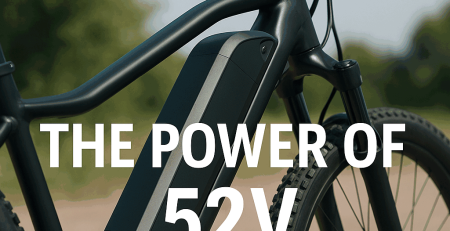
52V E-bike Battery Pack
- Voltage: 52V (58.8V peak)
- Best for: 1000W+ / Bafang mid-drives
- Typical Range: 17-25Ah (High Wh)
- Pros: Less voltage sag, max power.
Ready to upgrade your range?
Make sure the connector matches your controller before you order.
Frequently Asked Questions
What is the “battery of bike” on an e-bike?
It is the main traction battery pack, usually 36V, 48V, or 52V, consisting of lithium-ion cells controlled by a BMS to power the motor. It is distinct from the bike’s mechanical components and requires specific charging care.
How do I confirm my e-bike battery pack voltage?
Check the label on the back of the battery case or the output voltage listed on your charger. 42V output = 36V battery; 54.6V output = 48V battery; 58.8V output = 52V battery.
Can I use a higher Wh pack on the same voltage system?
Yes. Increasing Watt-hours (Wh) or Amp-hours (Ah) only increases range, not speed. It is safe as long as the voltage (V) remains the same. Just ensure the physical dimensions fit your frame.
What happens if voltage doesn’t match the controller?
If voltage is too low, the bike acts sluggish or cuts off immediately. If voltage is too high (e.g., 52V on a 36V controller), you will likely fry the controller capacitors or blow the display screen.
How do I check connector/mount compatibility?
Visually compare the plug (number of pins, shape, color). Common types include Anderson (red/black blocks), XT60 (yellow bullet), and barrel plugs. Adapters exist, but direct soldering is safer for high current.
Why does my pack cut off under load?
This is usually “voltage sag.” If the battery is old, cold, or the BMS current rating is too low, voltage drops below the controller’s cutoff threshold during acceleration, protecting the cells but stopping the bike.
Can I charge an e-bike battery pack when it’s cold?
Do not charge below freezing (32°F/0°C). Charging frozen lithium cells causes permanent damage (plating) and creates a fire risk. Always bring the battery inside to warm up for 1-2 hours first.
How should I store an e-bike battery pack for weeks?
Store it at roughly 50-60% charge in a dry, room-temperature area. Do not store it fully charged (100%) as it stresses the cells, or fully empty as it may drop below the critical wakeup voltage.
Conclusion
Finding the right battery of bike doesn’t have to be a gamble. By focusing on the fundamentals, you ensure your ride stays powered and safe.
- Compatibility First: Voltage and connector fit are non-negotiable. Don’t force a square plug into a round hole.
- Capacity Second: Use the “20Wh per mile” rule to estimate your real-world range, not the manufacturer’s brochure.
- Safety Always: Respect the chemistry—charge warm, store cool, and monitor your connectors for heat.
Bike Battery Review (battery of bike) — Customer Rating
★ ★ ★ ★ ★
4.7 / 5.0(1 rating)
This quick review focuses on the key things people care about when choosing a bike battery (battery of bike): real-world range stability, BMS safety protection, charging experience, and compatibility.
Pros
- More consistent power delivery: less noticeable power drop as the battery drains—great for daily commuting.
- Solid BMS protection: supports common protections (overcharge, over-discharge, over-current, short-circuit).
- Reliable build & connectors: sturdy wiring and connectors help reduce loose-connection issues.
Cons
- Heavier than low-capacity options: high-capacity packs add noticeable weight.
- Longer full-charge time: charging time depends on charger output and battery capacity.
- Compatibility must be verified: confirm voltage, connector type, and mounting style before buying.
Verdict
If you want a stable range + stronger safety protection, this style of bike battery is a strong choice. Just make sure the voltage, capacity, connector, and mounting format match your e-bike to avoid fitment issues.



LEAVE A COMMENT