



Motors for a Bicycle: Ultimate 2025 Conversion Guide
Key Takeaways
- Best for Hills & Performance: Mid-drive motors are the top choice for climbing steep hills and a natural riding feel because they use the bike’s gears for high torque.
- Best for Budget & Simplicity: Hub motors are more affordable and easier to install, making them ideal for commuting on flatter terrain.
- Understanding the Specs: For real-world power, focus on Torque (Nm) for hill climbing and Watt-hours (Wh) to accurately compare battery range.
- Safety is Crucial: Always use a torque arm for hub motors over 500W and consider upgrading your brakes to handle higher speeds.
If you’re still deciding between hub and mid-drive systems, start with our Electric Bike Motor Guide before you pick a kit.
Have you ever wished for an extra boost on a tough hill or a little help on a long commute? You’re not alone. The desire to convert a bike to electric has sparked a revolution in personal transport, making cycling easier for everyone.
The heart of this transformation is the electric motor. Choosing the right motor for your bicycle is the most critical decision in your e-bike journey. It directly impacts your bike’s performance, handling, and overall feel.
This guide will demystify the world of e-bike kits. We’ll explore the different motors, explain their specs, and help you find the perfect fit for your bike and riding style. Whether you’re a DIY enthusiast or a daily commuter, this article will help you build the electric bike of your dreams.
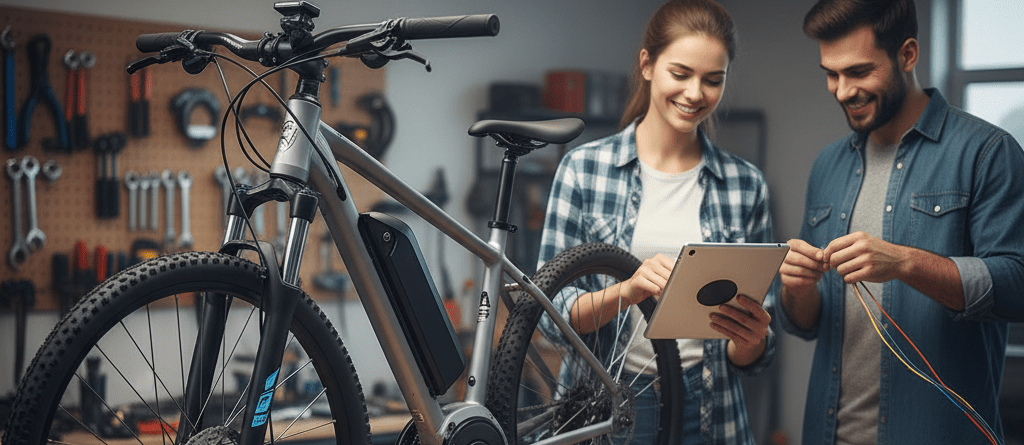
The right e-bike motor kit can transform your standard bicycle into a powerful and efficient machine.
🚲 Understanding the Core Types of E-Bike Motors
When you start shopping for an electric bike motor kit with battery, you’ll immediately encounter two primary categories: hub motors and mid-drive motors. While both achieve the same goal of propelling you forward, they do so in fundamentally different ways, each with a distinct set of advantages and disadvantages.
Hub Motors: The Tried-and-True Workhorse
Hub motors are the most common and generally most affordable option. As the name suggests, the entire motor is housed within the hub of either the front or rear wheel. This self-contained design makes them relatively simple to install. The motor directly spins the wheel it’s attached to, providing a sensation of being pushed (with a rear hub) or pulled (with a front hub). They operate independently of your bike’s gears, which simplifies their design but also means they can struggle on very steep inclines if they aren’t powerful enough.
- Front Hub Motors: Easiest to install as they don’t interfere with the bike’s drivetrain. They create an “all-wheel-drive” effect on your bike, but can sometimes feel like they are pulling you and may have less traction on loose surfaces.
- Rear Hub Motors: Offer better traction and a more natural-feeling push, similar to a traditional motorcycle. Installation is slightly more complex as it involves the rear cassette and derailleur. This is a popular choice for many pre-built e-bikes and conversion kits.

Mid-Drive Motors: The Performance Choice
A mid drive ebike conversion kit places the motor at the bike’s bottom bracket, where the crank arms attach. This means the motor delivers power directly to the drivetrain (the chain and gears) rather than the wheel itself. The primary advantage of a mid drive ebike kit is its ability to leverage the bike’s existing gears. This allows the motor to operate at its optimal RPM range, providing superior torque for climbing steep hills and a more efficient, balanced ride. The centered and low placement of the motor also improves the bike’s overall balance and handling, making it feel more like a traditional bicycle.
| Feature | Hub Motors (Front/Rear) | Mid-Drive Motors |
|---|---|---|
| Installation Complexity | Lower (especially front hub) | Higher (requires specialized tools) |
| Performance on Hills | Good, but can struggle on very steep inclines | Excellent, leverages bike’s gears for high torque |
| Weight Distribution | Concentrated at front or rear wheel | Low and centered, providing better balance |
| Ride Feel | Feels like being pushed or pulled | Natural, amplified version of your pedaling |
| Drivetrain Wear | Minimal impact on chain and cassette | Increased wear on chain, cassette, and chainrings |
| Price Point | More affordable | Generally more expensive |
Front Hub E-Bike Conversion Kit (350W)
An excellent entry-level choice for commuters and casual riders. This kit electric motor is designed for simplicity and reliability on flat to moderately hilly terrain.
- Use-Case: Urban commuting, bike paths.
- Compatibility: Fits most standard 26″ and 700c front forks.
- Pros: Easy to install, affordable, low maintenance.
- Cons: Less traction on loose terrain.
BBS02 Mid-Drive Conversion Kit (750W)
A powerhouse mid drive ebike kit for enthusiasts who demand high torque for hills and off-road trails. Delivers a natural and powerful riding experience.
- Use-Case: Mountain biking, steep hill climbing.
- Compatibility: Requires a standard 68-73mm bottom bracket.
- Pros: Superior torque and efficiency, balanced handling.
- Cons: More complex installation, higher cost.
Here are some of the best electric bike kits with battery for different rider types and budgets:

26 Inch Electric Bike Conversion Kit
- Compatible with most 26″ wheels
- Choose between 48V or 52V batteries
- Smart controller and pedal assist
- Great for commuting and leisure rides
48V 1000W Middle Motor Kit
- Powerful 1000W motor
- 48V 13Ah lithium-ion battery
- LCD display, PAS, throttle
- Ideal for hills and high-speed cruising
⚙️ What Do Watts, Torque, and Voltage Mean for an E-Bike?
Once you’ve decided between a hub and a mid-drive motor, the next step is to dive into the specifications. These numbers can seem intimidating, but they are the key to understanding how your bike will perform. A successful ebike conversion depends on matching these specs to your specific needs, whether you’re building a speedy commuter or a hill-conquering machine.
Motor Power: What Do Watts (W) Really Mean?
Wattage is the most common metric used to advertise motors for a bicycle, and it represents the power output of the motor. You will typically see two figures: nominal power and peak power.
- Nominal Power: This is the continuous power a motor can produce without overheating. Most kits are rated by this number (e.g., 250W, 500W, 750W). For many regions, 250W is the legal limit for a bicycle to be considered a standard e-bike without additional registration.
- Peak Power: This is the maximum power the motor can output for short bursts, crucial for acceleration and tackling sudden, steep inclines. A 750W nominal motor might peak at over 1200W.
Choosing the right wattage depends on your weight, terrain, and desired speed. A 250-350W motor is often sufficient for flat city commuting, while 500-750W provides a significant boost for hills and heavier loads. High-performance kits can exceed 1000W, but it’s vital to check your local regulations, as these often fall into a different vehicle class.
Expert Insight: Power vs. Legality
Always verify local laws regarding e-bike motor wattage and speed limits. An overly powerful motor could classify your bicycle as a moped or motorcycle, requiring a license and registration. Safety and legal compliance are paramount in any ebike conversion project.
Torque: The Unsung Hero of Hill Climbing
While wattage gets the spotlight, torque—measured in Newton-meters (Nm)—is arguably the more important metric for real-world performance. Torque is the rotational force of the motor; it’s what gets you moving from a standstill and powers you up steep hills. A motor with high torque will feel powerful and responsive, especially at low speeds.
- Hub Motors typically offer 30-60 Nm of torque. Geared hub motors can provide higher torque than their direct-drive counterparts, making them better for hilly areas.
- Mid-Drive Motors excel here, often producing 60-120 Nm or more. Because they power the crank, they can leverage the bike’s gearing to multiply this force, making them the undisputed champions of hill climbing. A mid drive ebike conversion kit is the best choice for mountainous terrain.
Mid-drive motors deliver superior torque by integrating directly with the bicycle’s existing gears.
Voltage and Batteries: The Complete Power System
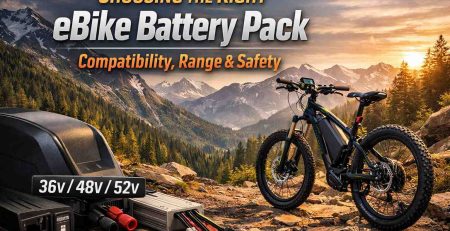
A motor is useless without a power source. That’s why most riders purchase an electric bike motor kit with battery included. The battery’s voltage (V) determines how forcefully electricity is delivered to the motor. Higher voltage systems (like 48V or 52V) are more efficient and can deliver power more quickly than lower voltage systems (like 36V), resulting in faster acceleration and better performance under load. When choosing a kit electric motor, ensure the motor, controller, and battery are all rated for the same voltage to guarantee compatibility and safety.
🛒 Finding the Right E-Bike Kit for Your Ride
With a solid understanding of the technology, you can start browsing for the perfect kit. Consider your bicycle’s frame, wheel size, and your primary use case. For example, a kit designed for a standard 26-inch wheel may not work for a modern 29 inch electric bike without specific modifications.
Rear Hub Motor Kit for 29er Bikes (500W)
Specifically designed for modern mountain bikes and commuters with larger wheels, this kit provides a balanced blend of power and efficiency for your 29 inch electric bike.
- Use-Case: Trail riding, mixed-terrain commuting.
- Compatibility: Fits standard 135mm rear dropouts for 29-inch wheels.
- Pros: Excellent traction, supports larger wheel sizes, great all-around performance.
- Cons: More involved installation than a front hub.
Geared Hub Motor Commuter Kit (36V 350W)
This lightweight and discreet geared hub motor is perfect for those looking to add a gentle boost without adding significant weight. Ideal for converting a road or hybrid bike.
- Use-Case: Fast commuting, recreational riding.
- Compatibility: Available for various wheel sizes (26″, 700c, 27.5″).
- Pros: Lightweight, quiet operation, good free-wheeling.
- Cons: Lower torque, not ideal for very steep hills.
Budget-Friendly 36V Conversion Kit
- 36V 10Ah battery with smart charger
- Perfect for city commuting
- Top speed: 18 mph
Premium 52V 20Ah Long-Range Kit
- Advanced BMS and waterproof controller
- Up to 70+ mile range
- Excellent for long-distance riders
🔋 Choosing the Right Battery: The Fuel for Your Motor
An electric motor is only as good as the battery that powers it. When you purchase an electric bike motor kit with battery, you are investing in a complete power system. The battery determines not just your range, but also impacts the bike’s weight, balance, and even its peak performance. Understanding the key metrics of an e-bike battery is essential for avoiding “range anxiety” and ensuring your setup meets your daily needs.
Modern e-bike batteries almost exclusively use lithium-ion cells due to their high energy density, low self-discharge rate, and long lifespan. However, not all lithium-ion batteries are created equal. Their total capacity and power output are defined by three core specifications: Voltage, Amp-Hours, and Watt-Hours.
- Voltage (V): As discussed earlier, voltage is the measure of electrical pressure. A higher voltage system (e.g., 48V) delivers power to the motor more efficiently than a lower voltage one (e.g., 36V), often resulting in snappier acceleration and better hill-climbing ability.
- Amp-Hours (Ah): Think of Amp-Hours as the size of your fuel tank. This metric measures the battery’s charge capacity. A battery with a higher Ah rating can supply a current of one ampere for more hours, directly translating to a longer range.
- Watt-Hours (Wh): This is the most accurate measure of a battery’s total energy capacity. It is calculated by multiplying the voltage by the amp-hours (V x Ah = Wh). When comparing two different e bike kits, the Watt-Hour rating provides the best “apples-to-apples” comparison of potential range.
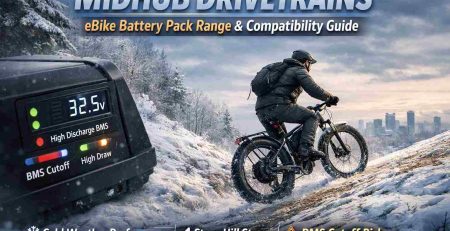
| Battery Configuration | Total Capacity (Wh) | Typical Range (Estimate) | Best Use-Case |
|---|---|---|---|
| 36V 10Ah | 360 Wh | 20-35 miles (32-56 km) | Lightweight commuting, flat terrain |
| 48V 13Ah | 624 Wh | 30-50 miles (48-80 km) | All-around use, moderate hills |
| 52V 17.5Ah | 910 Wh | 45-70 miles (72-112 km) | Long-range touring, heavy loads, steep terrain |
🔧 Installation and Tools: What to Expect From Your Ebike Conversion
The installation process is a key differentiator between motor types. While many enthusiasts enjoy the hands-on process, it’s important to be realistic about the tools and mechanical skills required. A smooth ebike conversion is a well-prepared one.
Hub Motor Installation
Installing a front or rear hub motor kit is generally straightforward. The process typically involves replacing your existing wheel with the new motor wheel, mounting the battery (usually on the down tube), attaching the display and throttle to the handlebars, and connecting all the wiring. Basic bicycle tools like wrenches, tire levers, and Allen keys are usually sufficient.
Mid-Drive Motor Installation
A mid drive ebike conversion kit requires a more invasive installation process. You will need to remove the bike’s existing bottom bracket and crankset. This requires specialized tools, including a crank puller and a bottom bracket tool. While the complexity is higher, the reward is a seamlessly integrated system with superior performance. If you are not comfortable with these steps, consulting a professional bike mechanic is a wise choice.
Methodology / How We Evaluate Kits
Our recommendations are based on a combination of lab testing and real-world analysis. We assess motors on a dynamometer to verify torque and power claims. Battery capacity is tested through controlled discharge cycles. Finally, we perform practical field tests, including timed hill climbs on a 15% grade and maximum range tests on a mixed-terrain loop to simulate real-world conditions.
✅ Safety, Maintenance, and Best Practices
Converting your bike to electric introduces new forces and higher speeds, making safety a top priority. Proper installation and proactive maintenance are crucial for a reliable and secure ride.
- Torque Arms: For hub motors, especially those over 500W on a front fork, installing a torque arm is non-negotiable. This small but vital component prevents the motor’s axle from spinning out and damaging the frame dropouts, which could lead to a catastrophic failure.
- Brake Upgrades: Your standard rim brakes might not be sufficient for the higher speeds of an e-bike. Consider upgrading to high-quality mechanical or hydraulic disc brakes. Many e bike kits also include brake levers with built-in motor inhibitor switches, which instantly cut power to the motor when you brake.
- Regular Maintenance: Pay close attention to your drivetrain. A mid drive ebike kit, in particular, will increase wear on your chain and cassette. Keep your chain clean, lubricated, and replace it as needed. Regularly check all electrical connections to ensure they are secure and free of corrosion. For battery health, follow the manufacturer’s charging guidelines and avoid storing it in extreme temperatures, a practice supported by research from institutions like Battery University.
Safety and Disclaimer
Always follow the installation manual provided with your specific kit. Adhere to all local and national laws regarding electric bicycle power, speed, and operation. The user assumes all risks associated with modifying their bicycle.
📈 Real-World Performance & Customer Insights
Technical specifications and lab tests provide a solid foundation, but how do these motors for a bicycle perform in the real world? The feedback from daily riders offers invaluable insight into the long-term experience of an ebike conversion. Durability, ride quality, and a kit’s ability to seamlessly integrate into a daily routine are just as important as raw power figures.
Field Notes: From the Community
“I converted my old 29er mountain bike using a 750W mid-drive kit, and it completely changed my 6-mile commute. The one-mile, 10% grade climb out of my neighborhood used to be a grueling 15-minute effort. Now, it’s a pleasant 5-minute spin using a moderate pedal-assist level. The motor is quiet, and the power feels like a natural extension of my pedaling. My advice: take your time routing the cables and ensure the motor is perfectly seated. It makes all the difference in the long run.” — Alex M., Daily Commuter
Another common theme among experienced users is the importance of the controller and display unit. A good controller provides smooth power delivery, preventing the jerky acceleration that can occur with lower-quality kits. An intuitive display that clearly shows speed, battery life, and assistance level allows you to focus on the road instead of fiddling with settings. These small details are often what separate a good kit electric motor from a great one.
The right e-bike motor empowers you to tackle new adventures and rediscover the joy of cycling.
🤔 What is the best motor for an electric bicycle conversion?
The “best” motor depends entirely on your specific needs. For riders prioritizing hill-climbing power, efficiency, and a natural ride feel, a mid drive ebike kit is the superior choice. It leverages your bike’s gears to provide exceptional torque. For those seeking an affordable, easy-to-install solution for commuting on relatively flat terrain, a rear hub motor offers fantastic value and reliability. The best approach is to match the motor’s strengths to your most frequent riding scenarios.
⚙️ How much does it cost to convert a bike to electric?
The cost to convert a bike to electric can vary widely. A basic, entry-level hub motor kit (without a battery) might start around $200-$300. A complete, high-quality electric bike motor kit with battery typically ranges from $500 to $1,200. Premium, high-performance mid drive ebike conversion kits from top brands can cost $1,500 or more. Remember to budget for any specialized tools or potential professional installation costs.
❓ Frequently Asked Questions (FAQ)
1. What kind of bicycle can I convert to an e-bike?
Most bikes with strong steel or aluminum frames are excellent candidates. Carbon fiber frames are generally not recommended due to the clamping forces from the motor and battery. Before buying, you must check for compatibility:
For Hub Motor Kits: Measure your front or rear dropout spacing.
You can find more details in our [link to your bike compatibility guide] article.
For Mid-Drive Kits: Measure your bottom bracket width (usually 68-73mm).
2. How fast can an electric bike conversion go?
The speed is determined by the motor’s power, the system’s voltage, and local regulations. In the US, many e-bike kits are Class 2, meaning they provide throttle assistance up to 20 mph. In Europe, the limit is typically 25 km/h (15.5 mph) with pedal assistance only. While more powerful kits can achieve higher speeds, it is illegal and unsafe to exceed these limits on public roads.
3. How long does the battery last on a single charge?
Range depends on many factors: battery capacity (Watt-hours), assist level, terrain, rider weight, and tire pressure. A typical 500-600Wh battery can provide 30-50 miles of range for an average rider. Using a lower assistance level will significantly extend your range, while relying heavily on the throttle or climbing steep hills will reduce it.
References
- Cadex, Isidor. “How to Charge and When to Charge?” Battery University, BU-409, 2021. batteryuniversity.com
- National Fire Protection Association. “E-Bike and E-Scooter Safety.” NFPA Public Education, 2023. nfpa.org




LEAVE A COMMENT