



Downtube Battery vs Rear Rack Battery: An eBike Engineering Guide
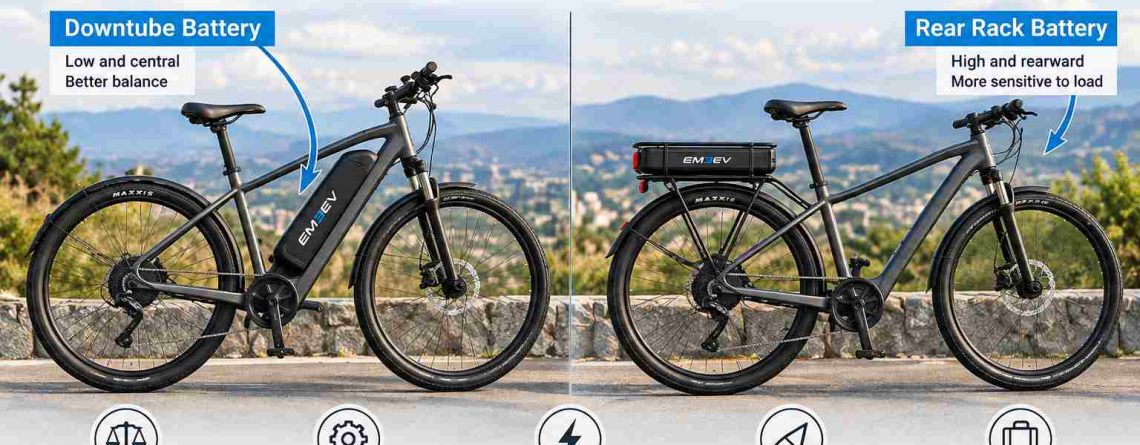
Downtube battery vs rear rack battery is a key eBike design choice because battery position affects handling, structural support, wiring, frame fit, and everyday practicality. A downtube battery mounts along the lower frame tube, usually on a dedicated rail, while a rear rack battery sits above the rear wheel on a compatible carrier. This guide compares both layouts from an engineering perspective to help you choose the right setup for your eBike.
Drawing on more than 15 years of custom lithium battery and pack structure engineering, we look at how the pack, rail, supports, frame, and wires work together.
Quick answer:
- Favor a low, central downtube pack when the frame supports it.
- Consider a rack pack when frame space or access limits your options.
- Check structural support and electrical limits before choosing capacity.
Imagine buying a larger pack for your commute. It fits the rack, but now the bike sways while you push it and the panniers block removal. That is a layout problem, even if the battery works perfectly.

Center of Gravity and Handling
A low, central battery generally makes added weight easier to manage; a high, rearward battery needs a stiff frame and careful load placement.
Downtube: central mass and neutral steering
A downtube pack keeps its mass between the wheels and usually below rack height. This helps reduce yaw inertia: how much the added weight resists a change in the bike’s heading. Less weight sits at the far rear as you turn.
For a rider weaving through tight bike storage, this can mean a steadier feel. On the road, it can reduce the rear-heavy feel during direction changes. It does not guarantee wobble-free cornering at high speed.
Rear rack: leverage and the “pendulum effect”
A rack pack sits high and rearward, sometimes extending behind the rear axle. Riders may describe side-to-side sway as a “pendulum effect.” The battery is not swinging freely; its high mass can make a rack or frame that flexes sway more. This is why rear load placement and rack stiffness matter when assessing handling stability.
Road bumps may excite this movement. On some bikes, a rear load can feed a rapid steering shake, known as speed wobble. Tires, frame geometry, structural flex, and rider input also matter.
Moving the same pack rearward shifts load away from the front wheel. Weight added behind the rear axle can reduce front wheel loading outright. This can limit front grip, especially uphill, though the complete bicycle and rider position both affect the result.
Does every rack battery cause wobble? No. A well-designed bicycle can safely use a rack pack. Stop and investigate any steering shake.
Is a downtube pack always easier to handle? No. A heavy pack on a flexible or unsuitable mount can undermine its positional advantage.
Structural Stress and Vibration
Durability depends on the load path: how the pack transfers forces through its rail, supports, and mounting points into the frame.
Rear rack: longer supports and repeated impacts
A rack pack loads the rail, deck, struts, joints, and frame mounts. An overhang adds bending stress at the supports. The same force acts through a longer lever arm.
Do not judge a rack just by how thick its top plate looks. Check how its stays brace the load and how far the pack sits from the supports. A stiff deck can still sway on weak stays.
On a rigid rear end, vertical road impacts pass from the wheel into the frame and rack. As the rack moves up and down, it must push and pull on the pack through its mounts. Flexible supports and loose joints can increase movement and impact at the rail.
Over time, poor support can lead to worn rails, loose fasteners, and fatigue cracks near welds. Welds may crack; bolted joints may loosen. These are distinct faults. Neither is certain to occur just because a pack sits on a rack.
Downtube: direct support, concentrated attachment loads
A downtube rail has a shorter load path into a main frame tube. A supported base can spread contact loads, but stress still concentrates at attachment points.
Where bottle bosses use rivnuts, those inserts may face shear, pull-out forces, and local bending. Pack height and weight increase leverage. Matching bolt spacing alone does not prove the frame can support the battery.
Picture a pack that clicks into place but rocks on its base. That movement can wear the rail and fret the electrical contacts. Fretting means wear caused by repeated tiny movements; it can make the contacts resist current flow.
Does a stronger shell fix a weak mount? No. Check shell protection through our ebike battery case guide.
Does a rack’s luggage rating prove battery suitability? No. Confirm the intended mounting arrangement and combined battery, hardware, and cargo load.
Wiring Length and Voltage Drop
Longer supply cables add resistance and more places that can rub; controller position and battery current determine how much that matters.
The battery feeds the controller, not the motor directly. Many mid-drives place the controller at the motor, so a rack pack needs a longer supply cable. For front hub systems, check the controller’s actual position.
Voltage drop = current × resistance. For the same wire material and gauge, extra length adds resistance. Include both supply and return conductors, plus connectors.
Under heavy load, these losses reduce voltage at the controller and create heat. They may contribute to an early low-voltage cutoff. The right wire size and sound plugs can keep this loss low.
Consider a rack cable routed toward a front controller. Each rack edge, steering bend, and unsupported connector becomes an inspection point. Allow steering or suspension movement without rubbing, pinching, or pulling on plugs.
Does a longer cable always make a rack pack unsuitable? No. Assess conductor size, routing, connections, and operating current together.
Should you size the supply wire from motor phase current? No. Use the controller’s battery-side current specification.
Downtube and Rear Rack Battery Decision Matrix
Choose the location that satisfies frame fit, structural support, cargo clearance, and electrical demand together.
| Factor | Downtube battery | Rear rack battery |
|---|---|---|
| Center of gravity and handling | Usually lower and central; favors neutral balance. | Higher and rearward; more sensitive to rear loading and flex. |
| Structural vibration resistance | Short load path; bosses and rail support remain critical. | More joints and possible overhang; inspect rack and rail stiffness. |
| Frame requirements | Often suits diamond frames; small triangles or suspension may obstruct fit. | Useful on some step-through frames; requires suitable rack mounts. |
| Cargo and storage | Leaves the rear rack free; may occupy bottle space. | Shares rack capacity; may obstruct panniers or battery removal. |
| Suitable motor power | No universal watt limit; verify pack, BMS, contacts, and controller demand. | Same checks; assess longer supply wiring where applicable. |
How to verify the proposed layout
- Check the frame and carrier makers’ mounting limits.
- Use a full-size template to confirm fit and removal space.
- Check support points, latch engagement, cable routing, and cargo interference.
- Have a competent installer check the system before use.
- After approved installation, check controlled low-speed handling and inspect for play. Stop if movement or steering shake appears.
Match the Layout to Your Build
Start with frame space and access, then choose a compatible pack format without sacrificing support or cargo clearance.
Diamond frames often suit Shark- or Dolphin-style downtube packs. These names describe case families, not universal rails. Step-through frames may favor rack placement, but many support dedicated downtube batteries. Check ebike frame compatibility.
For touring, imagine removing the battery with loaded panniers still attached. Check hooks, heel clearance, and the slide-out path. Combining both locations requires an approved dual-battery system; see cargo ebike battery setups.
EM3ev options to assess after choosing the location
These are frame-mounted candidates, not direct replacements for proprietary rack batteries.

EM3ev 48V Jumbo Shark
A downtube option for compatible builds. Check the case envelope and frame support before selecting capacity.
EM3ev Rhino 3P
An alternative shape for suitable custom mounting arrangements. It requires its own support plan, not an assumed Shark rail fit.
Battery Placement FAQ
Placement affects fit and load distribution; it does not determine capacity, system compatibility, or safety by itself.
Does battery placement change range?
Position alone does not increase stored energy. Compare usable capacity, total load, riding conditions, and wiring losses.
Can I move a rack battery onto the downtube?
Only with a compatible, approved mounting and electrical arrangement. A matching voltage or connector does not establish compatibility.
Are rack batteries only for low-power motors?
No. Check sustained pack output, BMS limits, connectors, wiring, and controller demand. Case position is not a power rating.
Will a Shark battery fit any bottle mounts?
No. Check the specific rail, frame load limits, case clearance, and removal path.
Are rear rack batteries unsafe?
No. A suitable pack on a properly engineered carrier can be safe. Poor support or damaged wiring needs correction regardless of location.
Our Recommendation: Low Placement, Rigid Support
We favor a low, central pack with a rigid, properly supported bracket whenever the frame permits it.
Our manufacturing work with Shark-style downtube packs and high-capacity custom batteries treats mounting as part of pack selection. A reinforced bracket should control movement without overloading weak frame points.
If a small or full-suspension frame blocks a standard pack, send frame photos, available dimensions, and controller details to the EM3ev Engineering Team. We can assess custom solutions and support requirements.




LEAVE A COMMENT