




eBike Battery Capacity Test: How to Read Ah and Wh Results
An ebike battery capacity test measures how much charge and energy a pack can deliver under defined conditions. It can help explain reduced range, but the result means little without the starting charge, load, temperature, and stopping point.
A battery that shows full may still deliver less energy than it once did. This guide explains what a proper test measures, what to ask a shop, and how to read the report. For the complete diagnosis and buying process, use our eBike battery replacement guide.
Quick Answer: How Do You Test eBike Battery Capacity?
A controlled discharge test records the current, voltage, and time as a suitable load draws energy from the battery. The equipment totals the delivered amp-hours (Ah) and watt-hours (Wh) until the specified endpoint. The pack’s protection stays active throughout.
- Use a qualified service provider with equipment suitable for the exact battery.
- Request measured Ah and Wh, plus the conditions and reason the test stopped.
- Compare the result with a relevant rating or baseline measured under comparable conditions.
- Treat capacity as one part of battery health, alongside faults, condition, and performance under load.
What Can a Capacity Test Tell You?
Capacity testing answers a practical question: how much can this pack deliver during this test? It can help assess a range complaint, compare an older pack with a valid baseline, or document performance for a supplier review.
It does not, by itself, locate a faulty cell, certify the battery as safe, or predict its remaining lifespan. A pack may deliver useful energy at a light load yet shut down under harder acceleration. A complete diagnosis may need other checks.
Before paying for a test, describe the symptom. If charge falls while the bike is parked, first review battery drain when not in use. Measuring discharge capacity and investigating idle power loss answer different questions.
Why Voltage and Battery Bars Are Not Capacity Tests
Voltage is a reading at one moment. Capacity is measured over a discharge period. Two packs can show similar voltage after charging and still deliver different amounts of energy.
A basic multimeter can help check external voltage, but it cannot determine full usable Ah or Wh from that reading alone. Our multimeter battery testing guide covers that separate check.
Battery bars and app percentages estimate the charge left. A BMS app may also show a configured capacity or a learned estimate. Ask what each field represents before treating a screenshot as a discharge-test report.
How an eBike Battery Capacity Test Works

A professional test should follow a procedure suitable for the pack. Ask the service provider to explain these steps:
- Identify and inspect the battery. Confirm its model, ratings, service requirements, and condition. A damaged, swollen, leaking, or unusually hot pack needs assessment before any routine discharge test.
- Prepare a known starting state. Follow the specified charging, rest, and temperature conditions. Starting partly charged will not measure the pack’s full usable capacity.
- Apply a controlled load. Use equipment and connections rated for the pack’s full-charge voltage, test current, and power. Keep the BMS and required system communication in place.
- Log the discharge. Record voltage, current, elapsed time, and relevant temperatures. Stop at the documented endpoint or earlier if a fault or safety limit requires it.
- Report the result. Provide delivered Ah and Wh, the discharge record, test settings, and any errors or unexpected shutdowns.
Keysight’s discharge-capacity testing overview describes the same core measurements: controlled loading, voltage, discharge time, and cutoff conditions.
The endpoint is not zero volts. Do not bypass the BMS, improvise a discharge load, or repeatedly restart a pack after protection stops the test. For a proprietary system, ask an authorized dealer which testing procedure is supported.
Understanding Amp-Hours and Watt-Hours
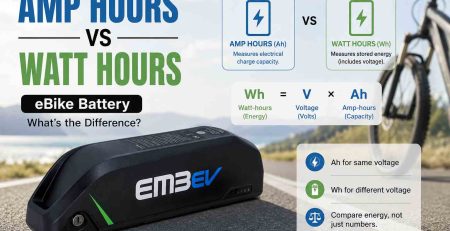
Amp-hours measure delivered charge
Ah adds up the discharge current over time. With constant current, the calculation is simple:
Delivered Ah = current in amps × discharge time in hours
If current changes, the equipment totals the charge across the recorded intervals. Ah is useful when comparing packs with the same voltage basis and comparable test conditions.
Watt-hours measure delivered energy
Wh includes voltage as well as current and time. The tester totals the energy throughout the discharge as the battery voltage changes.
Delivered Wh = the total of voltage × current × elapsed hours across the test intervals
Multiplying the manufacturer’s stated nominal voltage by rated Ah gives an approximate rated energy figure. It is not a measurement of the energy an older pack delivers today. Using full-charge voltage for that shortcut can overstate the figure.
Do not compare an Ah result directly with a Wh rating. For different voltage systems, Wh provides a more useful energy comparison, although it says nothing about whether the packs are interchangeable.
What to Ask for in a Battery Capacity Test Report
Ask for more than a pass/fail message. Keep a copy of the following details so later results can be compared fairly.
| Report item | What it should show |
|---|---|
| Battery identity | Model, pack identifier, rated Ah and Wh, and test date. |
| Starting conditions | Charge procedure, starting voltage, rest period, and temperature. |
| Load profile | Constant current, constant power, or a changing load, with its settings. |
| Stopping conditions | Specified endpoint, actual stop reason, and any BMS or temperature event. |
| Measured output | Delivered Ah, Wh, duration, and the voltage/current record. |
| Comparison basis | The rating or earlier result used, differences in conditions, and equipment accuracy or limitations. |
How to Compare Measured Capacity With a Baseline
First check whether the starting charge, temperature, load, endpoint, and measurement method are comparable. A colder test, heavier load, or earlier stop may produce a lower result without proving that permanent capacity loss accounts for the whole difference.
When the comparison is valid, calculate energy retention as:
Energy retention (%) = measured Wh ÷ reference Wh × 100
Illustrative example only: Suppose a pack delivered 600 Wh when new and later delivers 480 Wh under comparable conditions. The later test shows 80% of that measured energy baseline. These are hypothetical figures, not EM3EV test results or a universal replacement threshold.
If the denominator comes from the product label instead, describe the result as a percentage of rated energy. Without a comparable new-pack measurement, you cannot assume the entire difference is aging.
What Should You Do With the Result?
- Unexpectedly low output: Ask whether the pack started at the required charge and whether the test ended normally. Review faults and measurement limits before blaming worn cells.
- Useful capacity, but cutoffs on the bike: Review battery cutouts under load. A light-load capacity result does not prove the pack can meet the controller’s demand.
- Confirmed capacity loss: Compare the remaining usable energy with your riding needs and reserve margin. Discuss approved service or replacement options with the supplier.
There is no single percentage that decides replacement for every rider or pack. Warranty criteria are also separate from a practical range decision. Damage, abnormal heat, or repeated faults need attention regardless of the capacity number.
Need More Usable Energy for Your Rides?
If the assessment supports replacement, compare packs that meet your system’s voltage, current, communication, mounting, connector, and charger requirements. A larger Ah figure alone does not establish compatibility.Compare EM3EV Replacement Batteries
Frequently Asked Questions
Can I test eBike battery capacity with a multimeter?
A basic voltage reading cannot measure usable capacity. A capacity test must track discharge over time. Never place a meter in current mode directly across the battery terminals; this can create a short circuit.
Can I test capacity by riding until the battery is empty?
A correctly installed energy meter can record energy used during a ride, but terrain, load, temperature, starting charge, and controller cutoff affect the result. Do not deliberately ride to shutdown to create a test. Normal ride data is useful context, not a standardized capacity report.
Does a wall-plug energy meter show battery capacity?
No. It measures electricity entering the charger, including conversion losses and other consumption. That is different from the energy the battery later supplies during discharge.
How long does a capacity test take?
It depends on the pack, approved test load, preparation, and endpoint. Ask the provider for the full service time, including charging, temperature settling, testing, and the report.
Does 80% capacity mean I must replace the battery?
Not automatically. Confirm what the percentage compares and whether the test conditions match. Then consider condition, faults, current capability, riding needs, and manufacturer guidance. A percentage alone is neither a safety clearance nor a replacement rule.
Will a reset or recalibration restore lost capacity?
A documented calibration procedure may improve an inaccurate charge estimate. It does not reverse cell wear or repair damage. Do not perform repeated deep discharges or unsupported resets to chase a higher capacity reading.




LEAVE A COMMENT