




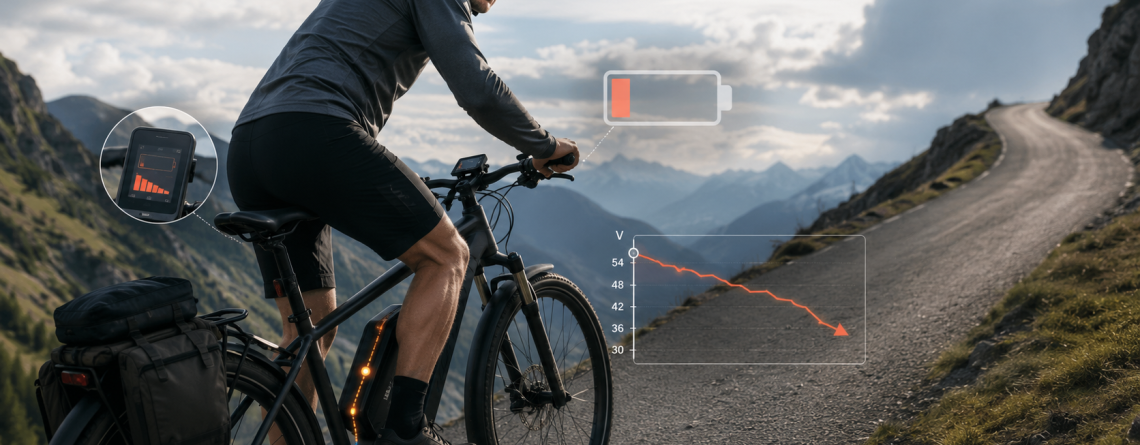
eBike Battery Cuts Out Under Load: Causes and Safe Fixes
If your eBike battery cuts out under load, you might notice the bike works normally on flat ground but suddenly shuts down during acceleration, hill climbing, or heavy-load riding. In many cases, the problem appears only when the motor asks the battery for more current.
Common causes behind this shutdown include voltage sag, BMS overcurrent protection, weak cells, a loose battery connection, an overheated controller, or a battery that is not correctly matched to the bike.
This guide explains how to identify the likely cause, which checks are safe for a rider to perform, and when a battery or electrical system needs professional testing.
Quick Answer: Why Does an eBike Battery Cut Out Under Load?
An eBike battery often cuts out under load because its voltage drops when the motor demands high current. If the voltage falls below the battery or controller protection limit, the system may shut down.
The BMS may also disconnect the battery if current or temperature exceeds its safe limit. Other possible causes include weak cells, loose terminals, damaged connectors, controller overheating, or an incorrect battery and controller combination.
A cutoff that happens repeatedly should not be ignored. Do not bypass the BMS or keep restarting the bike at full power.
What Does “Under Load” Mean on an eBike?
A battery is under load when it is supplying current to the motor. The load increases when the motor must produce more torque or maintain more power.
High-load situations include:
- Starting from a stop with full throttle
- Climbing a steep hill
- Using the highest assist level
- Carrying a heavy rider or cargo
- Riding into a strong headwind
- Using a high-current controller
- Accelerating when the battery charge is already low
The battery may appear normal when the bike is parked because very little current is being drawn. A problem becomes visible only when the motor requests a large amount of current.
What the Cutoff Pattern Can Tell You
| Cutoff pattern | Possible cause | First area to check |
|---|---|---|
| Bike shuts off during full-throttle acceleration | Voltage sag, BMS overcurrent protection, or controller demand | Battery voltage, BMS rating, and controller current |
| Bike cuts out only on steep hills | High current demand, weak cells, or an undersized battery | Battery condition and controller-to-battery matching |
| Bike cuts out when the charge level is low | Voltage sag reaching the low-voltage cutoff | Battery state of health and cell balance |
| Bike shuts off after hitting a bump | Loose battery mount, worn contacts, or damaged wiring | Battery rail, terminals, and external cables |
| Bike stops after a long ride but works after cooling | Battery, controller, or motor temperature protection | Heat, riding load, airflow, and electrical connections |
| Display stays on but the motor stops | Controller, motor, brake sensor, or motor cable problem | Bike-side electrical system |
| The entire electrical system turns off | Battery output, BMS, main connector, or battery mount | Battery-side power path |
These patterns are useful clues, but they are not final proof. Several faults can create the same symptom.
1. Battery Voltage Sag Under Load
Voltage sag is a temporary drop in battery voltage when the motor draws current. Every battery has some voltage drop, but an excessive drop can cause the bike to shut down.
The drop becomes larger when current demand rises. It may also become worse when:
- The battery is nearly empty
- The cells are old or damaged
- The battery is cold
- The cell groups are unbalanced
- The pack has high internal resistance
- The battery is too small for the controller

For example, the display may show a normal battery level while the bike is stopped. During acceleration, the voltage may fall far enough to reach the controller’s low-voltage cutoff or the BMS undervoltage limit.
When the load is removed, the voltage may rise again. This is why the bike may restart and appear normal after a short pause.
2. BMS Overcurrent or Undervoltage Protection
The battery management system monitors conditions such as cell voltage, current, and temperature. It may disconnect the battery when a value moves outside its programmed limit.
A BMS cutoff can be triggered by:
- Controller current exceeding the battery’s discharge limit
- A sudden current spike during acceleration
- A weak cell group falling below its voltage limit
- Battery temperature becoming too high
- A short circuit or damaged connection
A BMS trip does not always mean the BMS is defective. It may be performing its intended protection function because another part of the system is creating an unsafe condition.
Do not replace the BMS with a higher-current unit without confirming that the cells, wiring, connectors, and battery construction can safely support the higher current.
3. Old, Weak, or Unbalanced Battery Cells
Lithium-ion cells lose capacity and develop higher internal resistance as they age. A worn battery may still reach its normal charging voltage, but it may no longer deliver enough current under load.
Signs of weak cells include:
- Much shorter range than before
- Large battery-level changes during acceleration
- Power loss on hills
- Cutoffs that happen earlier as the charge level falls
- One cell group reaching low voltage before the others
- More heat during normal riding
Bluetooth BMS data can help identify differences between cell-group voltages. However, the data must be interpreted carefully. A small difference is not automatically proof that the battery is unsafe.
A controlled load test by a qualified technician provides stronger evidence than checking resting voltage alone.
4. Loose Battery Mounts, Terminals, and Connectors
High current must pass through the battery terminals, mount, wiring, and connectors. A loose or damaged connection adds electrical resistance and can interrupt power.
Inspect accessible external parts for:
- Loose battery movement on the rail
- Worn or recessed contact pins
- Corrosion or moisture
- Melted connector housings
- Dark marks around terminals
- Damaged insulation
- A burnt smell
- Cables that become hot during use

A bike that cuts out after bumps or rough roads may have an intermittent connection at the battery mount.
Do not insert metal tools into battery contacts. Remove the battery and follow the manufacturer’s service instructions before cleaning or adjusting external connections.
5. The Controller or Motor May Be the Real Cause
A power loss under load is not always caused by the battery. The controller or motor may enter protection when current or temperature becomes too high.
Bike-side causes can include:
- Controller overcurrent protection
- Controller thermal shutdown
- Motor overheating
- Damaged phase wires
- Loose motor connectors
- A brake cutoff sensor that activates incorrectly
- A display or communication fault
If the display remains powered while the motor stops, the fault may be after the battery rather than inside it.
Check the controller’s error codes and manufacturer instructions before assuming that the battery must be replaced.
6. Why an eBike Battery Cuts Out in Hot Weather
Hot weather reduces the amount of temperature margin available to the battery, controller, and motor. A long climb may then push one component into thermal protection.
A hot-weather cutoff may happen because:
- The battery starts the ride already warm from direct sunlight
- The controller draws high current for a long period
- A connector produces heat because of high resistance
- The BMS reaches its temperature limit
- The controller or motor enters thermal protection
- Old cells create more heat under the same load
If the bike works again after cooling, the thermal condition has changed, but the underlying cause may still be present.
Repeated heat-related cutoffs require inspection. Do not continue testing the bike on steep hills at full power.
Safe Troubleshooting Steps
- Record when the cutoff happens. Note the battery level, assist setting, hill grade, rider load, weather, and whether the display also turns off.
- Reduce the motor load. Test at a lower assist level on flat ground. Do not repeat full-throttle tests if the battery or connector is becoming hot.
- Check the battery mount. Confirm that the battery is fully locked and does not move on its rail.
- Inspect external connectors. Look for loose pins, discoloration, corrosion, damaged insulation, or melted plastic.
- Compare the battery and controller ratings. Confirm battery voltage, controller maximum current, BMS continuous current, connector rating, and charger compatibility.
- Check for heat. Stop if the battery, connector, controller, or motor becomes unusually hot.
- Review BMS data if available. Look for overcurrent, undervoltage, temperature, or cell-balance alerts.
- Arrange a professional load test. A technician can measure voltage behavior while the battery supplies current and help separate a battery fault from a controller fault.
Stop Using the Battery Immediately If You Notice:
- Swelling or case deformation
- Smoke, hissing, or crackling sounds
- A strong chemical or burnt smell
- Leaking fluid
- A melted battery terminal
- Rapid temperature rise
- Damage after a crash or water entry
Do not open the battery, bypass the BMS, bridge a fuse, or use an unapproved charger.
When Is the Battery Likely to Need Replacement?
A replacement may be appropriate when testing confirms that the battery can no longer support the required current or usable capacity.
Replacement becomes more likely when:
- Range has fallen significantly
- Voltage sag is excessive even at a high state of charge
- The battery repeatedly enters undervoltage protection
- One cell group falls much faster than the others
- The pack becomes hotter than it did when new
- The battery is undersized for the controller
- External damage makes continued use unsafe
Replacing the battery will not repair a damaged controller, motor, wiring harness, brake sensor, or battery mount. Confirm the cause before buying a new pack.
For Compatible 48V Systems

EM3ev 48V Super Shark eBike Battery
The 48V Super Shark is a compact downtube battery for compatible 48V systems. It is designed for riders who need a frame-mounted battery with smart monitoring and clearly stated electrical specifications.
- 48V nominal, 13S4P configuration
- Advanced programmable Smart BMS
- Cell-level fusing
- CNC-designed cell holders
- Multiple discharge connector options
- Requires a compatible 54.6V charger
This battery is not a universal fix for power cutoffs. Confirm your controller voltage, current demand, connector, polarity, charger, and frame dimensions before ordering
EM3ev 52V Jumbo Shark 17Ah eBike Battery
The 52V Jumbo Shark is intended for compatible 52V systems that require a larger rail-mounted battery format. It combines a 14S5P layout with smart monitoring and a temperature-protected BMS.
- 52V nominal, 14S5P configuration
- 17Ah and approximately 856Wh
- Genuine Samsung 35E cells
- Temperature-protected 40A Smart BMS
- Rail-mounted downtube format
- Designed for compatible 52V controllers
Do not use a 52V battery as an automatic upgrade for a 48V bike. Verify the controller, display, lighting system, motor electronics, connector, charger, and available frame space first.
How to Choose a Battery That Can Handle the Load
Do not select a replacement battery based only on voltage and amp-hours. A suitable battery must also support the current requested by the controller.
Match the system voltage
Use a battery voltage supported by the controller, display, motor system, lights, and other connected parts.
A 48V battery normally uses a 13-series configuration and reaches about 54.6V when fully charged. A 52V battery normally uses a 14-series configuration and reaches about 58.8V when fully charged.
A 52V battery should not be installed on a stock 48V system unless every connected component has been verified for the higher voltage.
Check controller current
Find the controller’s maximum battery-current rating. The battery cells, BMS, wiring, terminals, and connectors must all support that current.
Compare continuous and peak output
Peak current is only available for a short period. Hill climbing and cargo riding may require high current for much longer.
Compare continuous capability rather than relying only on a large peak number.
Choose enough parallel cells
Cells connected in parallel share the current demand. Pack layout, cell type, BMS settings, and construction all affect how the battery performs under load.
Confirm physical fit and connector rating
A battery must fit securely on the frame and have enough clearance for installation and removal. The connector should also be rated for the expected current.
Use the EM3ev battery selection guide to compare voltage, range, current capability, fitment, connector, and charger requirements.
For Compatible 52V Systems
Frequently Asked Questions
Why does my eBike battery cut out when accelerating?
Acceleration creates a sudden increase in current demand. The battery may experience voltage sag, or the BMS may enter overcurrent or undervoltage protection. Loose connectors and controller faults can cause similar symptoms.
Why does my eBike lose power only on hills?
Hill climbing requires more torque and usually more battery current. Weak cells, an undersized battery, a low state of charge, high resistance, or a BMS current limit may cause the system to shut down.
Why does the battery work again after I turn it off and on?
Removing the load allows battery voltage to recover. Some BMS protection states may also reset after the current demand is removed. This does not prove that the battery is healthy.
Can a loose battery connection cause the bike to shut off?
Yes. Worn battery contacts, a loose mounting rail, damaged connectors, or poor wiring can interrupt power. Heat or discoloration around a connector is a warning sign.
Does a higher-amp BMS stop voltage sag?
Not by itself. Voltage sag also depends on cell condition, cell type, parallel configuration, state of charge, temperature, wiring, and current demand. Installing a higher-current BMS on cells that cannot support it may create a safety risk.
Can hot weather make an eBike battery cut out?
Yes. High ambient temperature combined with climbing or high current can cause the battery, controller, or motor to reach a thermal protection limit. Repeated heat-related shutdowns should be investigated.
Should I replace the battery if the bike cuts out under load?
Not until the cause has been confirmed. The fault may be in the battery, BMS, mount, connector, controller, motor, brake sensor, or wiring. A professional load test can help identify the failing component.
Final Answer
When an eBike battery cuts out under load, the most common explanations are excessive voltage sag, BMS protection, weak cells, poor connections, thermal protection, or a mismatch between the battery and controller.
Start by recording when the cutoff occurs. Inspect the battery mount and external connectors. Compare the battery and controller ratings, and stop testing if any part becomes unusually hot.
Do not assume that a larger battery or a higher-current BMS will solve the problem. The battery voltage, cells, BMS, wiring, connectors, controller, charger, and frame fit must function as one compatible system.
Repeated shutdowns, overheating, damaged connectors, swelling, smoke, or unusual smells require professional inspection before the bike is used again.
Safety Note
Follow the instructions supplied by your battery, bicycle, controller, and charger manufacturers. Use only a charger confirmed as compatible with the battery voltage, connector, polarity, and charging profile.
EM3ev batteries are aftermarket battery systems. Compatibility must be confirmed for the specific controller, motor system, frame, connector, charger, and riding load.

LEAVE A COMMENT