




eBike Battery for Folding Bike: How to Choose the Right Pack
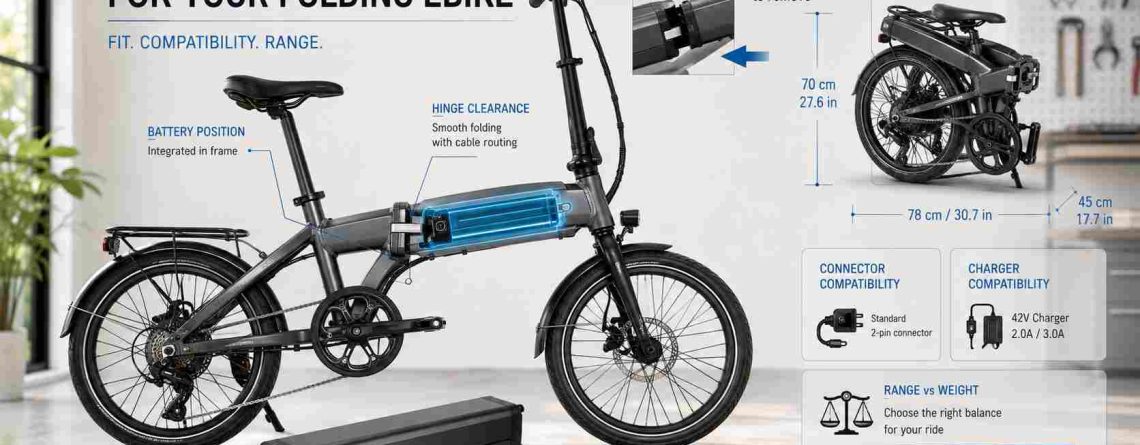
An eBike battery for folding bike use has to fit both the electrical system and the folding frame. Check voltage, battery dimensions, mounting position, removal direction, hinge clearance, connector, charger, and weight before choosing capacity. A 36V pack is suitable only when the bike is already designed for a compatible 36V system.
Quick Answer
- Match the original system voltage before comparing battery capacity.
- Measure the battery space with the bike both open and folded.
- Check the removal direction and make sure the lock or key stays accessible.
- Choose enough watt-hours for your route without adding unnecessary carry weight.
- Do not assume two folding-bike batteries are interchangeable because their cases look similar.
Folding eBikes create a battery-fit problem that many full-size bikes do not have. The pack has to work when the bike is open, folded, carried, and stored.
A battery may fit while you ride but still block a hinge, touch a folded wheel, pinch a cable, or become impossible to remove after installation. That makes physical fit just as important as voltage and range.
Start With Folding Clearance, Not Battery Capacity

Measure the complete folding and battery-removal path before deciding how large a replacement pack can be.
Measure the usable length, width, and height at the intended battery location. Then fold the bike slowly and watch what moves into that space.
Check the hinge, crank, pedals, wheels, cables, rack parts, and the latch that keeps the bike folded. Also confirm that you can reach the battery lock and slide the pack far enough to remove it.
A cardboard template made to the battery case dimensions is a simple way to test clearance before ordering.
| Fitment Check | What to Verify |
|---|---|
| Battery envelope | Length, width, height, and connector clearance |
| Folding path | No contact with the hinge, wheel, crank, cables, or latch |
| Removal path | Enough space to unlock and slide the battery out |
| Mount | Rail or bracket can be fixed securely to the frame |
Match Voltage and Current Before Range
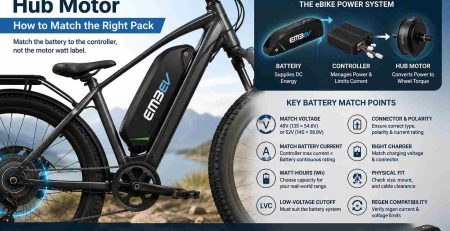
A folding-bike battery must match the controller voltage and provide the current the controller expects.
If the original bike uses a 36V system, stay with a compatible 36V battery unless the complete electrical system is specifically designed for another voltage.
A common 36V lithium-ion eBike battery uses a 10-series cell configuration and reaches about 42V when fully charged. The charger must be intended for that pack. Connector type and polarity also need to match.
Next, check the controller’s maximum battery-current requirement. Compare it with the battery manufacturer’s stated continuous discharge capability and BMS limit.
A large Ah rating tells you about capacity. It does not prove that the battery can safely supply more current.
Balance Range Against Carry Weight
More battery capacity can increase stored energy, but on a folding eBike it also adds size and weight that you may have to carry by hand.
Use watt-hours to compare stored energy:
Battery energy (Wh) ≈ nominal voltage (V) × capacity (Ah)
A larger Wh figure means more stored energy. However, there is little value in oversizing the battery if a smaller compatible pack already covers your normal route with a useful reserve.
This trade-off matters if you carry the folded bike into an apartment, office, car, train, or storage area. Extra battery weight can make those tasks harder.
The goal is therefore not the largest possible battery. It is enough usable energy without making the bike unnecessarily difficult to fold, lift, or store.
Check the Mount, Connector, and Charger

Similar-looking folding-bike batteries are not automatically interchangeable.
Compact eBikes may use frame-integrated batteries, downtube packs, batteries near the seat area, or rear-rack designs. Cases that look similar can still use different rails, locks, connector plates, or wiring.
Before replacing the battery, compare the original battery label with the proposed pack. Check the case dimensions, mount, connector type, polarity, and charger requirements.
If the bike uses a proprietary integrated battery system, do not assume a general replacement pack will work. Follow the bike manufacturer’s compatibility requirements or have the electrical system checked before changing the battery format.
Folding eBike Battery Compatibility Checklist
A suitable replacement should pass both an electrical check and a folding-frame check.
- Confirm voltage: Match the battery to the controller’s required system voltage.
- Check current: Compare controller demand with battery and BMS capability.
- Measure space: Record the real usable battery area, not just the open frame size.
- Test the fold: Make sure no part of the bike enters the battery space when folded.
- Check removal: Confirm the pack can still be unlocked and removed.
- Verify connection: Check the mount, connector, pin layout, and polarity.
- Match the charger: Use charging equipment intended for that battery.
- Choose capacity: Select enough Wh for your normal route and reserve needs.
When Does a 36V Battery Make Sense for a Folding eBike?
A 36V battery makes sense when the folding eBike is already built for a compatible 36V system and the pack also meets its physical-fit and current requirements.
Do not choose 36V simply because the bike folds. Folding-frame design does not determine system voltage.
For a compatible 36V bike, compare EM3ev 36V battery options by case dimensions, watt-hours, BMS output, connector requirements, and mounting method.
EM3ev 36V King Shark Battery
For compatible 36V systems. Confirm folding clearance, frame space, controller current, connector, mount, and charger before choosing a pack.
EM3ev 36V Super Shark Battery
Confirm folding clearance, rail dimensions, controller current, connector, mount, and charger compatibility before choosing this pack.
For a broader explanation of common pack shapes and case formats, see the eBike battery case guide. This page stays focused on the fit problems that are specific to folding bikes.
Frequently Asked Questions
Can I use any 36V battery on a 36V folding eBike?
No. Voltage is only one part of the match. The battery also needs suitable current capability, dimensions, mounting, connector, polarity, and charger compatibility.
Should a folding eBike use a small battery?
Not necessarily. Choose enough Wh for your route, but consider whether extra battery size and weight make the bike harder to fold, carry, store, or load into a vehicle.
How do I know if a replacement battery will fit?
Compare the battery dimensions with the usable frame space. Then check mounting points, connector clearance, key access, removal direction, and the complete folding path.
Can I replace an integrated folding-bike battery with an external pack?
Only if the electrical system, mounting, wiring, and connectors are correctly designed for that change. Do not treat it as a simple plug-in replacement.
What matters most when buying a folding eBike battery?
Start with electrical compatibility and folding-frame fit. Then compare watt-hours, battery weight, removable design, and charging convenience.
Final Answer
The right eBike battery for a folding bike is the pack that fits the bike when it is open, folded, and being carried.
Confirm voltage and controller current first. Then measure the battery space, folding path, mounting system, connector, charger, and removal clearance.
After those checks pass, choose enough watt-hours for your normal ride without adding unnecessary bulk. For a compatible 36V folding eBike, a well-matched 36V pack can be a practical choice.
Compatibility—not the folding-bike label—should make the final decision.


LEAVE A COMMENT