




Stop Range Anxiety with Better eBike LCD Display Settings
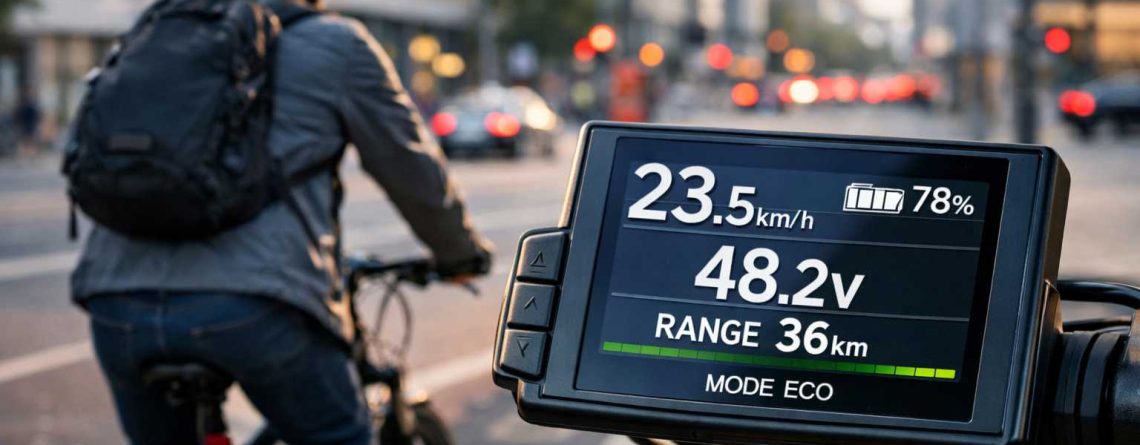
An ebike lcd display is the screen that shows your bike’s data. It tells you about speed and battery life. It reads the battery’s voltage to guess how much power is left. While it shows bars, these are often just estimates based on current battery pressure.
Quick Answer:
- Battery bars are guesses, not exact fuel levels.
- Voltage is the most accurate way to check your battery’s true state.
- Cold weather and steep hills make your battery look lower than it is.
- Correct “P-settings” make sure the screen matches your battery type.
Actually, to be honest, we’ve all felt that panic. You start your ride with a “full” battery. You hit one steep hill, and suddenly your screen is blinking red. You think your battery is dying. But when you reach the top, the bars jump back up. In my case, learning how these screens work saved me from a lot of stress.

Is your battery acting up?
Check out our high-quality battery packs for stable, long-lasting power.
Ultimate eBike Battery Voltage Chart (36V, 48V, 52V)
Display numbers are just estimates; always check your voltage while the bike is stopped to see your true battery status and verify your system settings.
eBike battery level on LCD display (meaning & accuracy)
The bars on your screen are like a digital “fuel gauge.” However, they don’t measure energy directly. They measure voltage. Think of voltage like water pressure in a pipe. When you use the motor, the “pressure” drops. This makes the display think the battery is emptier than it really is.
eBike LCD display battery percent vs voltage (which is reliable)
To be honest, voltage is much more reliable than percentage. A percentage might stay at 100% for a long time and then drop very fast. If your display can show a numeric voltage (like 48.2V), use that instead. It gives you a clear picture of how much energy is actually in the pack.
7-Step Accuracy Check:
- Check your battery bars when the bike is totally stopped.
- Watch the voltage while climbing to see the “sag.”
- Notice how the bars recover after you stop pedaling.
- Ensure your display is set to 36V, 48V, or 52V correctly.
- Keep your 5-pin connectors clean to avoid signal loss.
- Wait a few minutes after charging before checking the final voltage.
- Test your range in warm weather versus freezing cold.
| Bars | Voltage Reading | Riding State | Likely Cause |
|---|---|---|---|
| 5 Bars | Full (e.g., 54.6V) | Stopped | Fully Charged |
| Drops Fast | Lower Voltage | Climbing Hill | Voltage Sag (Normal) |
| 3 Bars | Medium (e.g., 48V) | Stopped | Half Empty |
| 1 Bar | Near Cutoff | Cold Weather | Cold-Soak Effect |
| Flashes | Minimum (e.g., 39V) | Any | BMS Cutoff Soon |
Experience Validation Workflow (The Real Test)
Don’t just trust the icons. Follow this simple plan to see how your battery actually performs in the real world.
- Step 1: Ride the same path on a warm day and a cold day.
- Step 2: Note the voltage at the start and end of each trip.
- Step 3: Watch how much the voltage drops during a hard sprint.
- Step 4: If the “resting” voltage is the same after both rides, your battery is healthy.
Why the battery bar drops fast (sag & cold)
A fast drop in bars is usually caused by temporary voltage sag or cold weather, not a permanent loss of battery capacity.
Voltage sag vs real capacity
When you use the throttle, the motor pulls hard on the battery. This causes the voltage to dip. Your screen sees this dip and drops a bar. Once you let go, the voltage goes back up. This is perfectly normal and does not mean your battery is broken.
Cold-soak effects
Batteries work slower in the cold. Riding in winter can make your display show a very low level. This is because the cold makes it harder for the battery to push power out. Keeping your battery indoors until you are ready to ride can help.
Recommended Upgrades & Fixes
Upgrading to a high-quality display can give you better data, clearer visibility, and advanced tuning options for your ride.
If your current screen is basic or hard to read, a new display can be a game-changer. Here are two top recommendations for different needs, especially for Bafang BBS motor users.
Best for Visibility

DCP14: Colour TFT BBS Display
A large, vibrant colour screen designed for Bafang BBS01, BBS02, and BBSHD mid-drives.
- Clear, high-contrast colour TFT panel.
- Shows real-time voltage and power data.
- Includes a robust, separate button pad.
Best for Customization

Bluetooth Display
A compact, app-connected display for Bafang BBS/Ultra and Lishui controllers.
- Connects to smartphone app via Bluetooth.
- Advanced parameter tuning on-the-fly.
- Acts as a dongle for programming.
Troubleshooting Tip: If your bike cuts power while still showing battery bars, check your P-settings. The low-voltage cutoff might be set incorrectly for your specific battery pack.
Optimizing Bafang Display Settings (P-Settings)
For Bafang BBS02 and BBSHD mid-drives, correct P-settings are vital for an accurate ebike battery indicator. Adjusting the low-voltage cutoff prevents premature power loss:
| Battery Type | Recommended Low-Voltage Cutoff | Display Setting Code |
|---|---|---|
| 36V Pack | 30V – 31V | P15 / Voltage Level |
| 48V Pack | 39V – 41V | P15 / Voltage Level |
| 52V Pack | 42V – 44V | P15 / Voltage Level |
Note: Always refer to your specific controller manual, as setting codes may vary by manufacturer.
Decision Box — Fix the screen or the battery?
Check your wire connections and menu settings first; then look at how the battery acts when it is cold or under a heavy load.
What to do:
- Is the reading wrong while stopped? → Check P-settings for the right voltage.
- Do bars only drop on hills? → This is normal voltage sag. No action needed.
- Does the bike die with 2 bars left? → Your display setting is likely wrong, or a cell is weak.
Still confused? Browse our EM3ev battery guides to find the best power solution for your bike.
Frequently Asked Questions
Is battery percentage on an eBike LCD display accurate?
Not always. Most screens use voltage as a proxy for capacity, which fluctuates based on power draw. Checking raw voltage is always more reliable for assessing true range.
Why does voltage look lower when riding?
This phenomenon, known as “voltage sag,” occurs when the motor draws high current from the battery. The display reads this temporary drop in pressure, but the level recovers once you stop pedaling.
Why does the battery drop faster in the cold?
Cold temperatures increase the internal resistance of lithium cells. This causes more significant voltage drops under load, making the display show a lower level than it would in warm weather.
What causes the bike to cut off suddenly?
This typically happens when voltage sags below the pre-set safety limit (Low Voltage Cutoff) of your controller, even if the display still shows a bar or two of “static” capacity.
How do I set the right voltage on my display?
Locate the P-settings menu (usually by holding the + and – buttons). You must select the voltage that matches your battery pack (e.g., 48V) to ensure the bar levels are calibrated correctly.
How can I fix incorrect Bafang display settings?
Access the advanced parameters on your Bafang screen to align the low-voltage protection with your battery’s actual capabilities. This prevents premature shut-offs and ensures an accurate ebike battery indicator reading.







LEAVE A COMMENT