




How Do eBike Batteries Work? Voltage, Cells, Wh & BMS Explained
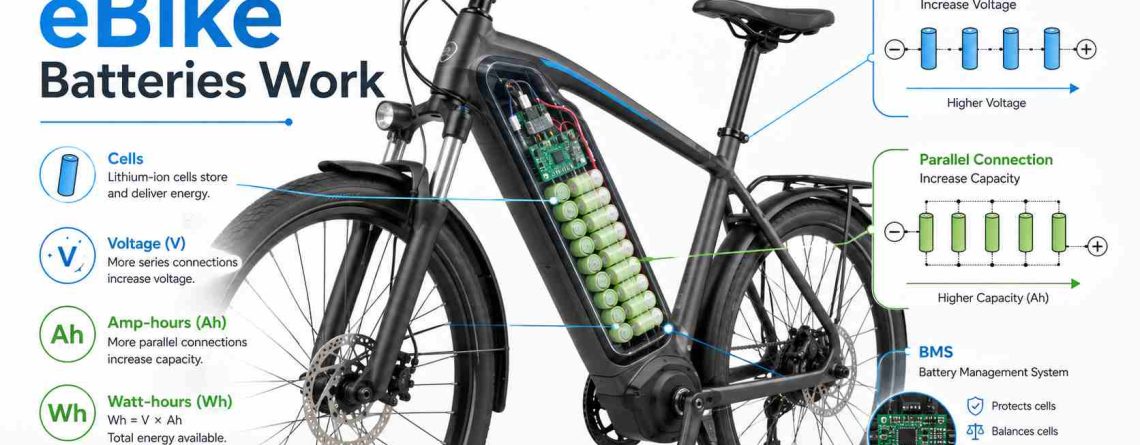
Electric bike batteries may look like one large power unit. Inside the case, however, it contains many smaller battery cells working together.
These cells are connected in a planned pattern to create the voltage, capacity and current capability needed by the bike. A Battery Management System, or BMS, also monitors the pack while it charges and discharges.
Understanding how eBike batteries work becomes much easier once you understand five basic ideas: cells, voltage, amp-hours, watt-hours and the BMS.
Quick answer: An eBike battery stores electrical energy in lithium-ion cells. Cells connected in series increase voltage. Cells connected in parallel increase capacity and help share current. The BMS monitors the battery, while the motor controller controls how much power is sent to the motor.
If you already know your bike’s voltage and battery requirements, you can browse EM3ev eBike battery packs.
What Is Inside an eBike Battery?
Most modern electric bikes use rechargeable lithium-ion battery packs. These packs are built from many individual cells instead of one very large cell.
A typical eBike battery contains:
- Lithium-ion cells that store electrical energy.
- Electrical connections that join the cells together.
- A BMS that monitors and protects the battery.
- Wires and connectors for charging and discharging.
- Temperature sensors in many battery designs.
- A protective case that supports the battery and protects it from damage.
The cells are the main energy-storage parts. How those cells are connected determines many of the specifications shown on a battery label.

How Series and Parallel Cells Work
Battery packs use two important types of cell connections: series and parallel.
They perform different jobs.
Series Connections Increase Voltage
When cells are connected in series, their voltages add together.
A common lithium-ion cell has a nominal voltage of about 3.6V. It may reach about 4.2V when fully charged.
For example, 13 cell groups connected in series create a battery commonly described as a 48V system.
| Battery System | Typical Configuration | Full Charge |
|---|---|---|
| 36V | 10S | About 42V |
| 48V | 13S | About 54.6V |
| 52V | 14S | About 58.8V |
| 72V | 20S | About 84V |
This is why a “48V battery” does not measure exactly 48V all the time. Its actual voltage changes as the battery charges and discharges.
Parallel Connections Increase Capacity
Parallel connections work differently. Cells connected in parallel keep the same voltage but increase total capacity.
They also share the electrical load.
For example, imagine one cell has a capacity of 3.5Ah. Five of these cells connected in parallel would provide about 17.5Ah of theoretical capacity.
A battery marked 13S5P therefore contains 13 groups in series, with five cells working in parallel inside each group.
Series count mainly determines voltage. Parallel count affects capacity and how current is shared between cells.
What Does eBike Battery Voltage Mean?
Voltage describes the electrical potential supplied by the battery.
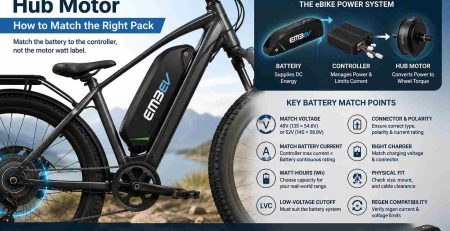
The voltage of the battery needs to match the design of the bike’s electrical system. The controller, motor, display and charger all need to work within the correct voltage range.
Battery voltage also changes during normal use.
It can be affected by:
- state of charge;
- motor load;
- battery temperature;
- cell condition;
- internal resistance;
- battery age.
A fully charged battery normally has a higher voltage than the same battery near empty.
Voltage can also fall temporarily when the motor demands high power. This is known as voltage sag.
What Are Ah and Wh?
Two other specifications often appear on eBike batteries: Ah and Wh.
Amp-Hours
Ah means amp-hours. It describes the battery’s charge capacity.
A 20Ah battery has more charge capacity than a 10Ah battery at the same voltage, assuming the specifications are measured in the same way.
Ah alone, however, does not give a complete picture of stored energy.
Watt-Hours
Wh means watt-hours. It provides a better estimate of total stored energy.
The basic relationship is:
Watt-hours ≈ Voltage × Amp-hours
For example, a battery described as 48V and 20Ah has about 960Wh when using the rounded 48V system rating.
Watt-hours are useful when comparing batteries with different voltages.
A battery with more Wh generally stores more energy. That does not mean it will always provide a specific number of miles, because riding conditions also affect energy use.
How Does the Battery Power the Motor?

The battery does not normally send uncontrolled power directly to the motor.
Instead, power flows through the motor controller.
- The rider pedals, changes the assist level or uses a throttle where fitted.
- The controller decides how much power the motor needs.
- The controller draws current from the battery.
- The BMS monitors the battery while current leaves the pack.
- The motor converts electrical energy into mechanical movement.
When the rider accelerates or climbs a steep hill, the motor usually needs more power. The controller then draws more current from the battery.
This is why battery performance depends on more than voltage and Ah alone.
What Does the BMS Do?
The Battery Management System is an important electronic part inside an eBike battery.
Its job is to monitor the battery and help keep it within safe operating limits.
Depending on the design, a BMS can monitor:
- cell-group voltage;
- overall battery voltage;
- charge current;
- discharge current;
- temperature;
- over-voltage conditions;
- under-voltage conditions;
- over-current conditions;
- short circuits.
Many BMS designs also help balance the series cell groups during charging.
If operating limits are exceeded, the BMS may stop charging or discharging.
For a more detailed explanation, read our guide to how an eBike battery BMS works.
Why Does Battery Voltage Drop Under Load?
You may notice the battery voltage fall when you accelerate hard or climb a steep hill.
After the load decreases, the voltage may rise again.
This is called voltage sag.
Every battery has some internal resistance. When current increases, more voltage is lost across that resistance.
A simple way to understand the relationship is:
Voltage drop increases as current and internal resistance increase.
Voltage sag can become more noticeable when:
- the motor draws high current;
- the battery is nearly empty;
- the battery is cold;
- the cells have aged;
- the pack has higher internal resistance.
This explains why a battery display may suddenly fall during a hard climb and then recover after you stop.
How Does Charging Work?
Charging moves electrical energy back into the battery.
A compatible charger supplies the correct charging voltage and current for the battery system.
During charging, the BMS continues to monitor the cell groups. Near full charge, some BMS designs also balance differences between groups.
The charger’s voltage must match the battery configuration. A 13S battery, for example, has a different full-charge voltage from a 14S battery.
Using the correct charger is therefore an important part of the battery system.
Why Can Two Similar Batteries Perform Differently?
Two batteries may show the same voltage and Ah rating but still perform differently.
The reason is that the numbers on the label only describe part of the battery.
Real performance also depends on:
- cell quality;
- cell model;
- cell consistency;
- parallel cell count;
- internal resistance;
- electrical connections;
- BMS design;
- wiring and connectors;
- pack construction.
For this reason, a battery should not be judged by voltage and capacity alone.
If you want to understand the differences between common cell formats and battery technologies, see our electric bicycle battery types guide.
How Does an eBike Battery Create Riding Range?
The battery stores energy in watt-hours. The bike uses that energy while you ride.
How quickly the energy is used depends on many factors.
- speed;
- motor assistance level;
- rider and cargo weight;
- hills;
- wind;
- tire pressure;
- temperature;
- riding style.
A larger Wh rating gives the bike more stored energy, but it cannot guarantee a fixed riding distance.
Two riders using the same battery can achieve very different range.
Frequently Asked Questions
Why does a 48V battery measure more than 48V when fully charged?
48V is the nominal voltage class. A common 13S lithium-ion battery can reach about 54.6V when fully charged.
What does 13S5P mean?
13S means 13 cell groups are connected in series. 5P means five cells are connected in parallel within each group.
Does more Ah mean more power?
Not necessarily. Ah mainly describes charge capacity. Current capability also depends on the cells, parallel count, BMS and pack construction.
Is Wh more useful than Ah?
Wh is usually more useful for comparing stored energy between batteries with different voltages because it includes both voltage and capacity.
Does the BMS control motor power?
The motor controller normally controls power sent to the motor. The BMS monitors the battery and may interrupt discharge if battery limits are exceeded.
Why does battery voltage recover after I stop riding?
Heavy current creates temporary voltage sag. When the current demand falls, the battery voltage can recover.
What Should You Learn Next?
Once you understand cells, voltage, Ah, Wh and the BMS, battery specifications become much easier to read.
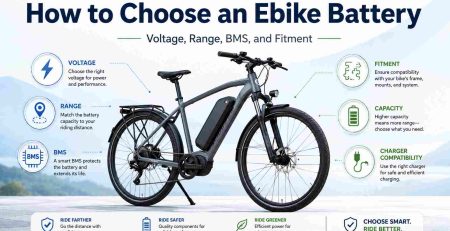
If your next goal is deciding which voltage, capacity and battery format fits your bike, continue with our guide to choosing the right eBike battery.
Final Takeaway
An eBike battery is not one large cell. It is a complete electrical system built from many smaller cells.
Cells connected in series create the required voltage. Cells connected in parallel increase capacity and help share current.
Watt-hours describe stored energy. The controller determines how much power the motor receives, while the BMS monitors the battery during charging and riding.
Once you understand these basic relationships, specifications such as 48V, 20Ah, 960Wh and 13S5P become much easier to understand.









LEAVE A COMMENT