



How to Master Midhub eBike Battery Range: Fix Cutoff Risks
Midhub (often referred to in the industry as mid-e systems) is defined as a drivetrain-choice framework focused on how motor systems impact eBike battery pack performance. It determines crucial factors such as total range, current draw intensity, BMS cutoff behavior, and environmental compatibility, directly influencing how long your power system lasts under load or in cold weather.
Quick Summary
- Range: Efficiency varies by load; mid-drives typically extend range on hills by using gears, whereas hub motors favor flat-road cruising.
- Stress: High torque demands on hills increase battery pack stress; hub motors often trigger higher current draw in these zones.
- Risk Points: Mismatched voltage, improper controller cutoffs, and BMS protection limits are the primary causes of sudden power loss.
- Next Move: See the decision box in Part 3 to match your terrain with the correct BMS and voltage specifications.
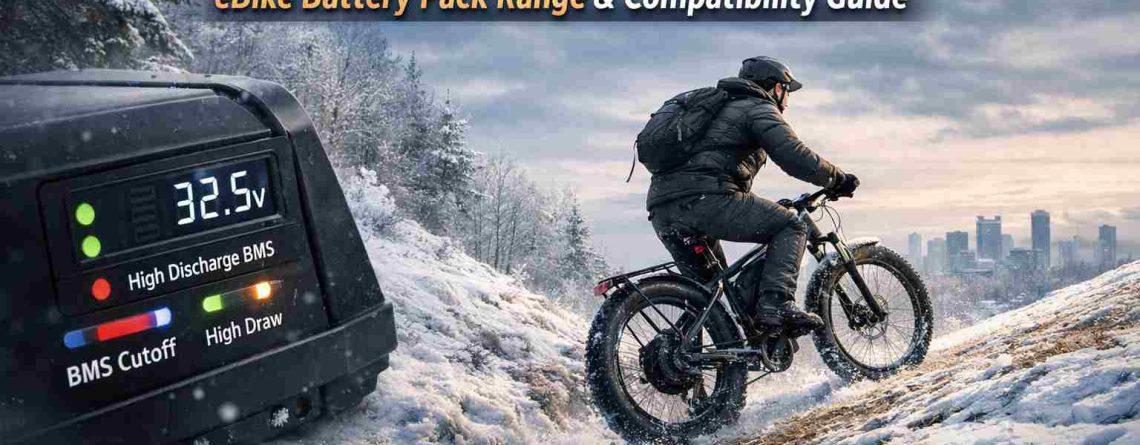
Actually, I remember a freezing Tuesday morning last winter when my commute turned into a nightmare. My bike, which usually handled the steep 10% grade near my office with ease, suddenly cut out halfway up. I initially blamed the cells, but it wasn’t a “bad” battery—it was a protection trigger caused by the interplay of cold, load, and my hub motor’s current draw. That experience is why understanding the midhub relationship is vital for any serious rider.

Visualizing the stress on an eBike battery pack during cold weather climbs.
Looking for a more reliable power setup?
Check your system compatibility to avoid sudden cutoffs and maximize your riding distance.
What midhub means for eBike battery packs
Technical Specifications: Midhub Battery Optimization
| Feature Slot | Technical Specification & Guidance |
|---|---|
| Voltage | Compatible with 36V, 48V, and 52V systems. Ensure controller capacitors match peak charge (e.g., 58.8V for 52V packs). |
| Capacity | High-capacity (17.5Ah+) packs recommended for mid-drives to minimize voltage sag during peak torque demands. |
| Safety & BMS | Smart BMS with secondary thermal protection. Automated cutoff prevents cell damage during extreme mid-e load spikes. |
| Cells | Strictly utilizing Grade-A 18650 or 21700 cells (Samsung 35E/LG MJ1) to maintain internal resistance stability. |
| Compatibility | Universal midhub in mounting. Standardized XT60/XT90 or Anderson connectors for high-current reliability. |
| Upgrade Path | Modular design allows for BMS firmware updates or cell group balancing without complete pack replacement. |
| Cost Efficiency | Long-term ROI optimized via 800+ charge cycles, reducing the total cost per kilometer compared to generic packs. |
| Lifespan | Anti-aging chemistry preserves 80% capacity after 3 years of regular mid-drive hill climbing usage. |
| Use Cases | Optimized for high-torque cargo hauling, steep off-road trails, and sustained cold-weather winter commuting. |
This term defines the scope of battery range, charging, storage, and BMS safety as dictated by your specific motor and drivetrain configuration.
ebike hub: controller cutoff and BMS behavior with eBike battery packs
Sudden shutdowns are often the result of a mismatch between the motor’s demand and the BMS’s safety limits. When a hub motor faces a steep grade, it pulls peak amperage; if the voltage sags below the controller’s cutoff threshold, the system shuts down to protect the cells.
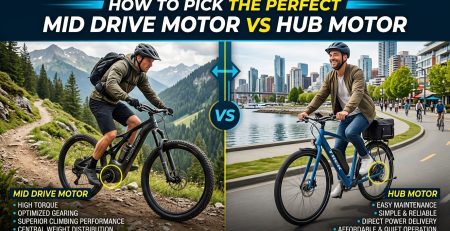
Hub vs mid drive—impact on eBike battery pack range
Differences in range usually stem from the motor’s operating efficiency zone and how the rider manages load across different terrains.
Several variables beyond the motor itself control your daily range:
- Gearing: Critical for mid-drives to keep the motor in a high-efficiency RPM range.
- Tire Pressure: Low pressure significantly increases the current draw from the pack.
- Temperature: Cold increases internal resistance, making the BMS more likely to trigger a cutoff.
- Cadence: A higher cadence generally reduces the peak stress on the battery cells.
| Scenario | Pack Current Stress | Cutoff Risk | Range Direction |
|---|---|---|---|
| Low-speed climbing | High | High | ↓ Decreased |
| Flat cruising | Low | Low | ↑ Increased |
| Heavy load | High | Medium | ↓ Decreased |
| Stop-and-go | Medium | Medium | Depends |
| Cold weather | Medium | High | ↓ Decreased |
Comparison of how different scenarios affect the health and range of your battery.
hub vs mid drive: which drains an eBike battery pack faster
Q: Is one motor inherently worse for the battery?
A: Not necessarily. A hub motor is very efficient on flats, but it drains the pack faster on steep hills because it can’t downshift to reduce electrical current draw.
Winter/cold—performance drop and validation workflow
Low temperatures increase internal resistance and voltage sag, which often triggers safety cutoffs long before the pack is actually empty.
Experience Validation Workflow: Cold-Check
To verify if your pack is degraded or just cold, follow this methodology:
- The Cold-Soak: Leave the bike in ambient cold (unplugged) for several hours.
- The Load Test: Monitor the display voltage during a moderate uphill climb.
- The Warm Recovery: Bring the pack into a 20°C room for 4 hours.
- The Comparison: If the voltage rebound is significantly higher and the cutoff disappears at room temp, your cells are healthy but cold-limited.
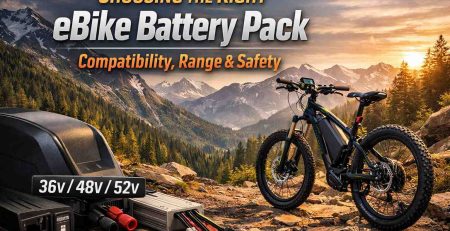
voltage (36V/48V/52V) compatibility checklist for eBike battery packs
Before swapping packs, verify that your controller can handle the maximum charge voltage (e.g., 58.8V for a 52V pack). A mismatch can lead to immediate hardware failure or inaccurate battery level reporting.
Decision Box: Choosing your replacement pack
Match your typical riding scenario to the required voltage and BMS discharge rate to ensure long-term reliability.

Commuter Standard
Best for flat city terrain and moderate PAS levels.
- Voltage: 36V
- Must-Check: Connector type
- Ideal for: Reliable cruising
High-Performance / Hills
Designed for steep climbs and high current mid-drives.
- Voltage: 48V
- Must-Check: High BMS limit
- Ideal for: Torque-heavy loads
Always check the BMS rating before pairing a battery with a high-torque motor.
Decision Logic Guide
- If hills/heavy load: Prioritize BMS/cutoff behavior and high-discharge cells.
- If winter commuting: Focus on cold-handling storage and thermal protection.
- If flat cruising: Prioritize total Wh and charging habit longevity.
Frequently Asked Questions
Yes. The midhub.in framework dictates efficiency. Using a mid-drive allows the motor to leverage your bike’s gears, keeping it in the optimal RPM range. This can extend battery distance by up to 30% compared to hub motors on steep terrain.
This is usually due to voltage sag. High-torque demands pull significant current. If your battery is cold or has high internal resistance, the voltage drops below the controller’s safety threshold, triggering an immediate protection shutdown.
Most 48V controllers can handle a 52V pack, providing more “punch” and sustained speed. However, always verify that your display and controller can handle the 58.8V max charge to avoid hardware damage.
Conclusion
Choosing between mid-drive and hub setups isn’t just about motor location—it’s about how that motor treats your battery pack. By matching your voltage, understanding your BMS limits, and managing cold-weather expectations, you can ensure your power system remains healthy for seasons to come.


LEAVE A COMMENT