




How to Choose the Right 750W eBike Battery
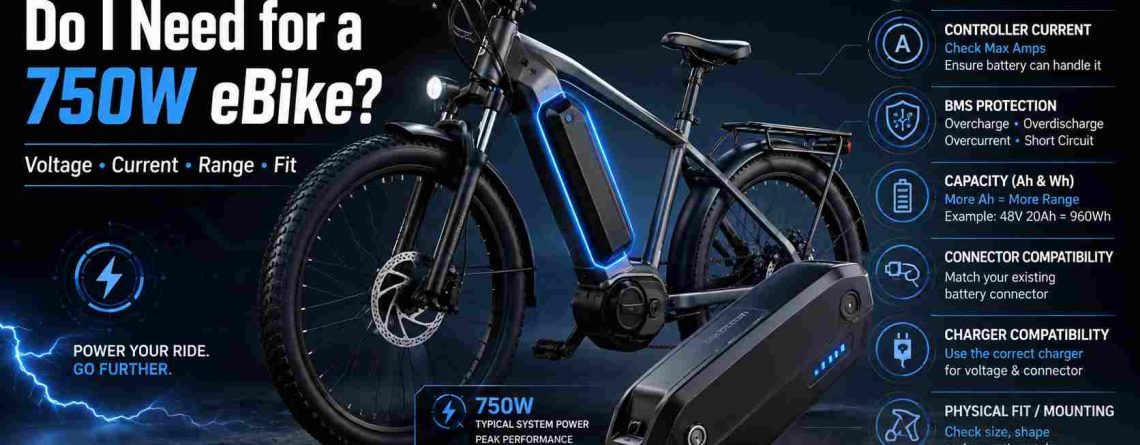
A battery for a 750W eBike must match the controller voltage, provide enough current, offer suitable range, and fit the bike correctly. The 750W label refers to motor power, not battery capacity, so it does not mean the bike requires a 750Wh pack.
Quick Answer
- Match the battery voltage to the controller, display, and charger.
- Check whether the cells and BMS can support the controller current.
- Choose Ah and Wh from your distance, terrain, load, and riding style.
- Confirm the case size, mount, connector, polarity, and cable position.
What Battery Does a 750W eBike Need?
A 750W motor does not have one fixed battery specification because the correct pack depends on the complete electrical system.
Many riders begin with the motor label, which is helpful but incomplete. Two bikes can both use a motor rated at 750W while having different controllers, voltage limits, current settings, connectors, and battery mounts. A pack that works well on one bike may not start the other bike or may trigger repeated protection cutoffs.
Start with the controller rather than the motor. Find the nominal voltage and current rating on the label, in the manual, or in the controller specifications. Then inspect the original battery and record its voltage, case style, connector, polarity, mount, and charger details.
Capacity comes after compatibility. More capacity may extend range, but it cannot correct the wrong voltage, an unsuitable BMS, or an incompatible connector.

Can any 48V battery run a 750W motor?
No. The 48V label only describes nominal voltage. The pack must also support the controller current, fit the bike, use the correct connector and polarity, and work with the correct charger.
Is 750W the same as 750Wh?
No. Watts describe power, while watt-hours describe stored energy. A 750W motor can work with batteries of different Wh ratings when the voltage, current capability, and other system details are compatible.
Why Motor Wattage Is Not Enough
The motor rating describes only one part of the system, while the controller determines how the battery is used during riding.
A controller can request more or less current depending on its design and settings. Acceleration, steep climbs, heavy cargo, and strong throttle use can also increase the load. Choosing a battery from motor wattage alone may therefore lead to weak performance or protective shutdowns.
Because controller settings vary, use the controller specification rather than marketing labels as the main reference.
Review the complete battery selection process
Learn how voltage, capacity, case format, and electrical connections affect eBike battery compatibility.How to Choose an eBike Battery
Match Battery Voltage to the Complete System
Choose the voltage supported by the controller, display, and charger; do not select 48V or 52V from the 750W motor label alone.
Many 750W eBikes use a 48V battery, while some systems are designed for 52V. These options are not automatically interchangeable because their fully charged voltage and operating range are different.
The controller must be designed for the chosen battery. The display, low-voltage protection, wiring, and charger must also match. If the controller only supports a 48V system, do not assume that a 52V pack is a safe or useful upgrade.
Check the controller label, original battery label, charger label, and bike or motor manual. When information is missing or inconsistent, pause before buying and ask the bike maker, controller maker, or battery supplier to confirm the supported voltage range.
Is 48V enough for a 750W eBike?
Yes, when the complete bike is designed as a 48V system and the battery can support the controller load. The motor rating by itself cannot confirm compatibility.
Can I use a 52V battery with a 750W motor?
Only when the controller, display, wiring, protection settings, and charger support 52V. The 750W motor label does not prove that the rest of the system can accept the higher voltage.
For a more detailed voltage comparison, read the 48V vs 52V eBike battery guide .
Check Controller Current and BMS Output
The battery cells, wiring, and BMS must support the controller current during ordinary riding and short periods of heavier demand.
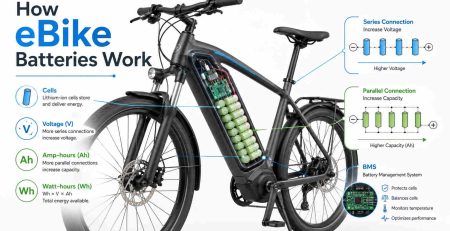
Voltage tells you whether the system operates in the correct electrical range. Current capability tells you whether the battery can deliver power when the controller requests it. Both factors matter, and neither should be judged from the motor label alone.
Current demand rises during hard starts, steep climbs, cargo use, and repeated throttle operation, especially when the pack is cold or partly discharged.
The BMS protects the pack from overcurrent, overcharge, deep discharge, and abnormal temperature. If its output limit is too low, the bike may cut out as the load increases. Weak cells, loose connectors, aging wiring, and high resistance can produce similar symptoms, so a cutoff does not always mean the BMS is faulty.
How many amps does a 750W eBike battery need?
Check the controller rating rather than calculating from the motor label alone. The battery and BMS should support the controller’s documented demand under the conditions in which the bike will be used.
Why does the battery cut out on hills?
Hills increase current demand. A cutoff may result from voltage sag, BMS protection, loose wiring, heat, connector resistance, or an aging battery, so the complete system should be inspected.
Choose Ah and Wh for the Range You Need
Ah and Wh affect stored energy and potential range, but they do not replace the need for correct voltage and adequate discharge capability.
After confirming voltage and current support, compare capacity. Ah is useful when batteries share the same nominal voltage, while Wh provides a clearer comparison when their voltages differ.
Range changes with assistance, throttle use, weight, hills, wind, speed, tire pressure, temperature, and battery condition, so estimates are not guarantees.
A larger pack can provide more riding time, but it also adds weight and may be harder to mount. Choose enough capacity for normal rides and a reasonable reserve.
What Ah battery should I use?
Choose Ah from your expected distance, terrain, assistance level, load, and available frame space. Confirm the correct voltage and current capability before comparing capacity.
Will a larger Ah battery make the bike faster?
Not by itself. More Ah mainly provides additional stored energy. Speed depends more on the controller, motor, system voltage, programming, wheel size, and riding conditions.
Check Physical Fit, Mounting, and Connections
A battery can be electrically suitable and still be unusable if its case, mount, connector, or cable layout does not match the bike.
Measure the frame space instead of relying on a product photo. Check the case dimensions, cable clearance, key access, and removal space.
The mount must hold the battery under vibration and normal riding loads. Do not depend on the connector or a loose strap to support the pack.
Two plugs may look identical while using different polarity. Confirm the wiring before connection, and use a charger designed for the battery voltage and chemistry.
750W eBike Battery Compatibility Checklist
Check every electrical and physical detail before ordering a replacement or upgrade battery.
- Read the controller label and record its voltage and current information.
- Inspect the original battery, including its case, mount, connector, and polarity.
- Confirm that the proposed battery and BMS support the controller demand.
- Choose capacity from distance, hills, load, throttle use, and temperature.
- Measure the installation area, cable clearance, and removal space.
- Confirm that the mount can secure the battery without movement.
- Verify the connector type, wiring, and polarity.
- Match the charger to the battery voltage and chemistry.
- Confirm that the display supports the chosen system voltage.
| System factor | What to check | Risk if mismatched |
|---|---|---|
| Voltage | Controller, display, and charger support | The system may not operate correctly |
| Current | Controller demand and battery output | Voltage sag, heat, or cutoffs |
| BMS | Continuous and short-load limits | Protection may activate under load |
| Capacity | Ah, Wh, and riding needs | Low range or unnecessary weight |
| Physical fit | Case, mount, and cable space | Unsafe or unstable installation |
| Connections | Plug, polarity, and charger | Electrical damage or incompatibility |
How to Verify Battery Compatibility
Use a repeatable inspection process instead of guessing from a motor label or product title.
First, photograph the controller, battery, and charger labels. Record the voltage, current, connector, case size, and mount. Compare them with the proposed pack, including its electrical limits, dimensions, cable position, and removal clearance. Confirm polarity before connection, and reuse the old charger only when its output is correct.
For the first ride, begin with a low assistance level and a short route. Stop if you notice unusual heat, repeated cutoffs, damaged wiring, unstable mounting, or a connector that becomes hot.
750W eBike Battery Decision Guide
Filter by system voltage first, then compare current support, range, physical fit, connections, and charger requirements.
Decision Box
- Choose 48V when the controller, display, and charger are designed for a 48V system.
- Choose 52V only when the complete electrical system clearly supports 52V.
- For steep hills or cargo use, pay extra attention to battery output, BMS limits, wiring quality, and voltage sag.
- For short commutes, a very large pack may add weight and cost without providing a useful daily benefit.
- When the controller label is missing, identify the controller or request technical confirmation before buying.

Battery Options for 750W eBike Systems
Product categories should be selected only after the bike’s voltage, current, physical fit, and connection requirements are confirmed.

EM3ev 48V Battery Options
Intended for systems confirmed to use 48V.
- Check controller current
- Check case dimensions and mount
- Verify connector and charger
EM3ev 52V Battery Options
Intended for systems confirmed to use 52V.
- Check controller voltage range
- Confirm display compatibility
- Use the correct 52V charger
Frequently Asked Questions
The correct answer depends on the complete eBike system rather than the 750W motor label by itself.
What battery do I need for a 750W eBike?
Choose a pack that matches the controller voltage, supports its current demand, provides enough Ah or Wh, fits the frame, and uses the correct connector, polarity, and charger.
Is a 48V battery enough for a 750W motor?
Yes, when the complete system is designed for 48V and the battery can support the controller load.
Can I use a 52V battery with a 750W eBike?
Only if the controller, display, wiring, low-voltage settings, and charger support 52V.
What BMS rating is suitable?
The BMS should support the controller’s documented current demand and the battery cell design. Check continuous and short-load limits rather than choosing from motor wattage alone.
How many amp-hours should the battery have?
Choose Ah based on distance, terrain, assistance level, load, temperature, and frame space. Compare Wh when evaluating batteries with different voltages.
Will a higher-Ah battery make the eBike faster?
Usually not. Higher Ah mainly increases stored energy and possible riding time, while speed depends more on the controller, motor, voltage, and programming.
Why does the battery cut out under load?
Possible causes include voltage sag, BMS protection, loose wiring, connector resistance, heat, or an aging pack. Inspect the complete system before replacing parts.
Final Compatibility Check
The right battery must work with the controller, display, wiring, mount, connector, and charger.
The correct battery for a 750W eBike is not defined by one number. Begin with the controller label and compare it with the original battery and charger. Then confirm current support, capacity, case size, mounting space, connector type, and polarity.
Following this order helps prevent a common mistake: buying a battery with attractive capacity and range, then discovering that it does not match the bike.
For more general guidance, read the electric bike battery guide .




LEAVE A COMMENT