





The Astonishing Secrets to a Powerful & Long-Lasting Bicycle Battery
By Joseph, E-Bike Technology Expert
Welcome to the definitive guide on electric bike batteries. Whether you’re a seasoned rider looking to upgrade or a newcomer, understanding your e-bike’s power source is key. The battery is the heart of your machine, defining its range, power, and your overall riding experience.
Key Takeaways
Performance: A battery’s voltage (V) determines power and acceleration, while its capacity (Ah) dictates range. Watt-hours (Wh) provide the most accurate measure of total energy.
Longevity: Proper charging (avoiding extremes of 0% and 100%), correct storage, and using the manufacturer-supplied charger will significantly extend your battery’s life.
Safety: Only use batteries and chargers designed for your specific e-bike model. Look for safety certifications like UL 2849 to prevent risks.
Investment: A high-quality power pack is the most critical component for a reliable and enjoyable e-bike experience.
🔋 What is an Electric Bicycle Battery?
An electric bike battery is a rechargeable power source that fuels the motor, providing the “assist” that makes e-bikes revolutionary. Think of it as the fuel tank; it stores electrical energy and converts it into the mechanical force that propels you forward. This reduces the effort needed to pedal, especially up hills or over long distances.
While early e-bike technology used heavy lead-acid batteries, modern advancements led to the dominance of lithium-ion technology. An electric bicycle lithium battery is prized for its high energy density, lighter weight, and longer lifespan, making e-bikes more efficient and accessible.
⚙️ Core Components and How They Work
To appreciate your e-bike, it helps to know what’s inside its powerhouse. An e-bike’s power pack is a system of components working in harmony.
Cells: These are the building blocks that store energy. Modern e-bikes almost exclusively use lithium-ion cells, connected in series and parallel to achieve the desired voltage and capacity.
Battery Management System (BMS): The battery’s brain. This crucial electronic circuit monitors and controls performance. It protects the cells from overcharging, overheating, and short circuits, ensuring safety and a long service life.
Casing and Connectors: The internal components are housed in a protective case, shielding them from moisture, impacts, and dust. High-quality connectors ensure a seamless and efficient transfer of power to the motor.To truly appreciate your e-bike, it helps to understand what’s inside its powerhouse. An e-bike battery isn’t a single unit but a carefully assembled pack of components working in harmony.

Understanding Battery Specifications
| Specification | What It Means | Impact on Your Ride |
|---|---|---|
| Voltage (V) | The “power” or “pressure” of the electricity. Common types are 36V and the more powerful 48V. | Higher voltage means more power, leading to faster acceleration and better hill-climbing. |
| Amp-Hours (Ah) | The battery’s capacity—how much charge it can hold. Think of it as the fuel tank’s size. | A higher Ah rating translates to a longer potential range. |
| Watt-Hours (Wh) | The total energy capacity, calculated by V x Ah. | Wh is the best metric for comparing the potential range of different e-bike batteries. |
Find the Perfect Power Source for Your Journey
Unsure which voltage or capacity is right for you? Explore our range of high-performance batteries and find the perfect match for your riding style and e-bike model.
🤔 Why Investing in a Quality Powerpack Matters
A high-quality battery is the single most important investment for your electric bike. It’s the difference between a reliable, exhilarating ride and a frustrating one. A premium unit delivers its promised power consistently, helping you tackle hills and headwinds.
Furthermore, quality manufacturing directly impacts your travel distance. A well-built power source with high-grade cells is essential for achieving a long-range goal, such as 80 km on a single charge. Superior units also feature advanced BMS technology, offering better protection and significantly extending the component’s overall lifespan.
⚡ Choosing the Right Specs: Voltage and Capacity Explained
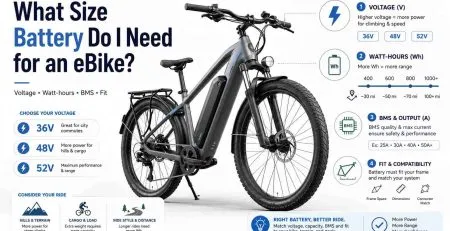
Selecting the right power pack means understanding voltage (V) and amp-hours (Ah). These figures directly determine your bike’s power and how far you can travel. Matching the battery’s performance to your riding needs is fundamental.
Voltage (V): The Power Behind Your Pedals
Voltage is the ‘force’ of the electrical current. The two most common standards you’ll encounter are 36V and 48V.
- 36V Systems: This is the workhorse of the e-bike world. It offers a fantastic balance of power, weight, and cost, making it ideal for daily commuters and casual riders on relatively flat terrain.
- 48V Systems: For riders demanding more performance, a 48-volt unit is the way to go. The increased voltage delivers quicker acceleration and superior hill-climbing, making it the choice for heavy-duty use, cargo bikes, or hilly areas.
Field Notes: Customer Insights
“I upgraded from a 36V to a 48V system for my daily commute over a steep overpass. The difference was night and day. The 48V unit helps me conquer the incline without losing speed. The e-bike just feels more responsive.” – Alex R., Urban Commuter.
Capacity (Ah) and Watt-Hours (Wh): The Fuel for Your Journey
If voltage is power, capacity (Amp-hours) is the fuel tank’s size. To get the full picture, look at Watt-hours (Wh), which represents the total energy capacity (V x Ah = Wh) and is the most accurate predictor of range.
For example, a battery designed for a range of up to 80 km will typically have a high Watt-hour rating (500Wh or more). While actual range depends on factors like rider weight, terrain, and assist level, a high-capacity power source is the essential starting point.

Matching battery capacity to your typical ride length is crucial for a great e-bike experience.
🔬 Types of Electric Bicycle Batteries: Lithium-Ion Dominance
The heart of a modern e-bike battery is its cell chemistry. Today’s market is dominated by lithium-ion due to its superior energy density, lower weight, and longer lifespan.
| Battery Type | Primary Advantage | Typical Lifespan (Cycles) | Best For |
|---|---|---|---|
| Lithium NMC (Nickel Manganese Cobalt) | High energy density (more range for less weight) | 800–1,000 | Most commercial e-bikes, where weight and range are priorities. |
| Lithium LiFePO4 (Lithium Iron Phosphate) | Exceptional lifespan and safety | 2,000+ | Heavy-duty use for applications where longevity is paramount. |
| Lead-Acid (SLA) | Very low cost | 200–300 | Obsolete for modern e-bikes due to extreme weight and short life. |
🔧 Upgrading Your Ride: E-Bike Conversion Kits
A great way to enter the world of e-bikes is with an electric motor kit that includes a battery. These packages provide the core components—motor, controller, and a matched battery—to convert a standard bike. When choosing a conversion kit, it’s crucial that the components are designed to work together. A 48V motor requires a 48V power source to function safely.

Commuter Pro 36V Conversion Kit
The ideal solution for converting your bike for daily commutes and city riding. This balanced kit offers reliable performance and easy installation.
- Voltage: 36V
- Capacity: 14Ah (490Wh) to 20Ah (706Wh)
- Motor Type: Mid-Drive Motor
- Use Case: Urban commuting, moderate terrain
- Pros: Lightweight, excellent balance, easy to install.
Trailblazer 48V Performance Kit
Unleash your bike’s full potential with this powerful 48V kit, designed for tackling hills and carrying heavier loads with ease.
- Voltage: 48V
- Capacity: 14Ah (655Wh) to 20Ah (917Wh)
- Motor Type: Mid-Drive Motor
- Use Case: Hill climbing, cargo, performance riding
- Pros: High torque, superior efficiency, powerful acceleration.
🛡️ Maximizing Lifespan & Safety: Proper Battery Care
Your e-bike battery is a significant investment. Proper care is key to maximizing its lifespan and ensuring safe operation. Its longevity is directly influenced by your charging habits, storage, and general maintenance.
Charging Best Practices for a Healthy Battery
- Use the Correct Charger: Always use the charger that came with your unit. A 36V charger is not compatible with a 48V system and vice-versa.
- Avoid Extreme States of Charge: Lithium-ion cells are happiest between 20% and 90% charge. Avoid leaving the battery at 100% or letting it sit at 0% for long periods.
- Charge in a Safe Environment: Charge in a dry, open space away from flammable materials. Let the battery cool to room temperature after a ride before plugging it in.
- Don’t Drain it Completely: The BMS prevents damaging discharge, but regularly running the battery until it cuts out adds stress. Recharge it before it’s empty when possible.
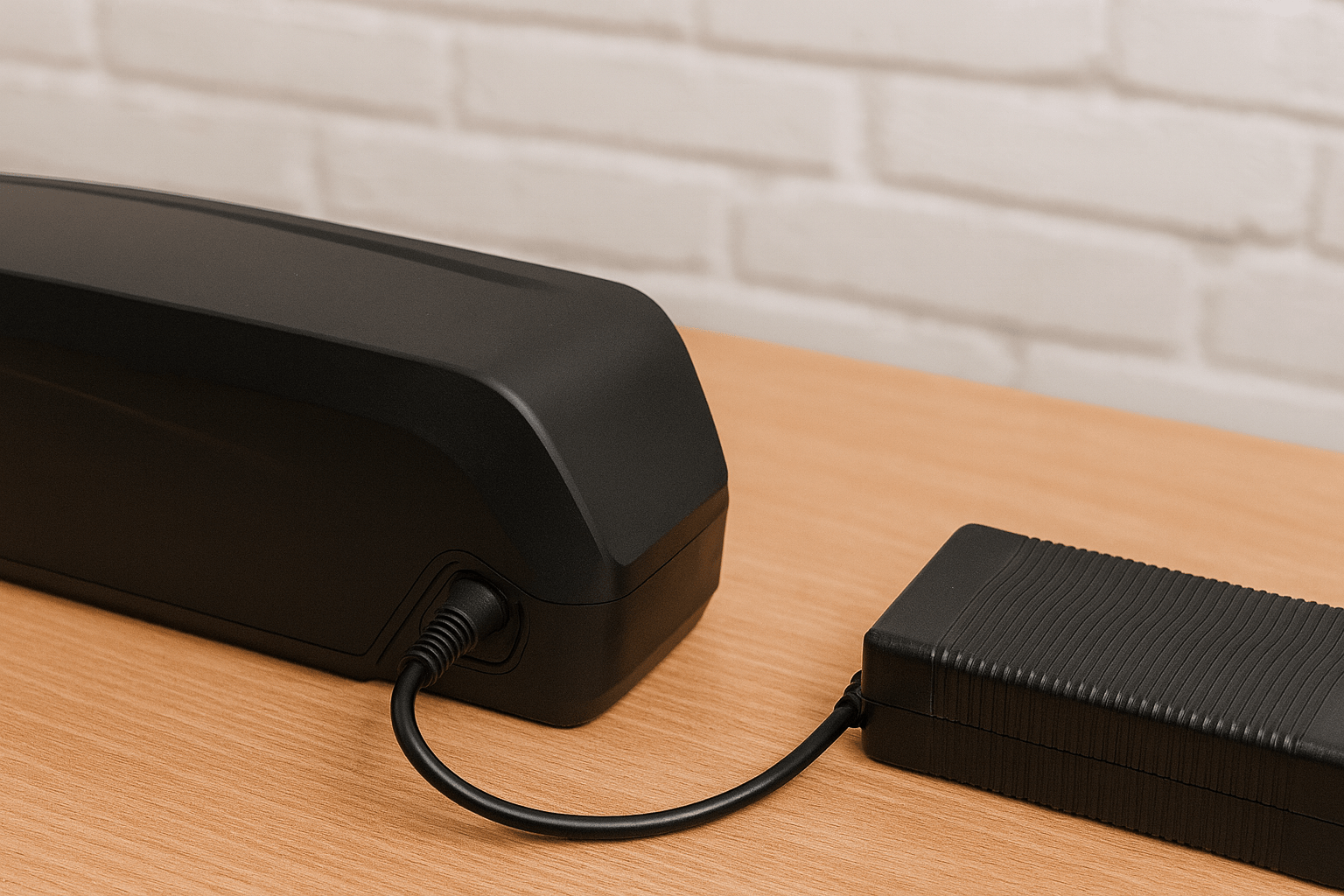
Always use the manufacturer-provided charger in a safe, temperature-controlled environment.
Storing Your Battery Correctly
If storing your e-bike for more than a few weeks, remove the battery and keep it indoors in a cool, dry place. The ideal storage charge is between 40-60%. Check the charge level every month or two and top it up as needed.
Safety First: Disclaimer and Official Guidance
Your safety is paramount. Always follow the instructions in your user manual. Never use a power pack that shows signs of damage, swelling, or leaking. We strongly recommend using batteries certified to safety standards like UL 2849, which covers the entire e-bike electrical system.
🩺 How We Test and Evaluate Batteries
To ensure our recommendations are reliable, we follow a strict testing methodology. Each 48-volt and 36V model we evaluate undergoes a controlled discharge test to verify its true Watt-hour capacity. We simulate various riding conditions to establish a baseline range and perform charge-cycle tests to assess long-term degradation.
Product Spotlight: 36V 13.6Ah Super Shark Battery Pack
Voltage: 36V
Capacity: 13.6Ah (490Wh)
Chemistry: LiNMC
Features: Bluetooth connectivity for app monitoring, advanced cell balancing, overcharge/discharge protection
Use Case: Urban commuting, seamless data integration
Product Spotlight: King Shark 48V 19.6Ah Battery Pack
Voltage: 48V
Capacity: 19.6Ah (918Wh)
Chemistry: LiNMC
Features: Quick-mount for portability, integrated basic BMS, excellent cycle life
Use Case: Extended range, riders prioritizing safety and durability
❓ Troubleshooting Common Bicycle Battery Issues
Even the best e-bike power source can have issues. A systematic check can help you identify the problem.
| Problem | Possible Causes | Recommended Solutions |
|---|---|---|
| Battery Not Charging | – Faulty charger or outlet. – Blown fuse. – BMS in sleep mode. | – Double-check all connections. – Test the outlet. – Let the battery rest for an hour before trying again. |
| Reduced Range | – Natural degradation. – Under-inflated tires. – Cold weather. – High pedal assist use. | – Ensure tires are at the correct PSI. – Keep the battery indoors in the cold. – Use lower assist levels. |
| Power Cuts Out While Riding | – Loose connection. – BMS protecting from over-current (steep hills). – Battery is nearly empty. | – Ensure the battery is locked in place. – Turn the system off and on to reset the BMS. – Charge the battery fully. |
🌍 Environmental Impact and Recycling
An electric bike’s lithium-ion battery is key to sustainable transport, but responsible recycling is crucial. Never dispose of one in household trash. Many local recycling centers, e-bike shops, and hazardous waste facilities have specific recycling programs.
Ready for an Upgrade or Replacement?
Explore our full range of high-performance bike batteries, conversion kits, and accessories. We provide detailed compatibility information to help you make the right choice for your e-bike.
🙋 Frequently Asked Questions (FAQ)
How far can an electric bike battery take me?
Range depends on the Watt-hour (Wh) rating and external factors. A high-capacity unit (500Wh+) is the foundation for a long range like an 80 km target. However, actual distance is influenced by assist level, terrain, rider weight, and wind. Most modern e-bikes offer a range of 40-120 km.
Can I use a 48V battery on a 36V e-bike system?
No. Never use a battery with a different voltage than what your motor and controller are designed for. It will permanently damage the components. Always match the voltage to your system’s requirements.
How long does an e-bike battery last before it needs replacement?
A quality lithium-ion unit is typically rated for 500 to 1,000 full charge cycles, translating to 3 to 5 years of use for a regular rider. After this, its maximum capacity will be noticeably diminished, meaning your range will be shorter.



LEAVE A COMMENT