





The Ultimate Guide: How Does an Electric Bike Work?
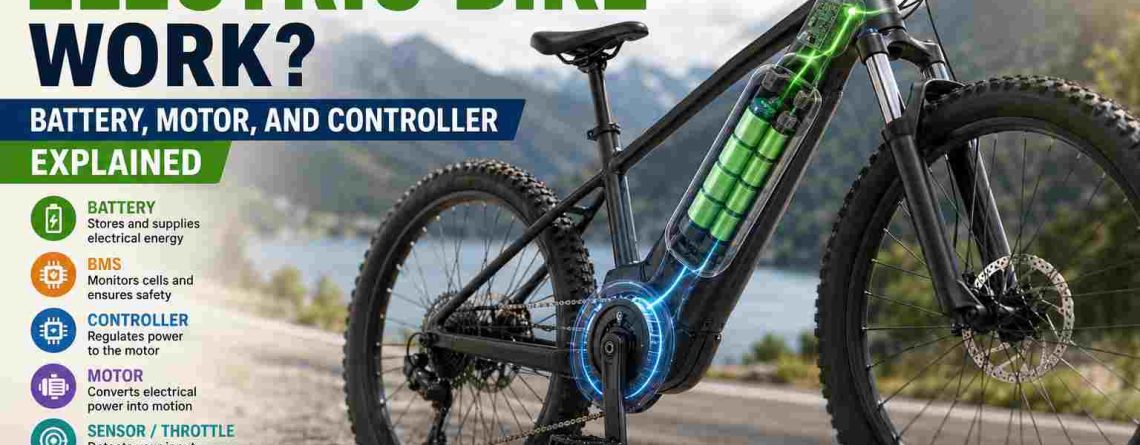
An electric bike uses energy stored in a lithium battery pack. The controller regulates this energy before sending it to the motor. The motor converts electrical energy into mechanical assistance. Knowing how does an electric bike work helps you ride better.
- The battery stores and supplies electrical energy.
- The BMS monitors the cells and limits unsafe current, voltage, and temperature conditions.
- The controller regulates how much battery power reaches the motor.
- The motor converts electrical power into assistance at the wheel or crank.
- Pedal-assist sensors or a throttle tell the controller when power is needed.
You press the pedals. The motor pushes you forward instantly. It feels like magic. But how does energy move from the battery pack to the motor so fast? A smart system makes it happen.

Understand Your eBike System
Learn how the parts talk to each other to fix simple issues fast.
How Does an Electric Bike Work Step by Step?
An electric bike works by moving stored energy from the battery through the controller to the motor when the rider pedals or activates the throttle.
Your bike reacts to your actions in milliseconds. Here is the exact path the power takes.
Step 1: The battery pack stores electrical energy
Lithium cells hold direct-current power. They wait for your command.
Step 2: The BMS monitors the battery cells
The Battery Management System checks heat and limits. It keeps the pack safe.
Step 3: Pedal-assist sensors or the throttle detect rider input
Sensors track your legs. Throttles track your hands. They send signals.
Step 4: The controller regulates voltage and current
The controller is the brain. It matches the power to your chosen speed.
Step 5: The motor converts electrical energy into mechanical assistance
The motor takes the power. It spins your wheel or cranks.
Step 6: The system reduces or stops assistance when input ends
Stop pedaling. Squeeze the brakes. The power cuts off safely.
Micro Q&A
Does an electric bike move without pedaling?
Yes. If your bike has a throttle, you can ride without pedaling.
Does the motor draw full battery power all the time?
No. The controller limits power based on your speed and assist level.
What stops the battery from delivering excessive current?
The BMS and the controller both block dangerous power spikes.
Energy Flow Through an Electric Bike
- The rider pedals or activates the throttle.
- A sensor sends an input signal.
- The controller requests power from the battery.
- The BMS permits or limits current delivery.
- The motor produces assistance.
- Power falls when the rider stops requesting assistance.
How the eBike Battery Pack Supplies Power
The battery pack supplies controlled direct-current power, while its BMS monitors cell voltage, current, and temperature conditions.
Your battery is not just a plastic block. It is a smart energy network.
Lithium-ion cells arranged in series and parallel groups
Small lithium cells are welded together inside. They form a powerful grid.
How series groups determine voltage
Connecting cells in a row adds voltage. High voltage means higher top speeds.
How parallel groups affect capacity and current capability
Connecting cells side-by-side adds capacity. This gives you a longer riding range.
The role of the BMS
What does an eBike battery BMS do? It balances cells and stops bad charges.
Battery connectors, discharge wiring, and protective components
Thick wires move the power safely. They stop the system from melting.
Nominal voltage compared with full-charge voltage
A fully charged pack has higher volts. The voltage drops as you ride.
Micro Q&A
What does an eBike battery BMS do?
It protects the cells from heat, overcharging, and deep drains.
Does a higher-capacity battery deliver more power?
It gives more range. Controller limits still cap the actual motor power.
Why does the battery need a compatible charger?
The wrong charger can ruin cells and bypass safety rules.
How the Battery, Controller, and Motor Work Together
The battery provides energy, the controller regulates its delivery, and the motor converts that controlled electrical power into movement.
Think of the battery as the heart. The controller is the brain. The motor is the muscle.
How an eBike battery connects to the controller
Thick wires link them. Strong plugs handle the high power safely.
How the controller responds to sensor input
It reads your speed. It sends smooth power to stop jerky starts.
Why controller voltage and current limits matter
Limits protect the parts. They stop the motor from taking too much power.
How motor type affects power demand
Mid-drive motors need more power to climb. Hub motors are better for flat roads.
Why battery, controller, motor, display, and charger compatibility must be checked together
They work as a team. Changing one part often means changing others.
| Component | Primary Function | Battery Relationship | Common Limitation |
|---|---|---|---|
| Battery cells | Store energy | Provide voltage and capacity | Voltage sag or reduced capacity |
| BMS | Monitor and protect cells | Controls allowable discharge | Current or temperature cutoff |
| Controller | Regulate motor power | Draws energy from the battery | Voltage and current limits |
| Motor | Produce mechanical assistance | Consumes controlled battery power | Power and thermal limits |
| Pedal sensor | Detect rider input | Triggers controller demand | Response and assist settings |
| Display | Show and control settings | Communicates with the electrical system | Compatibility limits |
Experience Verification Process
- Place the eBike securely and confirm that the battery is properly connected.
- Turn on the system and observe whether the display shows a normal battery level.
- Select a low assistance level before testing motor response.
- Confirm that pedal input or throttle input activates assistance smoothly.
- Observe whether power changes consistently across assistance levels.
- Note any voltage drop, delayed response, error code, or sudden cutoff.
Use the process only as a diagnostic method and do not invent test counts or performance figures.
How Pedal Assist and Throttle Control Battery Use
Pedal assist and throttle control when the system requests battery power, but the controller determines how much power is actually delivered.
How you ask for power changes your range. Pedaling and twisting the throttle act very differently.
Cadence sensors and torque sensors
Cadence acts like an on/off switch. Torque reads how hard you push.
How assist levels change controller demand
High levels pull more power. This gives speed but drains the pack fast.
How an eBike throttle uses battery power
A throttle skips the pedals. It asks the controller for instant power.
Why acceleration and climbing increase current demand
Moving a heavy bike up a hill is hard. The motor pulls a huge power spike to help.
Why pedal assist may use less energy than continuous high throttle
Pedaling shares the work. Full throttle forces the battery to do everything.
How controller programming changes the riding response
Brands tweak the software. This makes the start feel smooth or punchy.
Micro Q&A
Does pedal assist use less battery than a throttle?
Yes. Your legs help out, which saves electrical power.
Does a higher assist level drain the battery faster?
Yes. Higher levels pull more sustained power from the cells.
Can the throttle bypass the BMS?
No. All power goes through the BMS. It will block unsafe pulls.
What Battery Specifications Affect eBike Performance?
Voltage, capacity, watt-hours, current capability, BMS limits, temperature, and state of charge jointly affect how an eBike performs.
To really know how an eBike battery powers the motor, you must look at numbers. Specs dictate speed and range.
How eBike battery voltage affects performance
Voltage acts like pressure. More voltage pushes the motor to spin faster.
How eBike battery capacity affects range
Capacity is the fuel tank. Bigger Ah and Wh numbers mean longer rides.
How eBike battery current affects motor power
Current is the flow. High current makes the motor feel very strong on hills.
Voltage sag under acceleration and climbing
Pushing hard makes the voltage drop. The battery gauge might dip suddenly.
How eBike battery low-voltage cutoff works
The system watches the voltage. If it gets too low, it turns off to save the cells.
How eBike battery temperature affects performance
Cold weather slows the power down. Hot weather can cause safety shutdowns.
Battery age and internal resistance
Old batteries get tired. They sag more and give less total range.
Micro Q&A
Does higher battery voltage make an eBike faster?
Yes. If the controller matches, higher voltage raises the top speed.
Does a larger Ah rating increase motor power?
No. Ah adds range, but voltage and the controller limit true power.
Why can an eBike feel weaker at a low state of charge?
Low charge means low voltage. Less pressure equals less pushing force.
How to Check Battery Compatibility Before Replacement
A replacement battery must match the electrical system’s voltage, current demand, connector, physical dimensions, charger, and communication requirements.
Learning how to match an eBike battery to a motor and controller is vital. You cannot just buy any pack. If the specs do not match perfectly, your bike will fail or shut down.

Compatibility Decision Box
- Correct voltage but insufficient current rating: the pack may sag, limit power, or trigger BMS cutoff.
- Correct voltage and current but wrong connector: do not modify the connection without confirming polarity and compatibility.
- Higher voltage than the original pack: verify the controller, motor, display, charger, and other components first.
- Larger Ah or Wh rating: expect mainly more available energy, not an automatic increase in top speed.
- Battery cuts out during climbing: inspect voltage sag, BMS current limits, wiring, connectors, and controller demand.
- Battery does not activate the system: verify charge state, connector seating, switch position, fuse, and communication requirements.
Need a replacement? Ensure perfect electrical harmony. Check your specs and explore the EM3ev battery options for safe, reliable power upgrades.
Frequently Asked Questions
How does an eBike battery power the motor?
It provides stored direct-current electricity to the controller. When you pedal or use the throttle, the controller regulates this energy and sends it to the motor windings. This makes the magnetic force to move the bike.
What does an eBike battery BMS do?
The Battery Management System monitors the internal cells. It protects the pack by preventing unsafe overcharging, excessive current discharge, deep depletion, and dangerous heat. It ensures your battery stays safe.
Does an electric bike work without pedaling?
Yes, if the bicycle features a throttle. A throttle lets you command the controller to draw energy from the battery pack. It sends power directly to the motor without any physical pedaling.
What happens when an eBike battery is empty?
When the voltage drops too low, the system will trigger a low-voltage cutoff. The electrical assistance stops completely to protect the cells. You must pedal the bike using your own physical power.
Does higher battery voltage increase motor power?
Yes. Higher voltage increases the electrical pressure delivered to the motor. This allows the motor to spin faster. However, your controller and motor must be built to handle this extra voltage.
Does a larger Ah battery make an eBike faster?
No. A larger Ah rating increases your total capacity. It acts like a larger fuel tank, giving you a longer riding range. It does not directly change the top speed of your motor.
Why does an eBike battery cut out under load?
This happens when the motor demands more current than the BMS allows. Severe voltage sag can also hit the cutoff limit. The system shuts down quickly to stop internal cell damage.
How do I know whether a battery is compatible with my eBike?
A compatible battery must perfectly match your system’s voltage rating. It must supply enough continuous current for the controller. The physical size, mount, plugs, and charger must also fit exactly.
Conclusion
Knowing how the parts work together changes how you ride. Power flows from the battery, through the strict BMS, and into the controller. The controller measures your input and pushes that energy to the motor.
The battery is part of a delicate loop. If you ever upgrade, recommend checking voltage, BMS current capability, controller limits, connectors, charger compatibility, and physical fit before replacing a pack. For reliable components and expert guidance, checking out an EM3ev battery can keep your system running smoothly.


LEAVE A COMMENT