





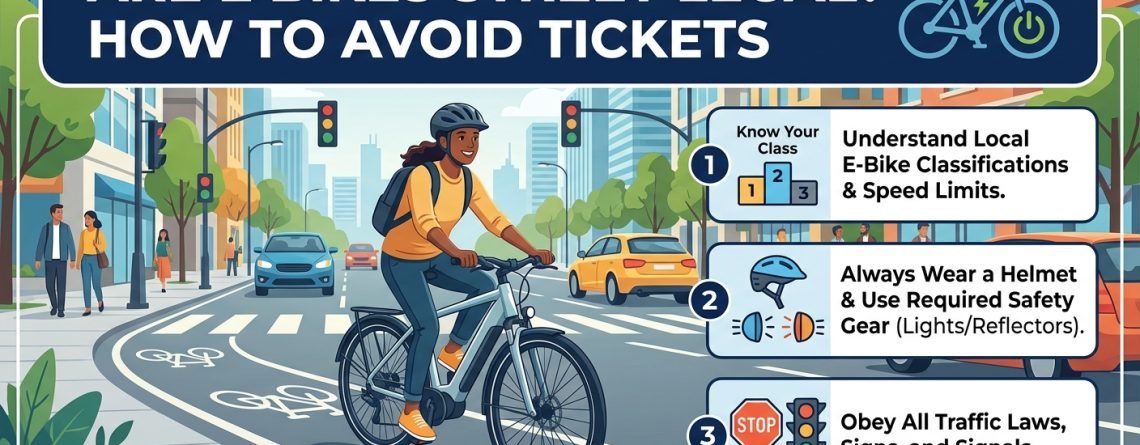
Are E Bikes Street Legal? How to Avoid Tickets
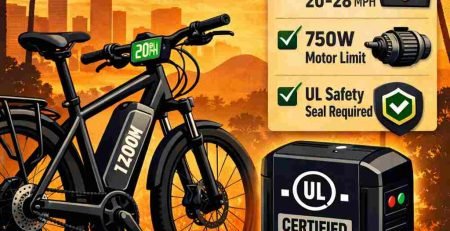
So are E Bikes Street Legal? Most standard e-bikes are street legal in the US if they meet federal guidelines: a maximum top speed of 20 mph on motor power alone and a 750W motor limit. However, local state laws, utilizing the 3-class system, dictate exactly where you can ride them, including bike lanes and public roads.
I still remember the day I unboxed my first electric bike. It was sleek, fast, and completely intimidating. Before I even took it for a spin around my neighborhood in North Carolina, a nagging question hit me: Are e bikes street legal? I genuinely had no idea if I could just ride it down the road, or if I was about to get pulled over by local law enforcement for operating an unregistered motor vehicle.
To be honest, the legal landscape surrounding electric bicycles is incredibly confusing. Between federal classifications, the EPAC standard in Europe, and a patchwork of local traffic codes, it’s easy for new riders to feel overwhelmed. But don’t worry—I’ve spent countless hours diving into DMV requirements, state bicycle laws, and local regulations so you don’t have to.

A visual breakdown of what makes an e-bike compliant with local traffic codes.
⚡ Quick Answer: Is Your Electric Bike Road Legal?
Yes, an electric bike is road legal if it has fully operable pedals, an electric motor under 750W (in the US), and a maximum assisted speed of 20 to 28 mph. If it exceeds these technical specs, it may be classified as a moped or motorcycle.
Actually, whether your specific bike is allowed on the road boils down to three main technical specs:
- Motor Power: In the United States, federal law caps street legal e-bikes at a 750W motor limit. In the UK and EU, the limit is a stricter 250W continuous power.
- Maximum Speed Limit: If the motor helps you reach a 20 mph speed limit (or a 28 mph top speed for certain classes), you’re usually in the clear. Over that, things get murky.
- Pedaling Mode: Does it have pedal assist, a throttle-only mode, or both? True e-bikes must have fully functional pedals.
What e bikes are street legal?
Street legal e bikes are those categorized as Class 1, Class 2, or Class 3 electric bicycles. These models do not require traditional motor vehicle registration because they are legally recognized as bicycles, provided they adhere to the speed and motor wattage restrictions outlined by local state authorities.
Want to double-check your bike’s specs?
Before hitting the road, always review your manufacturer’s manual to confirm your motor’s wattage and maximum speed settings.
🌱 The 3-Class E-Bike System Explained
The 3-class e-bike system categorizes electric bicycles into Class 1 (pedal-assist only up to 20 mph), Class 2 (throttle-assisted up to 20 mph), and Class 3 (speed pedal-assist up to 28 mph). This system determines where each bike is legally allowed to ride.
When I first started researching, I kept seeing terms like “speed pedelec” and “throttle-only mode.” It turns out, the US bicycle industry, alongside cycling advocacy organizations like PeopleForBikes, created a standardized 3-class framework that most states have now adopted. Understanding this is the key to knowing if your specific ride is a street legal e bike.
| E-Bike Class | Motor Assistance Mode | Top Assisted Speed | Where Are They Usually Legal? |
|---|---|---|---|
| Class 1 e-bike | Pedal assist only (no throttle) | 20 mph limit | Bike lanes, multi-use paths, public roads |
| Class 2 e-bike | Throttle-only mode & pedal assist | 20 mph limit | Bike lanes, public roads, some trails |
| Class 3 e-bike | Speed pedal-assist (speedometer required) | 28 mph top speed | Public roads, designated bike lanes (often banned on trails) |
Most manufacturers include a compliance sticker detailing the e-bike’s class and motor wattage.
📖 Do You Need a License, Registration, or Insurance for an E-Bike?
No, you do not need a driver’s license, motor vehicle registration, or insurance to ride a standard Class 1, 2, or 3 e-bike in most US states. Because they are legally classified as bicycles, they bypass traditional DMV requirements.
I’ll never forget calling my local DMV, bracing myself for a pile of paperwork, only to have the clerk laugh and say, “Honey, it’s just a bicycle.” In my case, she was absolutely right—but with a catch.
Do you need a license for an ebike?
For standard e-bikes under 750W, you do not need a license. However, if your electric bike exceeds the 750W motor limit or can travel faster than 28 mph, it transitions into the category of mopeds or motor vehicles. At that point, you will need a valid driver’s license.
Do ebikes need insurance and registration?
Generally, no. As long as your bike fits within the 3-class system, do ebikes need to be registered? The answer is no. Standard electric bicycles are exempt from state motor vehicle registration and mandatory liability insurance, though opting for specialized bicycle insurance is often a smart move to protect against theft.
Field Note: While researching “license for ebike” regulations, I discovered that age restrictions still apply! Many states require Class 3 riders to be at least 16 years old, and strict helmet laws apply to minors across the board. Always wear a helmet, regardless of the law.
🚀 Motor Power and Speed Limits Across US States
While federal law defines an e-bike as having a maximum 750W motor and a 20 mph speed limit, state regulations dictate exact riding rules. States like California, Florida, and Colorado have specific, localized laws regarding e-bike classifications and age limits.
You know, what’s completely legal in one state might get you a citation right across the border. Because local traffic codes vary so wildly, I mapped out some of the most frequently asked-about regions to figure out exactly what electric bicycles need to stay compliant.
- Are e bikes street legal in California? Yes, California fully embraces the 3-class system. Class 1 and 2 are allowed almost everywhere traditional bikes go, while Class 3 e-bikes are restricted from Class 1 multi-use paths unless specifically authorized. Helmets are mandatory for all Class 3 riders, regardless of age.
- Are e bikes street legal in Florida? Florida has some of the most relaxed e-bike laws. They recognize the 3-class system and grant e-bike riders all the same rights as traditional cyclists. There are no statewide age minimums, though local municipalities can impose sidewalk prohibitions.
- Are e bikes street legal in NY? Yes, but with distinct rules. New York legalized throttle e-bikes (Class 2) and pedal-assist e-bikes (Class 1) with a 20 mph cap. However, Class 3 e-bikes (up to 25 mph in NY specifically) are only allowed in cities with populations over 1 million, making the 28 mph top speed illegal in most of the state.
- Are e bikes street legal in NC? North Carolina defines an e-bike as a bicycle if its motor is under 750W and it maxes out at 20 mph. E bikes that are street legal here do not require DMV registration, but they are subject to standard state bicycle laws.
- Are e bikes street legal in Colorado? Absolutely. Colorado utilizes the 3-class system. Interestingly, local jurisdictions are given the power to allow Class 3 bikes on multi-use paths if they choose, making it a highly localized riding experience.
🛣️ Where Are You Allowed to Ride an E-Bike?
You can ride standard e-bikes on public roads, designated bike lanes, and most multi-use paths. However, high-speed Class 3 e-bikes are frequently banned from pedestrian-heavy trails, and many cities enforce strict sidewalk prohibitions for all electric bikes.
When I commute, I rely heavily on designated bike lanes. It’s the safest place to be. But the moment you transition to multi-use paths, you have to be hyper-aware of your speed. Pedaling a Class 1 e bike street legal ride on a trail is usually fine, but blasting past pedestrians at 28 mph on a Class 3 is a fast track to getting e-bikes banned in your town.
Always watch for local signage; cities can implement localized sidewalk and trail restrictions.
Need the right gear for street riding?
Street legality also means safety compliance. Make sure your e-bike is equipped with headlights, tail lights, reflectors, and a bell.
⚠️ Are Electric Dirt Bikes Street Legal?
Most electric dirt bikes are not street legal. They typically exceed the 750W continuous power limit, lack required safety features like headlights, turn signals, and mirrors, and are classified by the DMV as off-highway vehicles (OHVs).
This is a massive point of confusion, and frankly, I see why. A lot of riders buy powerful electric off-roaders like the Sur-Ron or Segway Dirt eBike and assume they can just ride them down to the grocery store. What e dirt bikes are street legal? Out of the box, almost none of them. To make them road legal, you have to undergo a complex process of adding DOT-approved lighting, registering them as mopeds or motorcycles, and obtaining proper insurance and license plates.
💡 Frequently Asked Questions (FAQ)
Do electric bicycles need license and registration globally?
While the US uses the 750W limit, the EU and UK operate on the EPAC standard, which enforces a strict 250W continuous power cap and a 25 km/h cut-off. Under these rules, standard e-bikes do not need a license. Anything faster is considered a “speed pedelec” and requires registration and insurance.
Which e bikes are street legal without a throttle?
Class 1 and Class 3 e-bikes operate purely on pedal-assist without a throttle. Because they require the rider to pedal to activate the motor, they are often granted wider access to public trails and multi-use paths compared to Class 2 throttle-assisted models.
Can I ride an e-bike if my driver’s license is suspended?
In most states, yes. Because standard Class 1, 2, and 3 e-bikes are legally defined as bicycles rather than motor vehicles, an ebike license is not required. However, you must double-check local traffic codes, as some strict municipalities may classify high-speed e-bikes differently.
What happens if I modify my e-bike to go faster?
If you hack your e-bike controller to bypass the 20 mph speed limit or 28 mph top speed, you void its bicycle classification. It officially becomes an unregistered motor vehicle, making it illegal to ride on public roads without proper DMV requirements.
Final Thoughts & Safety Reminder: Navigating electric bike road legal rules doesn’t have to be a headache. Just remember the golden rule: stick to the 3-class system, respect the 750W limit, and always prioritize pedestrians. Furthermore, please consult your official local Department of Transportation (DOT) and your bike’s user manual, as laws evolve rapidly.
References & Further Reading:
- PeopleForBikes – State E-Bike Law Resource
- Department of Transportation (DOT) Federal Bicycle Guidelines
- League of American Bicyclists Safety Portal
Disclaimer: This article shares expert experiences, general legal summaries, and was organized with AI assistance to ensure formatting and readability. It does not constitute formal legal advice. Always check your local jurisdiction’s specific traffic and bicycle codes.


LEAVE A COMMENT