






How to Safely Choose the Best Electric Bike Charger(Safe Guide)
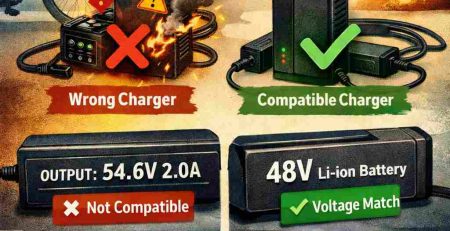
An ebike battery charger is more than just a power cord; it is a precision tool designed to refill your lithium cells safely. To protect your investment, you must match the specific voltage class and connector type of your electric bike charger to avoid permanent battery damage.
Key Safety Bullets:
- Voltage must match exactly (e.g., 48V charger for 48V battery).
- The plug shape and internal wiring (+/-) must be the same.
- Amps tell you the speed. 2A is slow, but 4A is much faster.
- Cold weather or a very empty battery can block the charging process.
Actually, I once bought a cheap charger online that looked perfect. The plug fit, so I thought it was fine. But after an hour, nothing happened. To be honest, I was lucky I didn’t ruin my expensive battery. In my case, the plug was right, but the internal wiring was reversed. It was a scary lesson about why “it fits” doesn’t always mean “it works.”

Always read the label on your electric bike charger before you plug it in.
Need Help Finding a Match?
Check our list to find the right charger for your eBike model.
How to match an electric bike charger to an eBike battery pack (voltage/amps/connector)
To pick the right charger, you must match the voltage, the plug type, and the wiring polarity.
Matching a charger is like choosing the right fuel for a car. If you use the wrong type, the motor won’t run. For eBikes, the “fuel” is the voltage and the wiring.
48V charger for eBike battery packs
Only use a 48V charger for a 48V battery. Using a different size is a high risk for your gear.
A 48V battery needs a specific amount of pressure to fill up. If you use a 36V charger, it won’t have enough power to push energy in.
36V charger for eBike battery packs
A 36V battery requires a 36V charger to reach a full charge safely and prevent errors.
eBike battery pack charger amps (2A vs 3A vs 4A)
Higher amps charge your battery faster, but they also create more heat during the process.
eBike battery pack charging safety checklist
- Check that the voltage numbers match exactly.
- Look at the plug shape carefully.
- Ensure the positive (+) and negative (-) sides match.
- Only use a charger made for lithium batteries.
- Charge in a room that is not too hot or too cold.
- Make sure the charger has space to stay cool.
| What to Check | Goal | Risk Level |
|---|---|---|
| Voltage | Exact Match | High Risk |
| Plug Shape | Perfect Fit | Low Risk |
| Polarity | Same Wiring (+/-) | High Risk |
| Amps | Safe Speed | Med Risk |
| Battery Type | Lithium Only | High Risk |
Matching the plug is the first step to choosing an electric bike charger.
How We Verify a Match
We use this simple flow to stay safe. You can do this at home too:
- Read: Look at the label on your battery first.
- Compare: Check the charger’s label. Do the numbers match?
- Test: Plug it in and watch the light. Does it stay red while charging?
- Feel: Touch the charger after 10 minutes. It should be warm, not hot.
- Stop: If you smell smoke or it feels too hot, unplug it right away.
Q: Can same-looking connectors have different polarity?
A: Yes. Many plugs look the same but have different wiring inside. Always check the symbol on the label.
The safest choice is to buy the same charger that came with your bike or conversion kit.
Universal charger for eBike battery packs (compatibility boundaries)
A “universal” charger works only if you check the settings and plugs yourself.
Actually, “universal” is a tricky word. It usually means it can work with different wall outlets (110V-240V). It does not mean it fits every bike battery automatically.
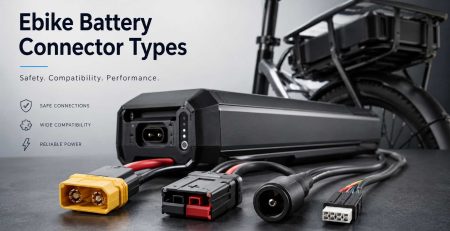
eBike battery pack charger compatibility (connector/polarity)
Even if a plug fits, the wiring inside might be different. Always check the diagram.
can you use a different charger on an eBike battery pack
You can use a different charger only if the voltage class and chemistry match perfectly.
The wiring (polarity) is the most important part of electric bike charger safety.

Standard 2A Charger
Best for: 36V / 48V Systems
Fast 4A Charger
Best for: 48V / 52V Systems
- 50% faster charging time
- Active cooling with built-in fan
- Compatible with EM3ev packs
How to charge an eBike battery pack (steps + safety)
Plug the charger into the battery first, then plug it into the wall.
This order helps prevent sparks. When you are done, unplug the wall first, then the battery.
eBike battery pack not charging troubleshooting (charger vs BMS cutoff)
If it won’t charge, your battery might be too cold or the BMS might be locked.
Q: My charger light stays green but the battery is empty. Why?
A: This often means the charger cannot “see” the battery. Check for a blown fuse or a loose wire in the charge port.
What to Do If Your Ebike Charger Is Not Working?
If your ebike charger not working properly, follow these three diagnostic steps before replacing the unit:
- Check the LED Light: A steady green light on an empty battery usually indicates a blown fuse in the charge port or a disconnected BMS wire.
- Verify Temperature: Most lithium batteries have a low-temperature cutoff; warm the pack to room temperature for 3 hours.
- Inspect Connectors: Ensure the DC or XLR pins are not bent and that the polarity matches the battery label diagram.
Common Questions
No. Using a 48v ebike charger on a 36V pack will cause the cells to overheat and may lead to a fire.
Heat is a normal byproduct of voltage conversion. Just ensure your electric bike charger has adequate airflow.
As long as the BMS is designed for it, a 4A fast charger is safe. It is recommended for packs with 15Ah capacity or higher.
The LED indicator will turn from Red (Charging) to Green (Full). The charger will then stop sending power automatically.
Final Recap: To stay safe, always match the voltage and the plug. Speed is great, but safety is better. When in doubt, always ask a professional or check your manufacturer’s guide.
Check that the voltage, plug shape, and wiring polarity (+/-) all match your battery’s original specifications.
Quick Review: EM3ev Fast 4A Charger (48V / 52V)
Rating: 4.8/5(Editorial score — based on compatibility, safety features, and charging speed)
Pros
- Cuts charging time significantly (fast 4A option).
- Built-in fan helps cooling during charging.
- Designed to work reliably with EM3ev batteries.
Cons
- Not a “universal” choice — compatibility is mainly for EM3ev batteries.
- Fast charging can generate more heat; ensure ventilation and correct voltage/plug match.
Summary
If you want a fast, safer match for an EM3ev 48V/52V setup, this 4A charger is a solid pick. For other brands/batteries, focus on exact voltage + plug + polarity matching before buying.



LEAVE A COMMENT