





The Ultimate 48v ebike battery charger for Proven Safety
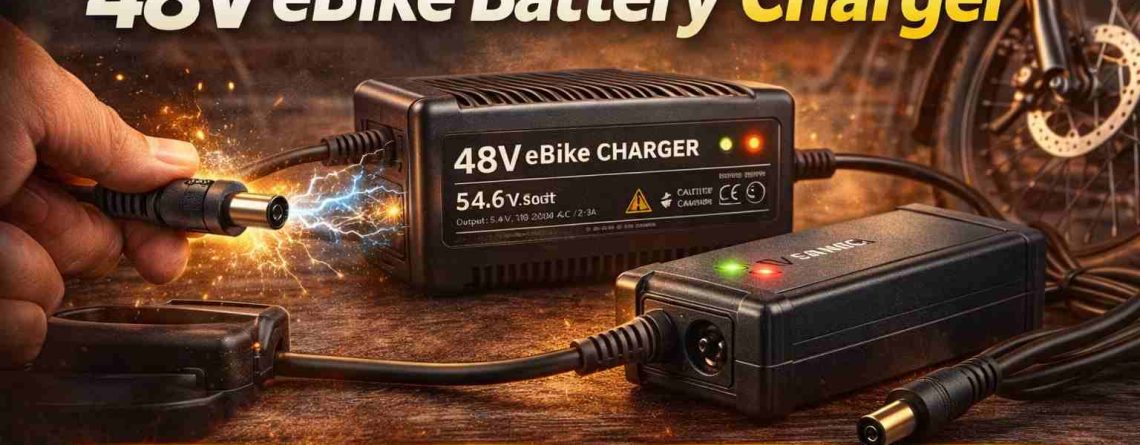
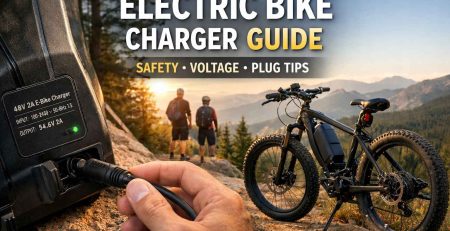
A 48v ebike battery charger is a tool that puts power back into your bike’s battery safely. It works by converting wall power into a specific 54.6V charge. It uses a special plug to connect to your battery and talks to the battery’s brain (BMS) to stop charging when the pack is full.
What a 48v ebike battery charger is
A 48v ebike battery charger must have the right plug and a 54.6V output to work safely with your battery.
I still remember the day my old charger died. It was a rainy Tuesday, and I had a long ride home ahead of me. I plugged it in, but the little light stayed dark. I felt stuck. I almost bought a random plug I found online, but then I learned a big lesson. Lithium batteries are very picky. If you don’t use the right 48v ebike battery charger, your bike simply won’t move.
To be honest, many people think any “48V” plug will do the job. But it’s not that simple. Your bike needs a specific “language” between the charger and the battery cells. If they don’t match, the battery won’t accept the power. It’s like trying to fit a square peg in a round hole.

Quick Answer Box
- The Voltage: Look for “54.6V” on the back of the charger. This is the “full” voltage for 48V packs.
- The Plug: Make sure the connector fits. The DC 5.5mm is very common.
- The Speed: A 2A charger is safe and slow. A 5A charger is fast but can get hot.
- The Light: Red means it is working. Green means it is full or not connected.
- Longevity: Using a slower charger usually helps your battery last for more years.
Need to find your match?
Don’t guess which plug you need. We can help you pick the right one.
How to choose the right electric bike charger 48v
To pick the right ebike battery charger 48v, you need to check your battery’s plug, voltage, and how much power it can handle.
Actually, choosing the best 48v ebike battery charger is mostly about reading labels and verifying safety protocols. You must use a dedicated 48v lithium ion battery charger for ebike systems, as generic power supplies lack the crucial BMS communication needed to balance cells. I always tell my friends to look at their old charger first. If you don’t have it, look at the battery itself. Most 48V packs need a charger that clearly states “Output: 54.6V.” If it says anything else, it might not charge your bike safely to 100%.
Compatibility Checklist
- Charger for 48v ebike battery: Check if your port requires a standard round 1-pin DC plug, or if you need a dedicated 48v ebike charger 3 pin connector (like an XLR or Anderson plug) for safe power delivery.
- 48 volt ebike charger: Make sure the wall plug fits your home outlets (110V or 220V).
- 48 volt electric bike charger: Look for a “Smart” label. This means it turns off by itself.
- Safety first: Only buy chargers that have “Short Circuit Protection.”
When evaluating a 48v 2a vs 5a ebike charger, the primary tradeoff is between longevity and speed. A 2A model keeps cells cool and extends battery lifespan, while a 5A model is built for rapid turnaround times. Use the reference table below to match your riding style:
| Use Case | Charger Output | Main Benefit | Tradeoff |
|---|---|---|---|
| Daily Commute | 2A Charger | Battery stays cool | Takes a long time |
| Quick Top-up | 5A Charger | Very fast charging | Heavier to carry |
| Spare Charger | 3A Charger | Good balance | Needs a fan |
Experience-Based Validation Flow
I have a simple way to test if a charger is right for you. I do this every time I get a new bike:
- Look at your battery’s sticker. Find the “Nominal Voltage” (it should be 48V).
- Find the “Max Charge Current.” Do not buy a charger that is higher than this number.
- Check the plug shape. Use a ruler to see if it is a 5.5mm DC plug.
- Plug the charger into the wall first. The light should turn green.
- Plug it into the bike. The light should turn red. If it stays green, the connection is bad.
How long to charge a 48v ebike battery pack
The time it takes depends on how big your battery is and how much power your charger can push out.
In my case, I use a 2A charger. It’s not the fastest, but it’s very quiet. If you have a 48v ebike battery charger for 14Ah battery packs, it usually takes about 7 hours. But if you have a 48v ebike battery charger for 20Ah battery packs, you might be waiting for 10 hours or more.
To be honest, how long to charge a 48v 20Ah ebike battery pack can also change if it’s cold outside. Lithium batteries don’t like the cold. If your garage is freezing, the battery might charge very slowly. I always bring my battery inside the house for an hour before I plug it in.
Field Note:One thing I noticed is that the last 10% of charging takes the longest. This is because the battery is “balancing” itself. Don’t worry if the light stays red for a long time at the end.
What to do when a 48v ebike battery pack is not charging
If your 48v ebike battery pack won’t charge, check your wall power, the plug, and the battery’s temperature first.
It’s a scary feeling when you see a 48v ebike battery pack not charging. But don’t throw it away yet! Most of the time, it’s just a small problem. Sometimes the pins in the plug get dirty. Or maybe your battery is too cold. A 48v ebike battery pack won’t charge if it’s below freezing because the battery’s brain is trying to keep it safe.
| The Problem | The Most Likely Cause | The First Check |
|---|---|---|
| Light stays Green | Loose connection | Clean the plug pins |
| Charger is very hot | High power use | Move to a cool spot |
| No lights at all | Blown fuse | Try a different outlet |
| Light blinks Red | Internal error | Unplug for 10 mins |
Which 48v ebike battery charger setup fits your use case
Choose your charger based on how far you ride every day and if you need to charge your bike at work.
If you only ride a few miles, a small and quiet charger is best. But if you are a delivery driver, you probably need something much faster. It all comes down to your own needs. Just remember to always put safety and battery health before speed.

Standard 2A Smart Charger
The reliable choice for overnight charging and maximizing cell life.
- Power: 2 Amps / 54.6V
- Plug: DC 5.5mm (Standard)
- Best for: Daily commuting
Rapid 5A Fast Charger
High-speed recovery for riders with 20Ah+ packs or limited downtime.
- Power: 5 Amps / 54.6V
- Plug: 3-Pin XLR / Anderson
- Best for: Quick top-ups
Pro Tip: How to Add a Charger
When viewing an EM3ev battery page (like the Super Shark 1304), simply scroll to the “Charger Options” section and check the box for the 54.6V Charger to include it in your order.
Final Pre-purchase Check
Before you click buy, double-check these three things. It will save you a lot of time and money!
- Does the charger output 54.6V?
- Does the plug look exactly like your battery port?
- Is the charger “Smart” so it won’t overcharge?
FAQ
Can I use any 48V charger for an eBike battery pack?
No, you must use a lithium-specific charger because a generic 48V charger might have the wrong voltage (it needs exactly 54.6V for a 48V pack) and could damage your cells or cause a fire hazard.
What connector should a 48V eBike charger use?
It depends entirely on your bike brand and battery case. The most common ones are the DC 5.5mm barrel plug, the 3-pin XLR plug, or the GX16 aviation connector.
Is a higher-output charger always better?
A higher-output charger (like 5A) is faster, but it also creates more internal heat. Charging at high speeds continuously can make your battery wear out sooner over time compared to a standard 2A or 3A charger.
How long does a 48V eBike battery pack take to charge?
Most packs take between 5 and 10 hours from empty. A 14Ah battery paired with a 2A charger will take roughly 7 hours to reach 100% capacity.
Why does the charger turn green before the pack seems full?
This usually means the plug is not pushed in all the way, the connector pins are dirty, or the battery’s internal BMS (Battery Management System) has stopped the charge due to an imbalance or temperature issue.
Why won’t my 48V eBike battery pack charge in cold weather?
Lithium batteries have a built-in safety feature that stops them from accepting a charge when the core temperature drops near freezing. This prevents irreversible lithium plating and internal damage. Always warm the battery indoors before charging.
Can the wrong charger shorten battery life?
Yes. If a charger puts in too much voltage (e.g., using a 52V charger on a 48V pack) or pushes too many amps causing excessive heat, it will degrade the cell chemistry rapidly and make the battery hold less power.
When should I replace the charger instead of the battery pack?
If your ebike works perfectly fine while riding, but the battery won’t accept a charge, and the charger’s indicator light stays dark or blinks erratically when plugged into the wall, it is highly likely the charger has failed and needs replacement.
Conclusion
Finding the right 48v ebike battery charger doesn’t have to be hard. Start with the plug, check the voltage, and think about how fast you need to charge. By choosing the right match, you’ll keep your bike running and your battery healthy for years to come. Ride safe!



LEAVE A COMMENT