




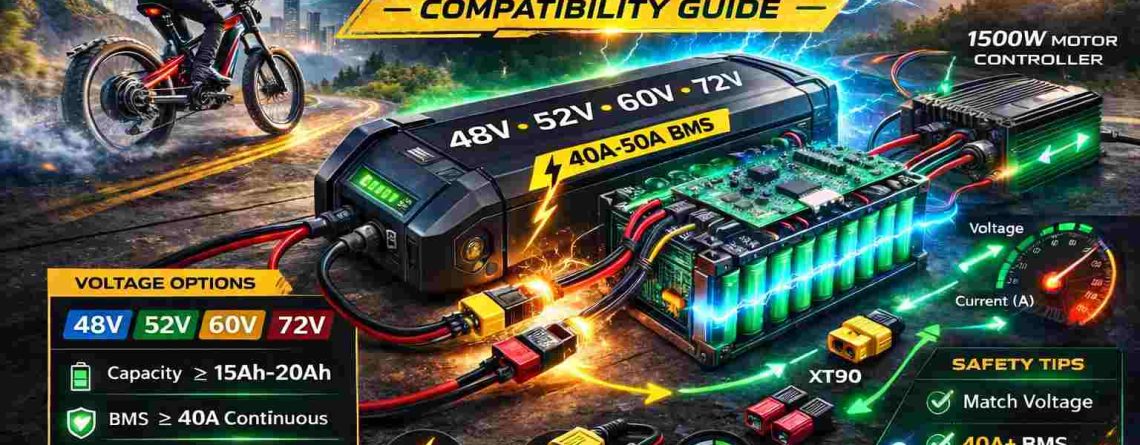
The Ultimate Secret to 1500w Ebike Battery Performance
1500W Ebike Rapid Compatibility Matrix
Before diving into technical details, use this quick-match table to ensure your battery specs meet the minimum safety requirements for 1500W motor controllers.
| Motor Type | Min. Voltage | BMS Discharge | Optimal Cell Type |
|---|---|---|---|
| 1500W Hub Motor | 48V / 52V | 45A Continuous | High-Discharge (21700) |
| 1500W Mid-Drive | 52V / 72V | 40A Continuous | Balance Power/Range |
| Heavy Fat Tire | 60V / 72V | 50A+ Continuous | Ultra High-Discharge |
*Note: Using a BMS rated below 40A on a 1500W system will lead to thermal shutdowns during hill climbs.
A 1500w ebike represents a high-performance electric bicycle class that requires a specialized battery pack capable of delivering sustained high current (35A-50A). To ensure safety and performance, the battery’s nominal voltage, continuous discharge rating (BMS), and connector type must precisely match the motor controller’s specifications to prevent thermal shutdowns or voltage sag.
Quick Compatibility Matrix:
- Voltage: 48V, 52V, 60V, or 72V (Must match controller)
- Capacity: Minimum 15Ah-20Ah recommended for 1500W draw
- BMS: Minimum 40A continuous discharge for reliable hill climbing
Ordering and Shipping High-Capacity Batteries
Due to the high energy density of 1500W-capable packs (often exceeding 1000Wh), shipping regulations are strict. Whether you are in the UK, Europe, or the United States, lithium batteries are classified as Class 9 Dangerous Goods.
- Processing Time: High-quality packs are often built to order or load-tested before dispatch. Please allow 1-3 business days for assembly and testing before the tracking number activates.
- Custom Builds: If you have a unique frame shape or need a specific discharge connector (like QS8 or XT150) not listed on our site, please contact our technical support team directly. We can often customize the BMS and cable length to suit your specific 1500w electric bike build.
Why the Right Battery Matters for a 1500W Build
pairing a 1500W motor with an undersized battery is the most common cause of premature system failure, reduced motor lifespan, and unexpected power cutoffs during high-torque acceleration.
Actually, I remember the first time I converted an old mountain bike frame using a 1500W hub motor kit. I was so excited about the “1500 Watts” sticker that I didn’t pay much attention to the used 48V pack I had sitting in my garage. To be honest, it was a disaster. Every time I hit a slight incline or tried to keep up with traffic, the display would flicker, the voltage would “sag” nearly 10 volts, and the whole system would just go dark.
It wasn’t a problem with the motor. It was a classic case of the battery “starving” the controller. At 1500W, you aren’t just riding a bike; you’re managing a small power plant. If your battery pack’s internal resistance is too high or the BMS (Battery Management System) is too weak, those 1500 watts are just a theoretical number on a box. In my case, I had to learn the hard way that high-power riding requires a high-power energy source that speaks the same electrical language as your controller.

In this guide, we aren’t going to talk about vague “marketing miles” or theoretical peak speeds. Instead, we’re going to look at the actual methodology of matching a battery to a high-power motor. Whether you are building a 72V speed demon or a 52V commuter powerhouse, the logic remains the same: you need to balance voltage, amperage, and thermal capacity.
Matching the Battery to the Bike Type
When building a high-performance machine, the battery must match the physical demands of the chassis. A typical 1500w electric bike is rarely a standard road bicycle. Most 1500W builds are heavy-duty conversions involving wide tires (fat tire ebikes) or full suspension mountain bike frames designed to handle off-road terrain and high speeds.
Wide tires increase rolling resistance, and a full suspension frame adds weight. Both factors significantly increase amp draw. If you are running a 1500W motor on a fat bike through sand or snow, your motor isn’t just pulling 1500 watts momentarily; it might sustain high peak loads for minutes. A weak battery will experience severe voltage sag under these conditions, even if it claims to be “48V compatible.” This is why choosing a high-discharge pack is non-negotiable for these heavy-duty setups.
Avoid the “Voltage Sag” Trap
Don’t let an inferior battery limit your motor’s potential. Check our compatibility checklist below.
Choosing the right battery pack voltage & capability
To run a 1500W motor reliably, you must match the battery’s nominal voltage to your controller and verify that the BMS continuous discharge rating meets or exceeds the controller’s maximum amperage to avoid sudden power cutoffs.
Voltage tiers explained (48V/52V/60V/72V) for high-power draw
Actually, choosing the voltage for a 1500W system is about more than just top speed. To be honest, it’s about heat management. When you run 1500W on a 48V pack, your system has to pull significantly more amps to reach that power level compared to a 72V system. More amps means more heat in your wires, connectors, and controller.
48V vs. 52V: Impact on 1500W Performance
| Battery Voltage | Typical Full Charge | Voltage Sag (at 40A) | System Efficiency |
|---|---|---|---|
| 48V Pack | 54.6V | High (~6V drop) | Moderate (Runs Hot) |
| 52V Pack | 58.8V | Medium (~4V drop) | High (Better Torque) |
| 72V Pack | 84.0V | Low (<2V drop) | Maximum (Optimal) |
The “Engine” Inside: 18650 vs. 21700 Cells for 1500W Builds
Voltage is only half the story. The raw performance of a 1500w electric bike depends heavily on the specific lithium-ion cells inside the pack. Not all 48V or 52V batteries are created equal. For high-power applications, the internal resistance of the cell is the limiting factor.
Why “Generic” Cells Fail at 1500W:
Standard laptop-grade cells (often found in cheap packs) have low discharge rates. When you twist the throttle on a 1500W motor, these cells heat up instantly. This heat causes “voltage sag,” where a fully charged 52V battery might suddenly drop to 44V under load, triggering the controller’s Low Voltage Cutoff (LVC). This is why your bike cuts out on hills.
The High-Discharge Solution:
We exclusively recommend high-discharge cells for motors over 1000W. The introduction of 21700 cells (like the Samsung 40T or 50S) has revolutionized the market. These cells are larger, run cooler, and can handle the massive 35A-50A continuous draw required by a 1500W controller without sweating.
| Cell Type | Max Continuous Discharge | Suitability for 1500W Motor |
|---|---|---|
| Generic 18650 (2500mAh) | 5A – 8A | Unsafe / Not Recommended |
| Samsung 35E (3500mAh) | 8A – 10A | Good for Range, Weak for Power |
| Samsung 40T (21700) | 35A – 45A | Perfect for 1500W+ Racing |
| Samsung 50S (21700) | 25A – 35A | Excellent Balance of Power & Range |
Comparison of cell chemistry capability for high-power applications.
BMS + controller low-voltage cutoff (LVC) and “unexpected shutdowns”
In my experience, 90% of the “my bike just died” emails I see come down to a mismatch between the BMS (Battery Management System) and the controller. The BMS is a safety circuit board inside your battery. If your 1500W controller asks for 45A of current, but your BMS is only rated for 30A, the BMS will “trip” like a circuit breaker in your house to protect the cells. Similarly, if your battery voltage drops too low under load (LVC), the controller will shut down to prevent permanent cell damage.
Compatibility checklist before you buy/replace
- Nominal Voltage: Does it exactly match your controller’s input range?
- BMS Continuous Rating: Is it at least 20% higher than your controller’s max current?
- Physical Connector: Do you have the right high-current plugs (e.g., XT90 or Anderson)?
- Charger Output: Is the charger voltage specifically for your pack chemistry (Li-ion vs. LiFePO4)?
| Battery Spec | Impact on 1500W Performance | Technical Importance |
|---|---|---|
| Voltage (V) | Dictates top speed and overall system efficiency. | High (Must match controller) |
| BMS Continuous | Prevents the bike from cutting out during hill climbs. | Critical Safety Element |
| Watt-Hours (Wh) | The total energy capacity; determines riding range. | Medium to High |
| Voltage Floor | Higher floors (52V vs 48V) reduce power loss as battery drains. | Efficiency Focus |
| Connector Type | Determines if the wires will melt under 40A+ loads. | Safety Essential |
Optimizing for 1500W Hub Motors
Hub motors, particularly direct-drive models, place unique stresses on a 1500W electric bike battery. Unlike mid-drives that benefit from bike gears, hub motors pull massive current during low-speed starts. To prevent your battery cells from overheating, we recommend a configuration with parallel groups capable of handling 50A bursts. If you are building a custom high-performance vehicle, please contact us for professional B2B battery solutions tailored to high-torque hub systems.
Range Estimation: Can You Really Go 100 Miles?
One of the most common questions we get is: “How big of a battery do I need to go 100 miles on a 1500W ebike?” The honest answer depends entirely on your riding style and the assist mode you select.
Amp-hours vs. Watt-hours: For a 1500W system, Watt-hours (Wh) is the only metric that matters. To calculate Wh, multiply Voltage by Amp-hours (e.g., 52V x 20Ah = 1040Wh).
- Throttle Only (High Speed): Riding at 30+ mph on a 1500w electric bike consumes roughly 35-45 Wh per mile. A 1000Wh battery might only last 25 miles.
- Pedal Assist (PAS): Using a low pedal assist level significantly reduces motor strain. By contributing human power in a low assist mode, consumption can drop to 15-20 Wh per mile.
To realistically achieve a 100 miles range on a high-power setup, you would typically need a dual-battery setup exceeding 2000Wh total capacity, or you must ride strictly in Eco mode. Do not rely on manufacturer charts that test primarily on flat ground with a lightweight rider; real-world 1500W performance requires massive energy reserves.
Experience verification process (Methodology)
We don’t believe in “manufacturers’ peak ratings.” Instead, we use a verification process to ensure a pack is truly 1500W-ready:
- BMS Stress Check: We compare the internal BMS mosfet ratings against the controller’s peak amperage.
- Voltage Sag Observation: On a test loop with a 10% grade, we observe how many volts the pack drops under full throttle. If it sags more than 4-5V, the internal resistance is too high for 1500W.
- Thermal Validation: After 15 minutes of high-power draw, we check the temperature of the main discharge connectors and the battery casing.
- Charger Sync: We verify the charger’s final cut-off voltage matches the battery’s full-charge spec (e.g., 54.6V for a 48V Li-ion pack).
Can a 48v ebike battery pack run a 1500w motor?
Direct Answer: Yes, but only if the BMS is rated for at least 35A-45A of continuous discharge. A standard “commuter” 48V battery will likely trip its safety circuit under 1500W loads.
52v vs 72v battery pack for a 1500w ebike motor?
Direct Answer: 52V is a better “drop-in” upgrade for 48V systems, while 72V offers significantly higher speed and efficiency but requires a 72V-compatible controller.
Range Reality: How to Actually Get 100 Miles
One of the most persistent myths in the industry is the “100-mile ebike.” While it is mathematically possible, it requires a specific set of conditions and riding behaviors, especially when you are hauling the heavy weight of a high-power motor.
The Impact of Tires and Suspension
Physical drag is the enemy of range. A 1500w electric bike setup is often paired with a heavy-duty chassis. If you are riding a bike with wide tires (such as 4-inch fat tires) and a heavy full suspension frame, your baseline energy consumption is already 30% higher than a standard road bike.
The Physics: Wide tires at low pressure create a massive contact patch. While this is great for traction in sand or mud, it acts like an anchor on pavement. To offset this drag, you need a battery with higher Watt-Hours (Wh).
Throttle vs. Pedal Assist (PAS)
How you ride determines if your battery lasts 20 miles or 100 miles.
- Throttle Only: If you rely solely on the throttle to maintain 30mph+, a 1500W motor will drain a 1000Wh battery in less than an hour (approx. 25-30 miles).
- Using Pedal Assist: By utilizing the lower levels of pedal assist (PAS 1 or 2), you share the load with the motor. In a low assist mode, the motor might only peak at 200W-300W, drastically extending your range.
To realistically achieve a 100 miles range on a heavy full suspension 1500W bike, you would need approximately 2000Wh of battery capacity (e.g., a massive 72V 28Ah pack or dual batteries) and must ride conservatively in a low assist mode.
Safety, storage, and cold-weather performance
Safe operation of high-power battery packs requires a combination of temperature-controlled storage, regular BMS health monitoring, and using high-quality connectors capable of handling high-amperage current without melting.
Actually, I’ve learned that the biggest risks with 1500W systems aren’t during the ride, but during charging and storage. To be honest, a pack that has been stressed by a high-power motor all day needs to be treated with respect. I once made the mistake of bringing a cold-soaked battery into a warm room and plugging it straight into a high-amp charger. The condensation caused a micro-short that could have ended much worse than it did. Now, I always follow a strict cooling and acclimation period.
Battery safety checklist for high-power ebike battery packs
When you are dealing with the current levels of a 1500W motor, “good enough” is a dangerous mindset. Here is the safety methodology I use for every high-power build:
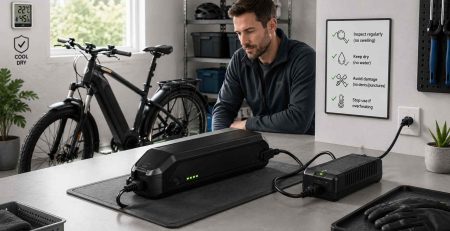
- Connector Integrity: Regularly inspect your XT90 or Anderson plugs for “pitting” or black carbon buildup. If they look burnt, replace them immediately.
- BMS Thermal Check: After a long hill climb, check if the battery case feels unusually hot in one specific spot. This could indicate a failing cell or a stressed BMS.
- Physical Mounting: 1500W motors create significant vibration. Ensure your battery is not just held by Velcro but is mechanically secured to the frame.
- Fuse Protection: Always have a physical fuse or a high-quality circuit breaker between the battery and the controller, even if your BMS has built-in protection.
Battery storage and lifespan basics for high-power ebike battery packs
To be honest, the way you store your battery in the off-season determines whether you’ll get two years or five years out of it. Actually, high-discharge cells (the kind used in 1500W packs) are more sensitive to being left at full charge. I recommend storing your pack at roughly 50-60% capacity (about 3.6V to 3.7V per cell). If you leave it at 100% in a hot garage, the internal chemistry degrades much faster, and you’ll notice your “1500W punch” starts to feel more like 750W within a few months.
Winter/cold weather performance of a 1500w ebike battery pack
Actually, winter is the ultimate test of a battery’s internal resistance. In freezing temperatures, the chemical reactions inside the pack slow down. This means your 1500W motor might only be getting 1000W of actual power because so much energy is being lost to heat inside the cold cells. To combat this, I’ve found that using a thermal neoprene sleeve helps, but the best “hack” is simply starting your ride with a battery that was stored at room temperature. Once the discharge begins, the internal resistance will generate just enough heat to keep the pack in its optimal operating range.
Field Note: The “Smell” Test
If you ever smell a sweet, metallic odor near your battery after a hard 1500W pull, stop immediately. This is often the first sign of an electrolyte leak or a venting cell. Safety should always override the desire to finish the ride.
Shipping, Warranty, and Support for High-Voltage Batteries
Purchasing a high-capacity lithium battery is not like buying a book online. These are classified as Class 9 Dangerous Goods, which requires specialized handling, packaging, and shipping carriers.
Shipping to the United States and Europe
For customers in the United States, Canada, and the EU, we utilize specialized dangerous goods freight channels. Unlike standard airmail, these packages must often travel via ground or sea freight for safety compliance.
- Processing Time: Every high-power pack is load-tested before dispatch. Please allow 1-3 business days for final assembly, balancing, and testing.
- Transit Time: Once tracking is generated, delivery to the United States typically takes 10-15 business days depending on customs clearance.
Custom Builds and Technical Support
Every 1500W build is unique. You might have a custom triangle frame, a specific controller connector (like XT90-S anti-spark), or distinct dimension requirements. We do not recommend “guessing” if a battery will fit.
If you are unsure about fitment or BMS compatibility, please contact our technical support team. Send us a photo of your bike frame and your controller’s spec sheet. We aim to respond to all technical inquiries within one business day to ensure you get the correct power source for your project.
Recommended 1500W Battery Configurations
Based on our verification methodology, these specific packs from EM3ev are optimized for high-current 1500W demands without triggering premature BMS cutoffs.

52V 20Ah High-Power Pack
The ideal balance for 48V controller upgrades seeking more “punch” and sustained top speed.
- BMS: 50A Continuous / 80A Peak
- Cells: High-discharge Grade A
- Best For: Daily high-speed commuting
72V 15Ah Performance Pack
For custom 1500W+ builds requiring maximum efficiency and speeds over 40mph.
- BMS: 60A Continuous
- Cells: Extreme discharge density
- Best For: Off-road & Racing
Decision Tip: If you are reusing a 48V controller, go with the 52V pack. If you are building from scratch for max power, the 72V system is the professional choice.
Build a Safer System
High power demands high standards. Ensure your build is protected with the right safety gear.
Expert Q&A: Master Your 1500W Build
Technically, 1500W / 48V = 31.25A. While 40A seems sufficient, real-world peak loads during hill climbing can exceed 45A. We recommend a 50A continuous BMS to ensure reliability and longevity.
Yes, but you must use high-discharge Grade-A cells from Samsung or LG. Generic 18650s will fail under 1500W loads due to high internal resistance. For modern builds, 21700 cells are the superior choice for thermal management.
Absolutely. As a specialist in custom lithium solutions for marine and off-road applications, we design packs with specific dimensions, connectors (XT90/QS8), and Smart BMS configurations. Our engineers provide response within one business day for technical inquiries.
Need help matching a battery to your controller?
Don’t guess with high voltage. If you are unsure about your connector type or BMS requirements, please contact us with a photo of your controller’s label. Our engineers will reply within one business day.
Summary Checklist for a 1500W Build:
- Match Voltage to Controller (48V, 52V, 60V, or 72V).
- Ensure BMS Continuous Discharge ≥ Controller Max Amps.
- Use XT90 or Anderson Powerpole connectors.
- Estimate range at ~30Wh/mile for safe planning.
Final Thoughts: Building or upgrading a 1500w ebike is an exhilarating experience, but the battery is truly the heart of the machine. By focusing on electrical synergy rather than just “max speed,” you ensure a ride that is not only fast but safe and durable. Respect the current, watch your connections, and always verify your specs before you ride.
For a 1500W ebike, the battery decision comes down to three things: (1) matching your controller voltage (48/52/60/72V), (2) choosing a BMS rated for 40A+ continuous discharge, and (3) sizing enough Wh capacity to reduce voltage sag and power cutoffs under load.
- Explains the real failure points on 1500W builds: voltage matching, BMS continuous current, voltage sag, and safe connectors.
- Gives a practical baseline spec (48–72V / 15–20Ah / 40A+ BMS) that’s easy to apply.
- Includes ordering/fitment considerations (wiring, connectors, BMS options) to help you avoid mismatch.
- More of a compatibility/selection guide than a single model review; it doesn’t compare specific SKUs side-by-side.
- Real-world range still depends on terrain and riding style; a quick “Wh-by-scenario” example would make decisions faster.
A strong, practical guide for choosing a battery for a 1500W ebike setup. If you match controller voltage first, then prioritize a 40A+ continuous BMS and adequate Wh capacity, you’ll avoid the most common issues like hill-climb cutoffs and heavy voltage sag.


LEAVE A COMMENT