



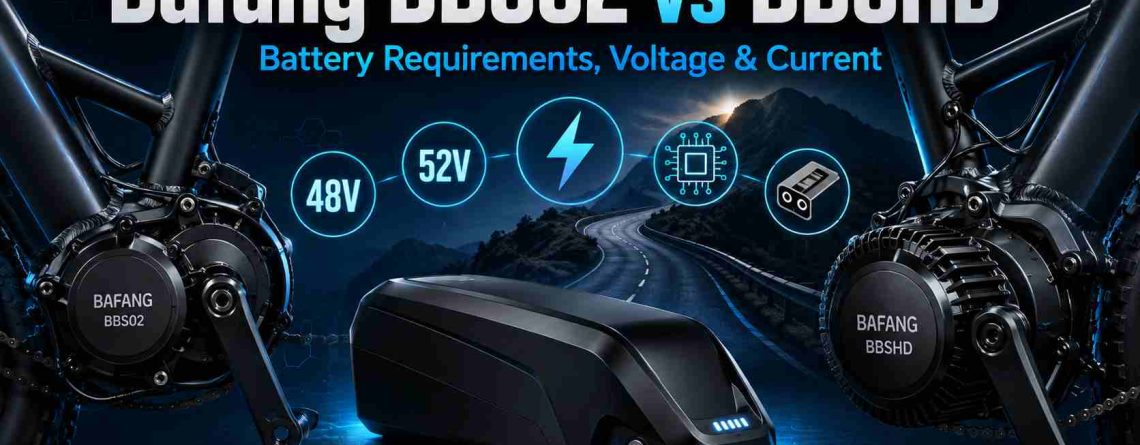
Proven Way to Find a Bafang BBS02 vs BBSHD Battery
The Bafang BBS02 vs BBSHD battery choice is not only about 48V or 52V. The pack must also match the controller, current demand, BMS, connector, charger, and available frame space. A battery may power the display but still fail when the motor is under load.
Quick Answer
- Check the controller voltage before choosing a battery.
- Match the battery’s continuous current to the controller demand.
- Make sure the BMS is not the weak point in the system.
- Check the plug, polarity, cable size, charger, and frame fit.
Imagine the first ride after finishing a new mid-drive build. The display turns on, the battery level looks normal, and the bike feels smooth on a flat road.
Then the road becomes steep. You add more assistance, the controller asks for more current, and the whole system suddenly cuts out.
Many riders blame the motor first. Yet the battery may be the real cause. A pack can have enough voltage to start the bike but not enough current for a hard climb.

Start With the Battery, Not Just the Motor Name
The correct battery depends on the complete electrical system, not only the BBS02 or BBSHD model name.
Motor names provide useful guidance, but they do not describe the whole bike. Controller settings, battery voltage, terrain, gearing, wheel size, rider weight, and riding style can all change battery demand.
One rider may use low assistance on city roads. Another may carry cargo up long hills. Although both bikes use a mid-drive motor, they may need very different battery packs.
A light commuter may care most about range, weight, and easy mounting. A cargo bike may need stronger current output, less voltage sag, and more robust wiring.
Field note: A battery may work during a wheel-off-the-ground test but shut down on a real hill. An unloaded test confirms basic operation, but it does not reproduce sustained riding demand.
Can capacity alone show whether a battery is suitable?
No. Ah shows how much charge the pack can store. It does not show how much current the battery can safely deliver. Two packs with the same Ah rating may perform very differently under load.
Does a matching plug mean the battery is compatible?
No. The plug is only one part of the check. You must also confirm voltage, polarity, current output, BMS limits, cable size, charger type, and frame fit.
Check the Complete Battery Specification
Compare voltage, energy, discharge ability, case size, and connector options before choosing a pack for your mid-drive build.Compare eBike Battery Options
Bafang BBS02 vs BBSHD Battery Requirements
Both systems need the correct voltage, enough continuous current, a suitable BMS, safe wiring, and a secure battery mount.
The basic matching process is similar for both motors. First, find the voltage range that the controller accepts. Then compare the controller’s current demand with the battery’s continuous output.
A higher-load build gives the battery less room for error. Hard starts, steep hills, cargo, and soft ground all increase demand. If the battery voltage drops too far, the bike may lose power or shut down.
Mid-Drive eBike Battery Requirement Comparison
| Comparison factor | Moderate-demand setup | Higher-demand setup |
|---|---|---|
| Voltage match | Required | Required |
| Continuous current | Medium | High |
| Peak-load stress | Medium | High |
| BMS demand | Medium | High |
| Voltage-sag risk | Medium | High |
What should you check first?
Check the controller’s voltage range first. Do not rely only on the motor label. A battery can have the right plug but still have the wrong voltage.
Why does continuous current matter?
Peak current may last for only a short time. A long climb can keep the battery under load for much longer. Continuous current is therefore more useful when judging normal riding needs.
Can a weak battery make a healthy motor feel slow?
Yes. A weak pack, poor connector, or restrictive BMS can limit the power that reaches the controller. The motor may feel weak even when it is working correctly.
48V vs 52V Battery for a Mid-Drive eBike

Choose 48V or 52V only after confirming the controller’s full voltage range and the required charger.
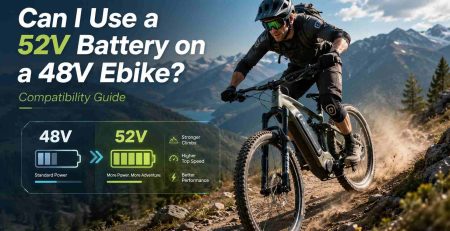
Many riders see 52V as a simple upgrade. That is not always true. Due to standard lithium-ion discharge characteristics, you must check the battery’s highest charged voltage (often 58.8V for a 52V pack), not just the nominal voltage printed on the case.
The display must also support the selected voltage. The charger and low-voltage cutoff must match as well. Otherwise, the battery gauge may be inaccurate or the system may shut down at the wrong time.
Consider a rider replacing an old pack that has lost range. Moving from 48V to 52V may appear useful. However, a stronger 48V pack may be the safer choice if the controller was designed for 48V.
Is a 52V battery always better than a 48V battery?
No. It is useful only when the complete system supports it and the rider needs its benefits. Battery quality, output, weight, range, and frame fit still matter.
Will a 52V battery work with every 48V mid-drive bike?
No. Some controllers support both voltages, while others do not. Check the controller, display, charger, and cutoff settings before connecting a 52V pack.
Does higher voltage remove the need for strong current output?
No. Voltage and current must work together. A higher-voltage pack may still perform poorly if the cells, BMS, wiring, or connector cannot support the load.
How to Match Battery Current and BMS Capacity
The cells, pack layout, BMS, wiring, and connector must all support the controller’s current demand.
The BMS protects the battery from unsafe conditions. It can also stop the system when the requested current becomes too high. This often happens during hard starts, steep climbs, or cargo use.
The cells matter as well. A high BMS rating cannot turn a weak cell layout into a strong battery. The whole pack must be designed for the planned load.
Mid-Drive Battery Compatibility Checklist
- Find the controller’s supported battery voltage.
- Check the controller’s maximum current demand.
- Confirm the battery’s continuous discharge rating.
- Check that the BMS can support the planned load.
- Check the plug, polarity, cable size, and terminals.
- Measure the battery case and available frame space.
- Use the correct charger for the selected battery.
- Start with a low-load test before increasing the load.
Experience-Based Verification Process
Read the controller label and manual first. Compare those values with the battery specifications. Check the BMS, plug, polarity, cables, mount, and charger.
Power the bike under a light load before riding hard. Increase the load in small steps. Watch for cutouts, warm cables, unstable display readings, or a large voltage drop.
Field note: A shutdown that happens only during acceleration or climbing often points to a load-related issue. Check the battery, BMS, connector, wiring, and controller.
Field note: Heat near a connector should not be ignored. A loose, damaged, dirty, or undersized connection can create a hot spot.
What happens if the BMS limit is too low?
The BMS may cut the power when current reaches its protection limit. The bike may work again after the load is removed or the battery is reset.
Does a larger Ah rating give stronger acceleration?
Not always. Ah mainly shows capacity. Strong output also depends on the cells, pack layout, BMS, voltage, wiring, and connector.
What are common signs of a poor battery match?
- The bike cuts out during hard starts.
- Power drops on steep hills.
- Voltage falls quickly under load.
- The BMS trips again and again.
- The plug or cable becomes warm.
- Output falls sharply as the battery level drops.
Which Battery Setup Fits Your Riding Style?
Choose the battery for the real riding load, required range, available frame space, and controller demand.
A daily commuter and a cargo bike may use similar mid-drive motors. However, they can place very different loads on the battery.
A commuter may ride at a steady assistance level on flat streets. A cargo bike may start under heavy load and climb at low speed. Those conditions can place much more stress on the battery.
Battery Decision Guide
- Daily commuting: focus on fit, weight, useful capacity, and steady output.
- Long hills: focus on continuous current, voltage sag, and BMS limits.
- Cargo use: focus on strong output, safe wiring, and a secure mount.
- Higher-load riding: choose a pack designed for higher current.
- Long trips: compare Wh, frame space, and charging options.
Daily commuting
For short and steady trips, a secure fit and useful range may matter most. A very large pack may add weight without giving much practical benefit.
Steep hills
Long climbs increase current demand. A battery with weak output may sag or trigger the BMS. Good gearing and steady pedaling can reduce stress, but the pack still needs enough current.
Cargo and heavy loads
Extra weight makes starts and hills harder. A weak connector or restrictive BMS may show problems sooner. The battery mount must also hold the pack firmly on rough roads.
Long-distance riding
Use Wh when comparing range across different voltages. Ah alone can be misleading. Real range also changes with speed, hills, tire pressure, temperature, rider effort, and total weight.
For Compatible 48V Systems

EM3ev 48V eBike Battery Options
A 48V battery may suit a system that was designed for 48V. Check the controller, current rating, case size, and connector.
- Suitable use: General riding
- Check the controller voltage range
- Check continuous current output
- Check the case and connector
For Compatible 52V Systems
EM3ev 52V eBike Battery Options
A 52V pack may suit a system that clearly supports its full voltage range. Confirm every related component first.
- Suitable use: confirmed 52V systems
- Check the controller and display
- Check the charger
- Check cutoff behavior
Should you buy the largest battery that fits?
Not always. A larger pack provides more energy, but it also adds weight and may be harder to mount. Choose a pack that safely meets your range and load needs.
Does every mid-drive bike need a high-discharge battery?
No. A low-load commuter may not need the same output as a cargo bike used on long hills. Match the pack to the bike’s real use.
Compare Voltage, Current, and Frame Fit
Review the battery specifications beside the controller requirements before choosing a capacity or enclosure.
Bafang BBS02 vs BBSHD Battery FAQ
Battery compatibility depends on voltage, current, BMS, connectors, charging, and installation—not on one motor or capacity label.
What battery voltage does a mid-drive eBike need?
Use a voltage that the controller supports. Check both the nominal voltage and the fully charged voltage before connecting the pack.
Is a 52V battery always better than a 48V battery?
No. A 52V pack is useful only when the controller, display, charger, and cutoff settings support it. Fit, range, weight, and battery quality still matter.
How many amps should a mid-drive battery provide?
Its continuous current should meet the controller’s sustained demand. Use verified controller and battery specifications instead of guessing from motor wattage.
What BMS rating should the battery have?
The BMS should support the expected current without becoming the weak point. It must also match the cells, wiring, and planned riding load.
Can a small battery make the motor cut out?
Yes. A weak pack, high voltage sag, restrictive BMS, or poor connector can cause a cutout under load. Check the controller and wiring as well.
Does a higher Ah rating mean more power?
No. Ah mainly measures capacity. Power output depends on the cells, pack layout, voltage, BMS, wiring, and connector.
Will a 52V battery work with a 48V mid-drive bike?
Only when the controller and related parts support the battery’s full voltage range. Do not assume the motor name or plug proves compatibility.
Do the battery and controller plugs need to match?
Yes. The plug, polarity, current rating, cable size, and condition must all be suitable. An adapter cannot correct the wrong voltage or polarity.
Final Battery Selection Summary
Check voltage first, then current, BMS, wiring, and frame fit before choosing battery capacity.
A Bafang BBS02 vs BBSHD battery comparison should treat the battery as part of the complete drive system. It is not a simple accessory.
Confirm the controller voltage range first. Match the battery’s continuous current and BMS to the expected load. Then check the plug, polarity, charger, case size, and battery mount.
After those points are clear, choose the Ah and Wh that fit your route, hills, rider weight, assistance level, and charging plan. This order leads to a safer and more useful battery choice.



LEAVE A COMMENT