




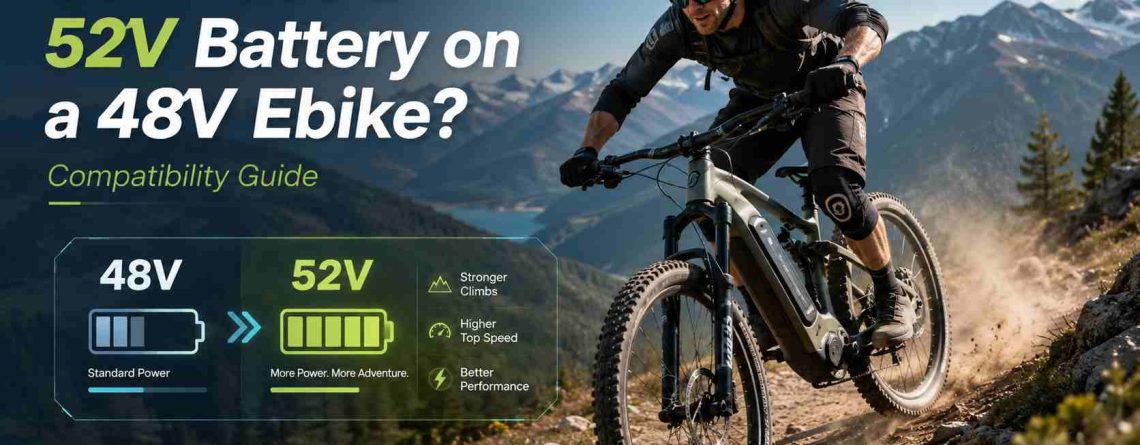
Can I Use a 52V Battery on a 48V Ebike? Simple Compatibility Guide
Many riders ask the same question before upgrading: can I use a 52V battery on a 48V ebike? The short answer is: sometimes, but only if your controller, display, charger, motor system, and wiring can safely support the higher voltage.
A 52V ebike battery can offer better voltage headroom, stronger acceleration, and a more responsive feel on compatible systems. However, it is not a safe upgrade for every 48V ebike. If the system is not designed for 52V, the battery may damage the controller, display, charger, or other electrical parts.
This guide explains what to check before using a 52V battery on a 48V ebike. It covers controller voltage limits, charger compatibility, low-voltage cut-off, BMS protection, display behavior, fitment, and riding performance.
If you are still comparing voltage, capacity, BMS, current rating, and fitment, start with our full guide on how to choose an ebike battery.
If you already know your controller supports 52V and you are ready to compare compatible options, start with the EM3ev ebike battery range.
What Is the Difference Between a 48V and 52V Ebike Battery?
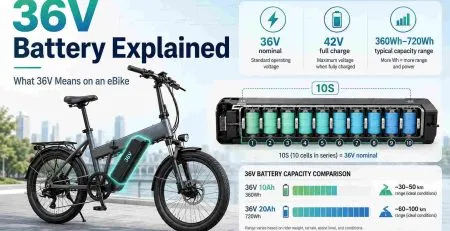
A 48V ebike battery and a 52V ebike battery are close in voltage, but they are not the same. A typical 48V lithium ebike battery is usually built with 13 cell groups in series. A typical 52V battery is usually built with 14 cell groups in series.
This means a 52V battery has a higher full-charge voltage than a 48V battery. That extra voltage can help a compatible ebike feel stronger, especially during acceleration or hill climbing. It can also help the system maintain better performance as the battery discharges.
The higher voltage is also why compatibility matters. A controller that is only designed for 48V may not be able to handle the full-charge voltage of a 52V pack. Before upgrading, you need to check the electrical limits of your system.
Can a 52V Battery Work on a 48V Ebike?
A 52V battery can work on some 48V ebikes, but only when the controller and related parts are designed with enough voltage tolerance. Some 48V controllers can accept 52V packs. Others cannot.
The label “48V” does not always tell the full story. Some controllers are built for a wider voltage range, while others are more limited. You should check the controller label, product manual, manufacturer specs, or original system documentation before installing a 52V pack.
If you cannot confirm compatibility, do not assume the upgrade is safe. A 52V battery may work at first but still put stress on electrical parts that were not designed for the higher full-charge voltage.
Check the Controller Voltage Limit First
The controller is the most important part to check before using a 52V battery on a 48V ebike. The controller manages power from the battery to the motor. If it cannot handle the higher voltage, it may fail.
Look for the controller voltage range. Some controllers may list a range such as 36V/48V, 48V/52V, or another supported range. If the controller clearly supports 52V, the upgrade may be possible. If it only lists 48V with no voltage range, you need to be careful.
You should also consider the controller’s current rating. A 52V battery can make the system feel stronger, but the controller still controls how much current is drawn. The battery, BMS, wiring, and connectors should all be suitable for the controller demand.

Do Not Use a 48V Charger on a 52V Battery
Charger compatibility is critical. A 48V charger is not the same as a 52V charger. A 52V ebike battery needs the correct charger designed for its full-charge voltage.
Using the wrong charger can cause charging problems, incomplete charging, battery damage, or safety risks. If you upgrade from 48V to 52V, you normally need a charger made for the 52V battery.
Before buying a new battery, check the charger voltage, charge connector, charge current, and polarity. Do not rely on connector shape alone. Two chargers can have similar plugs but different output voltages.
Check the Display, Low-Voltage Cut-Off, and Battery Gauge
The display may also affect whether a 52V battery works well on a 48V ebike. Some displays can recognize different voltage ranges. Others are designed only for one voltage.
If the display is set for 48V, the battery percentage or voltage bars may not read correctly with a 52V battery. The bike may show the wrong charge level, or the low battery warning may not behave as expected.
Low-voltage cut-off is another important point. This setting tells the system when to stop drawing power from the battery. If the controller or display uses a cut-off designed only for 48V, it may not manage a 52V battery correctly.
A good upgrade should not only turn on and run. It should also show usable battery information and protect the battery properly during discharge.
Will a 52V Battery Make a 48V Ebike Faster?
A 52V battery may make a compatible 48V ebike feel stronger, but the exact result depends on the controller, motor, current limit, gearing, wheel size, and system design.
In many compatible setups, riders notice better throttle response, stronger acceleration, and improved hill-climbing support. This happens because the system has more voltage available under load.
However, a 52V battery does not automatically turn every 48V ebike into a high-performance bike. If the controller current limit is low, or the motor is not designed for higher output, the improvement may be limited.
If your goal is stronger acceleration or hill climbing, you should also understand discharge current and voltage sag.
BMS and Current Rating Still Matter
When upgrading to 52V, do not look at voltage alone. The BMS and discharge current rating are just as important. A 52V battery with weak current output may not perform well on a high-power ebike.
The BMS helps protect the battery from overcharge, over-discharge, overcurrent, short circuit, and other risks. If the BMS rating is too low for the controller, the battery may cut off under load.
This is especially important for Bafang mid-drive systems, 1000W motors, cargo bikes, hill climbing, and throttle-heavy riding. If your controller asks for more current than the battery can safely provide, you may experience voltage sag, heat, or sudden power loss.
To understand this topic better, read our guide to ebike battery BMS protection.
Fitment, Connectors, and Wiring
A 52V battery also needs to fit your bike physically. Check the frame space, mounting style, cable routing, battery removal direction, charge port location, and discharge connector.
If your current 48V pack is a downtube battery, a new 52V pack may not use the same case, mount, connector, or charger. If your bike uses a triangle pack, check the frame bag or mounting area carefully before ordering.
Connector compatibility is important for safety and reliability. Avoid low-quality adapter chains, loose connectors, or wiring that is not rated for the expected current. Poor wiring can cause heat, resistance, voltage drop, and reliability problems.
When a 52V Upgrade Makes Sense
A 52V upgrade may make sense if your controller, display, motor, charger, wiring, and connectors support the higher voltage. It is especially useful for riders who want a more responsive ride on compatible DIY ebike systems.
A 52V battery may be a good direction if you ride hills, use throttle often, have a higher-power controller, or want more voltage headroom. It can also be useful for Bafang BBSHD, compatible BBS02 builds, and some 1000W ebike systems.
If you use a Bafang mid-drive motor, read our guide on the best battery for Bafang BBSHD and BBS02. If you are choosing for a 1000W system, see our guide to choosing a battery for 1000W ebike motor builds.
When You Should Stay With 48V
Staying with 48V may be the better choice if your controller, display, charger, or motor is designed only for 48V. It may also be better if you want the simplest replacement battery with fewer compatibility concerns.
A quality 48V battery can still provide strong range, reliable performance, and good power delivery when matched correctly. For many commuters and daily riders, 48V is a practical and dependable option.
If you are not sure whether your system supports 52V, choosing a well-built 48V replacement ebike battery may be safer than taking a risk with an unsupported upgrade.
Recommended EM3ev Battery Options for 52V Upgrades

If your controller and system are confirmed to support 52V, the right battery depends on your frame space, range needs, current demand, and riding style. Below are two EM3EV options that fit different 52V upgrade scenarios.
For Performance-Focused 52V Builds

52V Rhino 5P – Samsung 50G
The 52V Rhino 5P – Samsung 50G is a strong option for compatible riders who want better current delivery, stronger hill-climbing support, and stable power under load. It is especially suitable for performance-oriented DIY builds, Bafang mid-drive setups, and riders who care about acceleration and throttle response.
For Long-Range 52V Riding

52V King Shark 14S4P – Samsung 50E
The 52V King Shark 14S4P – Samsung 50E is a practical direction for riders who want a 52V pack with strong range potential, daily usability, and balanced performance. It is a good fit for compatible riders who want more watt hours for commuting, longer rides, mixed terrain, or touring-style ebike use.
Common Mistakes When Using a 52V Battery on a 48V Ebike
- Assuming every 48V controller can handle 52V.
- Using a 48V charger on a 52V battery.
- Ignoring display and battery gauge compatibility.
- Forgetting to check low-voltage cut-off settings.
- Choosing a 52V pack with weak discharge current.
- Using unsafe adapters or low-quality connectors.
- Buying a battery that does not fit the frame.
- Expecting a 52V battery to fix every performance issue.
FAQ About Using a 52V Battery on a 48V Ebike
Can I use a 52V battery on a 48V ebike?
Sometimes, but only if the controller, display, charger, motor system, wiring, and connectors can safely support the higher voltage. Do not assume every 48V ebike can use a 52V battery.
Will a 52V battery damage a 48V controller?
It can if the controller is not rated for the higher full-charge voltage of a 52V battery. Always check the controller voltage range before upgrading.
Do I need a new charger for a 52V battery?
Yes. A 52V battery requires the correct 52V charger. A 48V charger is not the right charger for a 52V lithium ebike battery.
Will a 52V battery give me more range?
Range depends on watt hours, riding style, speed, terrain, and throttle use. A 52V battery with more watt hours may provide more range, but higher power use can also drain energy faster.
Is 52V better for hill climbing?
A 52V battery may help compatible systems feel stronger under load, but hill climbing also depends on motor power, controller current, gearing, rider weight, discharge current, and voltage sag.
Final Thoughts
A 52V battery can be a good upgrade for some 48V ebikes, but only when the system is compatible. The most important parts to check are the controller, display, charger, low-voltage cut-off, BMS rating, connector, and physical fitment.
If your system supports 52V, the upgrade may improve throttle response, hill-climbing feel, and power delivery. If your system does not support it, staying with a quality 48V battery is the safer choice.
When you are ready to compare compatible packs, start with the EM3EV ebike battery range.




LEAVE A COMMENT