




Can I Use a 52V Battery with a 48V Controller? What You Need to Know
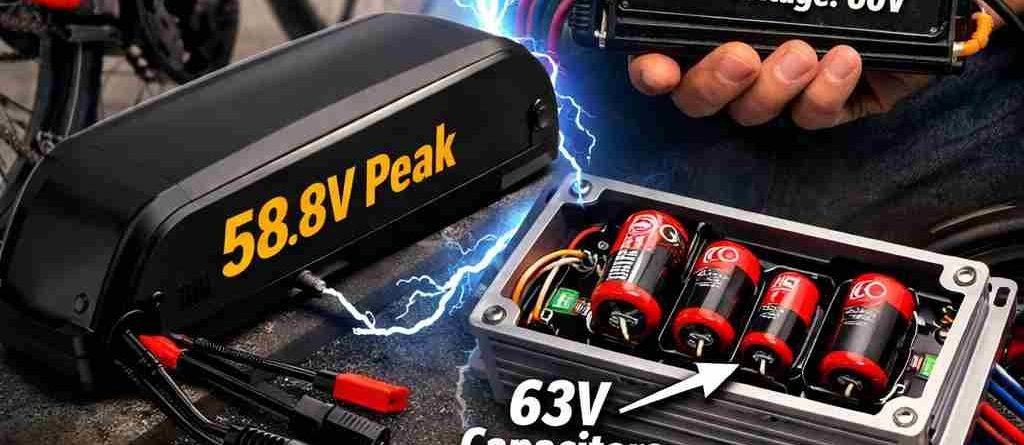
Some 48V controllers can use a 52V battery, but you must check the exact model and version first. A typical 52V lithium-ion pack reaches 58.8V when full. The controller must support that pack and its operating range. A 48V label alone does not give you the answer.
If you want to use a 52V battery on a 48V controller, start with the maker’s manual. Do not use a test ride to find out whether the voltage is safe.
Quick Compatibility Check
- Confirmed support: The maker lists 14S or 52V battery support for your controller version.
- Unknown support: You only have a 48V label, a parts rating, or advice about a similar model.
- Not supported: The maker rules out 14S packs or specifies a maximum input below 58.8V.
For an unknown model, ask the maker or kit supplier before you connect the pack. Send a clear label photo and any model or version numbers.
48V vs 52V: Compare Full-Charge Voltage
The name on a battery is not its highest voltage. This table applies to common lithium-ion packs with a 4.2V full-charge limit per cell.
| Battery class | Series cell groups | Full-charge voltage |
|---|---|---|
| 48V | 13S | 54.6V |
| 52V | 14S | 58.8V |
The full-charge difference is 4.2V. Though it may look small, it can exceed a controller’s supported input. Check the battery’s actual specification if its chemistry or cell count differs.

How to Check Whether Your Controller Supports 52V
Read the Complete Controller Rating
Look for the supported battery types, input voltage range, and required settings. A clear 48V/52V rating is useful evidence, but confirm that it applies to your exact hardware and firmware version.
If a listing only says “Max 60V,” ask what that means. It could describe a working limit or an absolute limit that should not be used as a normal operating target. Do not treat those as the same thing.
Do Not Judge by a 63V Capacitor
A capacitor is just one part of the controller. Its voltage rating does not prove that the other parts or the control software support a 52V pack. Brief voltage spikes can also matter.
You do not need to open the controller to make this choice. Use the maker’s approved battery range.
Check Current and Cutoff Settings
Find the controller’s maximum battery current. The pack, BMS, wires, and plugs must support that demand. Motor phase current is a different value; do not use it as the battery-current rating.
Check the low-voltage cutoff and battery gauge settings for the new pack. Do not copy one cutoff value across all systems. If the bike has regenerative braking, also confirm its return-current and voltage limits with the controller and battery makers.
Ask the Supplier a Specific Question
Ask: “Does this exact controller version support a 14S lithium-ion battery at 58.8V when full, and what settings must I use?” Include the display model and battery details. Keep the reply with your bike records. This is more useful than asking whether a 52V upgrade usually works. If the supplier cannot confirm support, leave the new pack disconnected until you have a clear answer.
Will a 52V Battery Hurt a 48V Controller?
It can if the controller does not support the pack’s voltage. A fault may appear at once, or stress may cause problems later. A screen that lights up and a wheel that turns do not prove long-term compatibility.
Only after support is confirmed should you follow the maker’s setup and test steps. Stop if there are fault codes, power cutouts, or abnormal heat. Do not bypass protection settings to make the pack run.
The rest of the bike also matters. Displays, lights, and other parts fed by the battery may have their own limits. Use our whole-bike 48V-to-52V compatibility guide to check those parts.
What If 52V Support Is Not Confirmed?
Keep using a pack approved for the system while you check. If your goal is more range, a higher-capacity 48V pack may help, provided it fits and meets the bike’s electrical needs.
A new controller is another option, but it must also match the motor, display, sensors, and wiring. Changing the controller alone does not make every 52V conversion suitable.
Frequently Asked Questions
Can a 48V 1000W controller run on a 52V battery?
Only if that exact controller supports the pack. A 1000W label describes a power rating, not proof of 58.8V input support. Check its manual and version.
Can a 48V 750W controller run on a 52V battery?
The same rule applies. The watt rating does not settle the voltage question. Confirm 14S support and the required settings before connecting the battery.
Can I use a 52V battery on a 48V motor?
The motor label alone cannot answer that. Check the controller, motor limits, load, and cooling. More voltage does not mean the motor can safely handle more power in all riding conditions.
Will a 52V battery make my bike faster?
It may on a supported setup, but there is no fixed speed gain. Motor speed, load, gearing, controller limits, and speed settings all affect the result.
Choose Capacity After You Confirm Compatibility
Once your system is confirmed to support 52V, compare EM3ev 52V battery by stored energy, current rating, and fit.
For delivery work, start with our delivery bike battery sizing guide to plan battery capacity around your route, shift length, and charging breaks.
If you are considering a specific pack size, read whether a 52V 20Ah battery is enough for food delivery to assess how that option fits your shift.






LEAVE A COMMENT