




Can You Charge an eBike Battery With a Solar Panel?
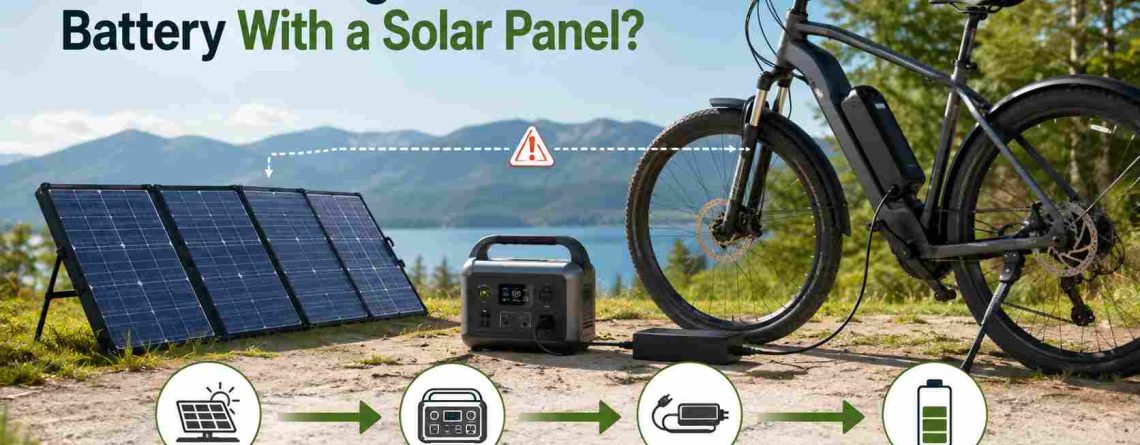
Yes, you can charge an eBike battery with solar power, but a solar panel should not normally connect straight to the battery. For most riders, the safer setup is: solar panel → regulated power source → the charger supplied with or recommended for the battery → eBike battery. Use direct DC solar charging only when the battery maker specifically supports it.
Quick Answer
- Solar energy can charge an eBike battery.
- A raw solar panel is not an eBike battery charger.
- Keep the supplied or manufacturer-recommended charger in the charging path unless an approved direct-DC solution exists.
- 48V and 52V batteries need different charging voltages.
- A matching plug, “48V” label, or MPPT label alone does not prove compatibility.
Solar charging sounds simple: put a panel in the sun, connect your eBike, and refill the battery. In practice, the important part is what sits between the panel and the lithium-ion battery.
A solar panel produces DC electricity, but its output changes with sunlight, temperature, shade, and panel angle. An eBike battery needs charging equipment designed for the pack. That difference is the key to using solar power safely.

How Does Solar Charging an eBike Battery Work?
The safest general approach is to use solar power as the energy source while keeping the battery’s normal charger in the system.
For a typical consumer setup, the power path looks like this:
- Solar panel: collects energy from sunlight.
- Regulated solar power source: manages the changing solar input.
- eBike charger: provides the charging output required by the battery.
- eBike battery: receives power through its intended charging system.
A portable power station with suitable AC output is one way to create this setup. A home, cabin, or RV solar system can do the same. In both cases, the solar equipment powers the eBike charger instead of replacing it.
This distinction matters because U.S. CPSC guidance tells micromobility users to use the charger supplied with or recommended by the manufacturer. UL also evaluates eBike electrical safety as a system that includes the battery and charger, rather than treating the charger as an unrelated accessory.
Why Shouldn’t You Connect a Solar Panel Directly to the Battery?
A raw solar panel does not provide the controlled charging conditions an eBike lithium-ion battery is designed to receive.
Solar-panel output changes during normal use. Clouds pass over the panel. Its temperature rises. The sun moves. Part of the panel may fall into shade. The U.S. Department of Energy notes that PV module ratings are measured under standard test conditions, so rated power should not be treated as constant real-world output.
A matching plug is not enough either. Two connectors can physically fit while voltage, polarity, current limits, or charging behavior differ.
The battery management system, or BMS, is also not a replacement for the correct charger. It adds important protection inside the battery, but the external charging source still needs to be suitable for the pack.
| Solar charging route | General recommendation | Why |
|---|---|---|
| Raw solar panel → eBike battery | No | The panel is not a regulated eBike charger. |
| Generic solar controller → eBike battery | Not by default | Voltage labels alone do not prove battery compatibility. |
| Solar system → AC output → approved eBike charger | Preferred general route | Keeps the battery’s intended charger in the system. |
| Approved direct-DC solar charger | Only when supported | The complete charging system must match the specific battery. |
What About Solar Charging a 48V or 52V eBike Battery?
Both 48V and 52V eBike batteries can use solar energy, but they do not use the same battery-side charging voltage.
“48V” and “52V” are nominal battery-system labels. They do not mean that any device carrying the same voltage label can safely charge the battery.
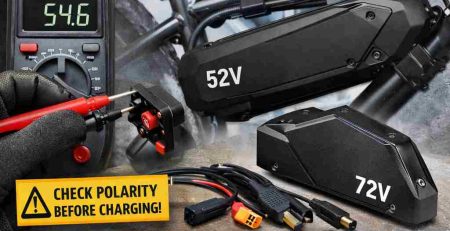
EM3ev’s current 48V batteries are 13-series, or 13S, lithium-ion packs and use 54.6V chargers. EM3ev’s 52V packs are 14S and use 58.8V chargers. The two charger voltages should not be mixed.
| eBike battery | Pack type | Matching charger voltage |
|---|---|---|
| 48V lithium-ion | 13S | 54.6V |
| 52V lithium-ion | 14S | 58.8V |
This is why a solar controller advertised for a “48V battery system” is not automatically a charger for a 48V eBike battery. The required charging voltage, current limits, battery chemistry, connector, polarity, and manufacturer requirements still need to match.
If you are simply using solar power to run the normal eBike charger, the setup is easier to understand: the solar system supplies the charger, and the charger remains matched to the battery.
How Much Solar Power Do You Need?
Start with your battery’s energy capacity in watt-hours rather than relying on a fixed solar charging-time promise.
There is no single honest answer such as “this size solar panel will always charge your eBike in this many hours.” Real solar production changes with weather, location, season, temperature, shade, and panel position.
If your battery specification lists watt-hours (Wh), use that figure as your starting point. If it lists only nominal voltage and amp-hours, you can estimate battery energy with:
Battery energy (Wh) ≈ nominal voltage (V) × capacity (Ah)
Then consider how much of that energy you actually need to replace and how much solar energy your system can realistically produce.
For example, a partially discharged battery needs less energy than an empty one. A panel in strong, unobstructed sunlight may produce more useful energy than the same panel on a cloudy or shaded day.
Because those conditions change, this article does not promise a specific charging time. Size the solar system with reasonable margin instead of planning around the panel’s best-case rated output.

Solar eBike Battery Charging Safety Checklist
Solar power does not change the normal safety rules for charging a lithium-ion eBike battery.
- Use the charger supplied with or recommended for your battery.
- Check the charger’s input requirements before using a power station or inverter.
- Make sure the regulated power source can support the charger’s required continuous input.
- Keep the battery, charger, and electrical connections dry.
- Do not charge a battery that is swollen, cracked, leaking, badly damaged, or behaving abnormally.
- Stay present while charging and do not charge while sleeping.
- Stop charging if you notice unusual heat, swelling, odor, smoke, or damaged connections.
- Follow the battery or bike manufacturer’s instructions when they are more specific.
CPSC specifically recommends being present during micromobility charging and using the supplied or recommended charger. It also warns against unapproved “universal” chargers because individual batteries have specific charging needs.
Does an MPPT Controller Make Direct Solar Charging Safe?
No. MPPT alone does not mean a solar controller is compatible with an eBike battery.
MPPT stands for maximum power point tracking. It helps a solar system make use of the changing output from photovoltaic panels.
That tells you something about how the controller handles the solar side. It does not prove that its output matches the charging needs of your eBike pack.
A direct-DC charging system still needs to match the battery’s voltage, charge-current limits, chemistry, polarity, connectors, and any other requirements set by the battery maker.
In short, treat “MPPT” as a solar-system feature, not as a universal eBike-charger compatibility label.
When Does Solar eBike Charging Make Sense?
Solar charging is most useful when normal grid power is difficult to reach but you still have a safe, regulated way to run the correct eBike charger.
That can include an off-grid cabin, an RV, a campsite, or a home solar system with regulated AC power.
It can also provide another charging option on longer trips. However, do not assume that your battery can charge while the bike is being ridden. Unless your battery and electrical system are specifically designed for simultaneous use and charging, charge the battery while the bike is stationary.
Battery capacity matters as well. More watt-hours can reduce how often you need to recharge, which may be useful when sunshine is limited or unpredictable.
Does Solar Charging Affect Whether You Should Choose 48V or 52V?
No. Choose 48V or 52V based on your eBike’s electrical compatibility and riding needs, not because one is easier to charge with solar power.
A 48V battery should be matched to a system designed for 48V/13S operation. If your controller and bike system explicitly support 52V/14S, a 52V battery may also be an option.
If you are comparing replacement packs, you can review our dedicated options below:
Important: Please confirm the controller, charger, connectors, and physical fit before choosing a pack.
Frequently Asked Questions
Can a solar panel charge a 48V eBike battery?
Yes. Solar energy can charge a 48V eBike battery, but the panel should normally feed a regulated power source that powers the correct eBike charger. EM3ev 48V/13S packs use 54.6V chargers.
Can a solar panel charge a 52V eBike battery?
Yes. The same principle applies, but a 52V/14S battery requires different charging equipment from a 48V pack. EM3ev 52V batteries use 58.8V chargers.
Can I connect a solar panel directly to my eBike battery?
Not as a normal consumer charging method. Use the battery’s supplied or manufacturer-recommended charger, or a direct-DC charging system specifically approved for that battery.
Do I need a power station to charge an eBike from solar?
Not necessarily. A power station with suitable regulated AC output is one practical option because it can run the normal eBike charger. Other properly designed solar systems can provide the same function.
Can I use any MPPT solar controller with an eBike battery?
No. MPPT does not prove charger compatibility. The battery-side charging voltage, current limits, chemistry, polarity, connectors, and manufacturer requirements still need to match.
Can I solar-charge an eBike battery while riding?
Do not assume so. Unless the battery and bike electrical system are specifically designed to support charging while operating, charge the battery while the bike is stationary.
Final Answer
Can you charge an eBike battery with a solar panel? Yes—but think of the panel as the energy source, not as the battery charger.
For most riders, the safer general route is to let a regulated solar system power the charger supplied with or recommended for the battery. Avoid improvised panel-to-battery connections, and do not assume that a matching connector, MPPT controller, or “48V” label proves compatibility.
Whether your eBike uses a 48V or 52V battery, start with the battery maker’s charging requirements. Then design the solar side around those requirements.






LEAVE A COMMENT