




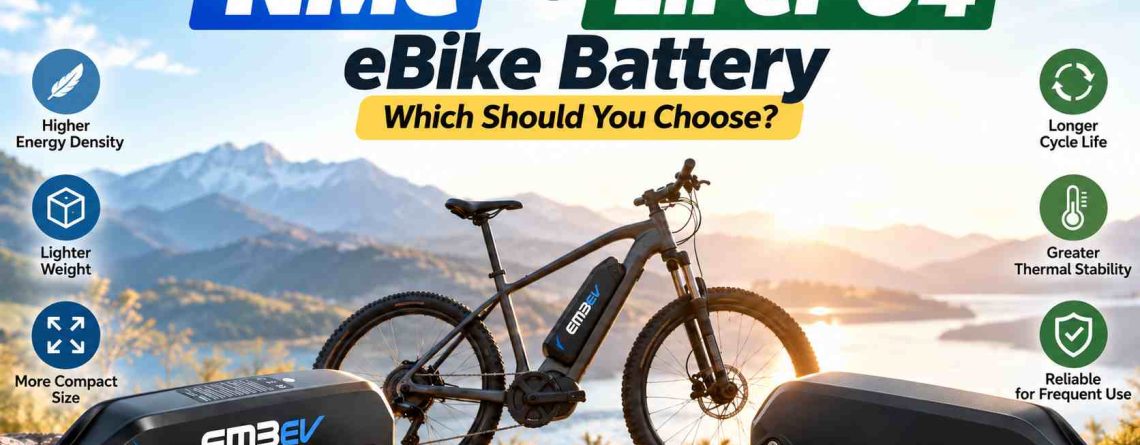
NMC vs LiFePO4 ebike battery: Which Should You Choose?
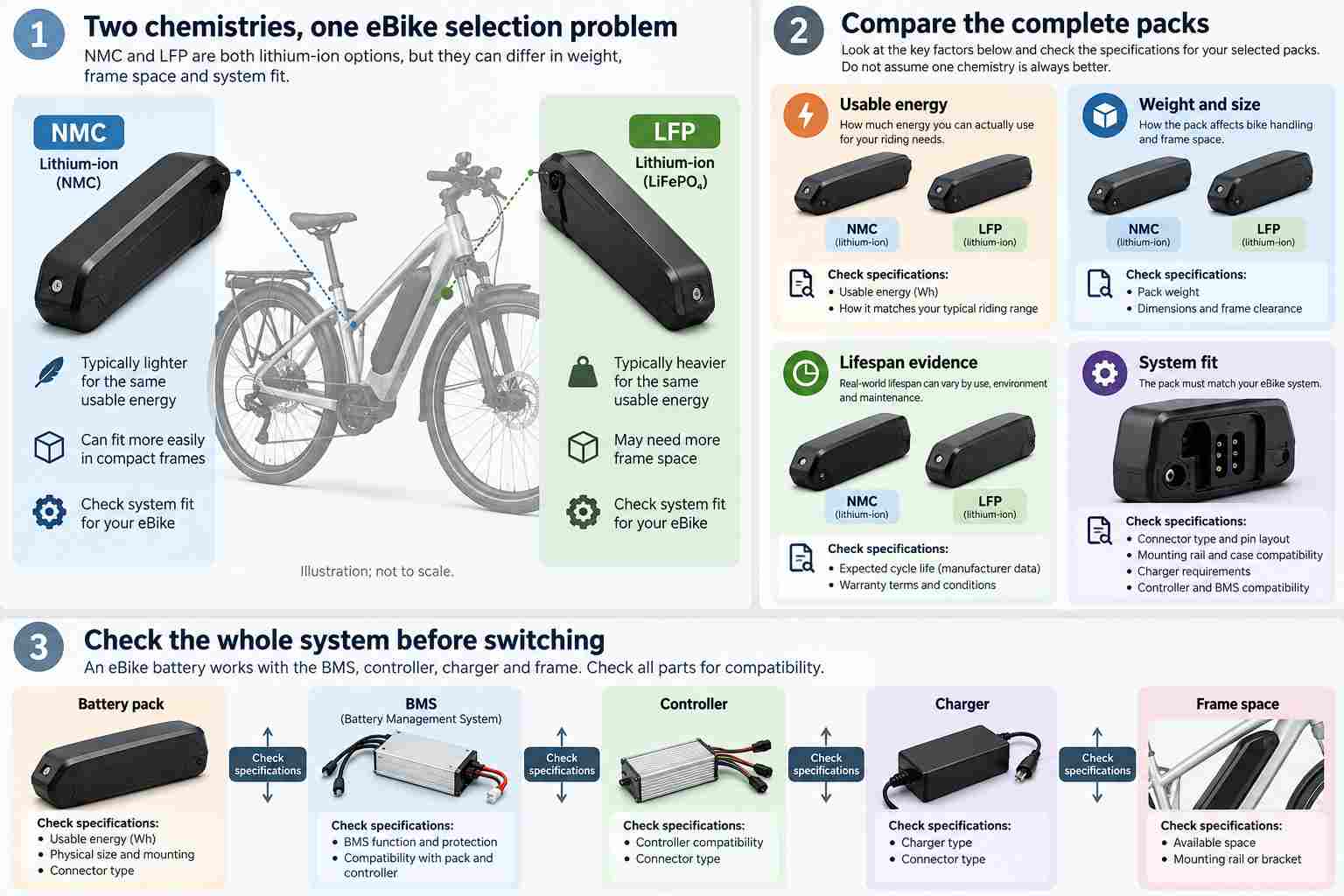
NMC vs LiFePO4 ebike battery selection compares two lithium-ion chemistries. NMC means nickel manganese cobalt oxide; LiFePO4, also called LFP, means lithium iron phosphate. NMC generally favors energy density, while LFP offers strong thermal stability and cycle-life potential. The right choice depends on the complete pack and how it works with your bike.
Quick answer
- Start with NMC when space is tight or you need a light .
- Consider LFP for frequent use, but compare lifespan claims under the same conditions.
- Treat thermal stability as one safety factor; check the whole pack and its protection.
- Check the charger, BMS, controller, and mount before you change chemistry.
Imagine replacing a commuter battery. An LFP listing promises long life, and its voltage label matches your old pack. It looks straightforward. Then you notice a different charger requirement. That detail can matter more than the headline chemistry comparison.
NMC vs LiFePO4 ebike battery: The Practical Trade-offs
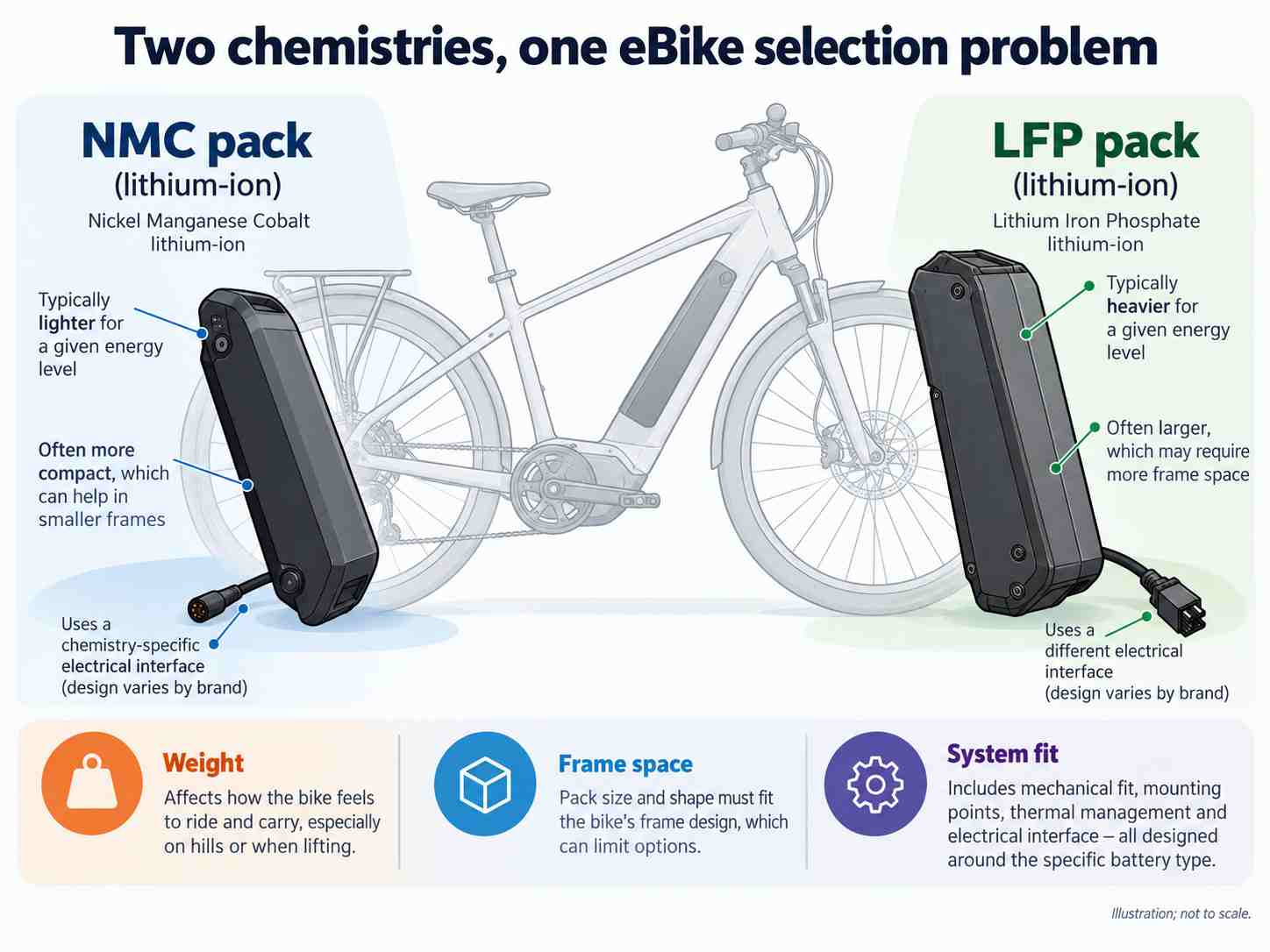
NMC usually suits tight weight and space limits; LFP can favor cycle life and thermal stability, but usable energy, lifespan evidence, and system fit must guide the choice.
What do NMC and LiFePO4 mean for an eBike pack?
These names describe the cell chemistry. They do not define the case, mount, charger, or power rating. An NMC pack is not the same as an NCA pack, even though both may carry a lithium-ion label.
Compare equal energy before comparing weight
An NMC pack will often be smaller or lighter than an LFP pack with similar usable energy. That matters when you lift a bike upstairs or fit a battery inside a small frame.
But cell energy density is not pack energy density. The case, wiring, BMS, and supports all add weight. Compare the size and weight of the whole pack alongside usable watt-hours (Wh).
If you carry the pack indoors each night, its bulk may decide the choice. With more room on the bike, that trade-off may be fine. Check the space needed to slide the pack off its rail, too. A pack that fits when locked in place may still be hard to remove.
Does equal Ah mean equal range? No. Voltage and usable energy also matter, along with load, terrain, assistance, and temperature.
Separate cycle life from time-based aging
LFP often offers strong cycle durability. Yet the label cannot tell you when a pack will wear out. Temperature, charge limits, discharge depth, and current affect aging.
A delivery rider cycling a pack frequently has different priorities from someone taking occasional weekend rides. For the second rider, calendar aging—the changes that occur over time—may matter more than a large advertised cycle count.
Ask how each lifespan claim was measured. Were the cells cycled at the same heat and load? Did the test stop at the same level of wear? A cell test and a pack warranty answer different questions.
Thermal stability is not a complete safety assessment
LFP generally has greater thermal stability than NMC. This is a useful chemistry-level advantage, not proof that every LFP assembly is safer than every NMC assembly.
Cell quality, insulation, wiring, pack support, and a suitable charger still matter. The battery management system (BMS) must protect the cells within their rated limits. A strong case alone cannot make up for poor wiring or the wrong charger.
Does LFP remove the need for a BMS? No. It still needs protection configured for the actual cells and pack design.
| Selection factor | NMC | LiFePO4 / LFP | What to verify |
|---|---|---|---|
| Energy density | High | Low | Complete-pack energy, mass, and dimensions |
| Space demand at similar usable energy | Low | High | Actual pack and mounting hardware |
| Cycle durability | Check specifications | Check specifications | Matched test conditions and aging limits |
| Thermal stability | Low | High | Pack protection and system design |
| Sustained output | Pack-specific | Pack-specific | Cells, BMS, wiring, and connector limits |
| Replacement compatibility | Not universal | Not universal | Voltage range, charger, interface, and fit |
High/Low describe relative chemistry trends within this pair, not measured pack scores or safety grades. Actual performance depends on pack/BMS/conditions. Verify complete-pack data before choosing.
Can You Change Chemistry Without Changing the System?
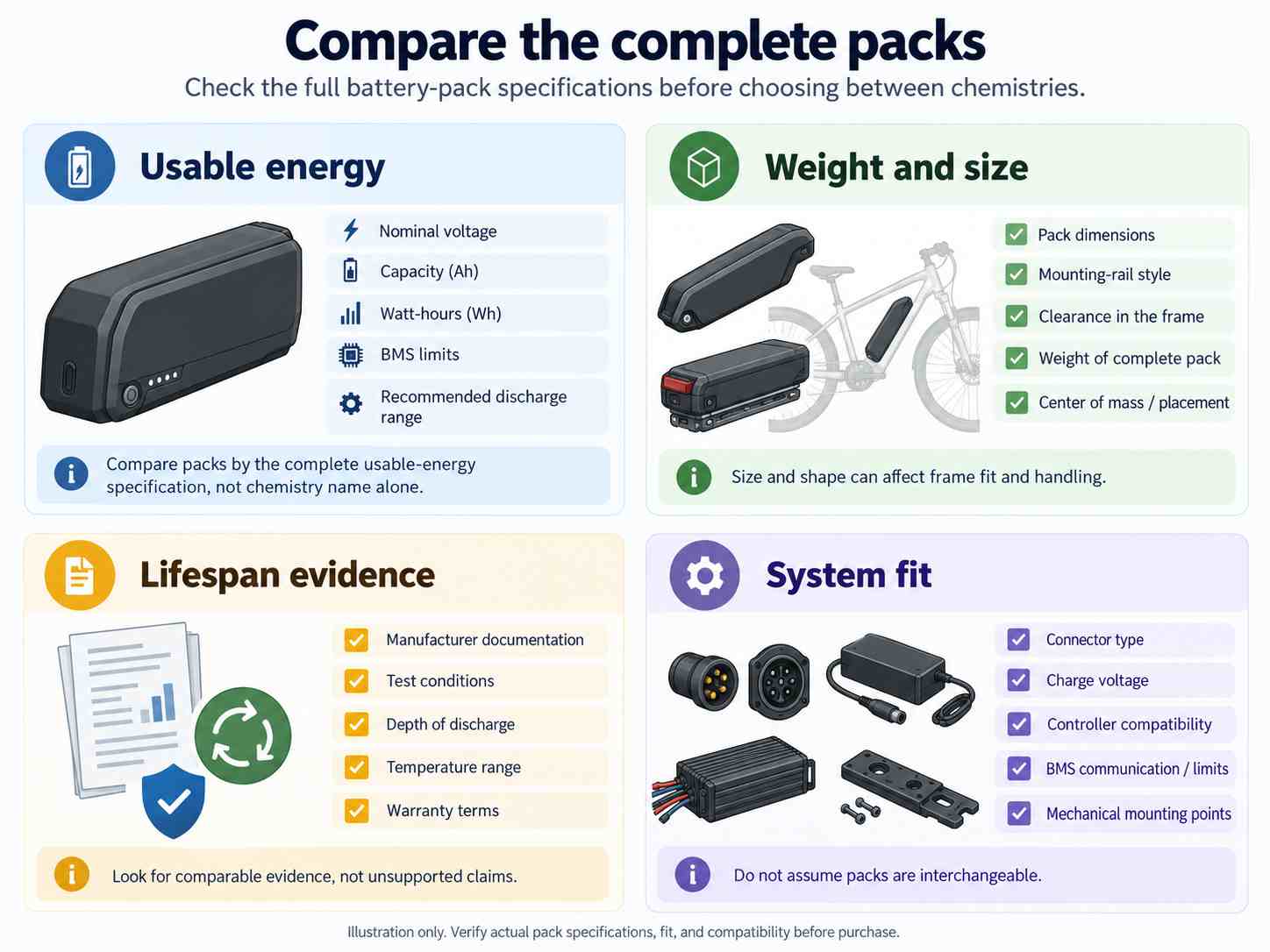
The same voltage label or plug does not prove a match; check the charger, BMS, controller limits, and mount before you replace the pack.
Return to that commuter upgrade. The new battery may physically fit, yet its voltage profile and charging limits can differ. Your existing controller, charger, or display may not support the change.
LFP also has a relatively flat discharge-voltage curve. A voltage-based display set for another chemistry may show the wrong charge level even when the pack can power the bike.
A practical verification process
- Identify the pack: Obtain the actual chemistry, usable energy, dimensions, and continuous-output specification.
- Check charging: Match the manufacturer-approved charger requirements, connector polarity, and charging limits.
- Check the controller: Compare its voltage range, low-voltage cutoff, and battery-current demand with the pack. Check that its cutoff works with the pack’s normal operating limits.
- Check protection: Confirm suitable BMS voltage thresholds, current limits, and temperature controls.
- Check the interface: Verify mount strength, removal space, communication needs, display support, and cable clearance.
- Record the result: Mark each item confirmed, incompatible, or unknown. Ask the supplier to resolve key unknowns before use; an unknown is not a pass.
Use this process to review documents and fit. Do not open the battery or change BMS settings to make a pack work. For a fair energy comparison, ask for data with the load, temperature, charge limits, and discharge cutoff stated. Nameplate Wh and usable Wh are not always the same.
Think of a climb near the end of a ride. Voltage can fall under load, and a cutoff may stop assistance before you expect it. Check discharge data for that load rather than judging from the voltage at rest. This is a review method, not a claim that we tested these packs.
Can the connector prove compatibility? No. Matching plugs do not establish polarity, charging requirements, or system communication.
Is a short test ride sufficient? No. It cannot establish safe charging, temperature protection, or sustained-load capability.
Choose for Your Frame and Riding Pattern
First confirm that the pack fits and works with the bike; then compare usable energy, carrying weight, and lifespan evidence for your rides.
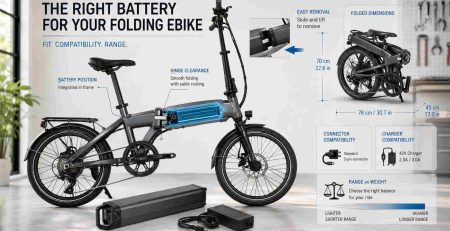
Imagine two commuters taking similar routes. One carries a folding bike onto a train. The other has a utility bike with ample battery space. They may reasonably choose different packs, even before considering chemistry.
Decision guide
- Limited space or frequent lifting: Evaluate a compatible NMC pack first.
- Frequent cycling with sufficient space: Compare LFP and NMC packs using relevant durability evidence.
- Proprietary factory system: Follow the approved replacement route instead of choosing by chemistry alone.
- Cold-weather use: Check separate limits for riding, charging, and storage. Do not assume either chemistry has one universal temperature limit.
Does cargo use automatically favor LFP? No. Payload limits, mounting space, power demand, and existing electronics still apply.
For a utility bike, count tools and bags in the payload. More mounting space does not remove the bike’s load limit.
Must a working NMC system be converted? No. A chemistry change is not inherently an upgrade.
NMC options from EM3ev: Both packs below use NMC cells. They illustrate different pack choices within one chemistry; neither is a LiFePO4 alternative or a universal replacement.

EM3ev 52V Super Shark
Suitable use: Compatible commuter builds where carrying weight and frame space matter.
Chemistry: NMC lithium-ion.
Before ordering: Check case dimensions, rail fit, controller voltage and current limits, connector polarity, and the required charger.
EM3ev 52V King Shark 1404
Suitable use: Compatible touring builds where greater energy capacity takes priority over carrying weight.
Chemistry: NMC lithium-ion.
Before ordering: Check mounting clearance, rail fit, controller voltage and current limits, connector polarity and the charger.
Frequently Asked Questions
Match the pack to the bike first; then use weight, energy, and lifespan evidence to choose between the options.
Is LiFePO4 a lithium-ion eBike battery?
Yes. LFP and NMC are both lithium-ion chemistries. “Lithium-ion” alone does not identify the chemistry inside an eBike pack.
Is LiFePO4 always safer than NMC?
No. LFP generally offers greater thermal stability, but complete-pack safety also depends on manufacturing, protection, installation, condition, and charging.
Which chemistry lasts longer?
LFP often offers strong cycle durability. Actual service life depends on the cell model, operating conditions, calendar aging, and the rest of the pack.
Can both use the same charger?
Only if the manufacturer explicitly confirms compatibility with both exact packs. Matching nominal voltage or connector shape is insufficient.
Does the same chemistry mean the same range?
No. Packs with the same chemistry can store different amounts of usable energy. Range also changes with load, terrain, tire pressure, assist level, and temperature.
Which is better in cold weather?
Compare the specific packs’ temperature limits and discharge data. Riding, charging, and storage require separate checks. Neither chemistry permits unrestricted charging while cold-soaked.
For seasonal handling, see our eBike cold-weather battery guide.
For your NMC vs LiFePO4 ebike battery decision, start with compatibility. Then compare usable energy, weight, and lifespan evidence. If the match remains unclear, share your pack, charger, and controller details, plus the space available on your frame.


LEAVE A COMMENT