





Warning: What Size Battery Do I Need for an eBike?
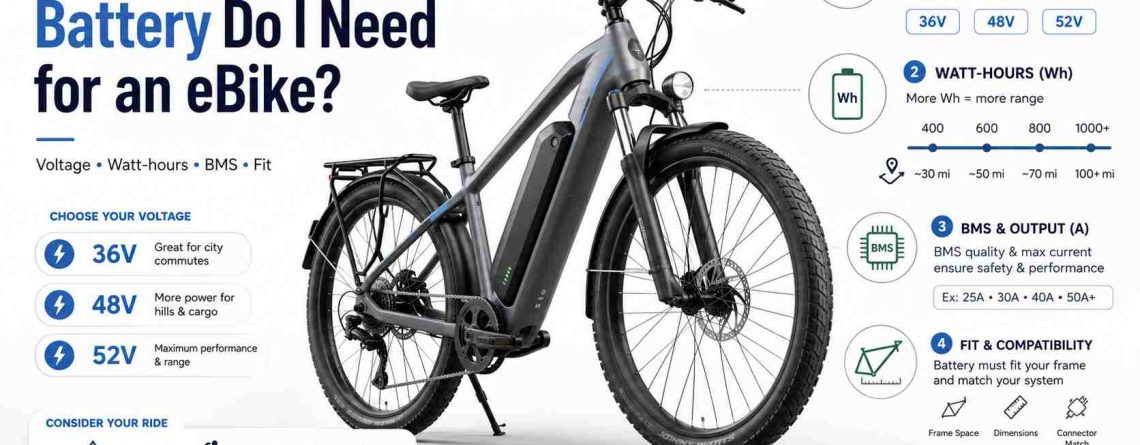
The right eBike battery size depends on voltage, watt-hours, BMS output, and physical dimensions. First confirm a safe electrical match with the controller and charger, then choose enough capacity for your normal distance, terrain, load, weather, and riding style.
Quick Answer
- Match the battery voltage to the controller, display, motor system, and charger.
- Compare watt-hours instead of judging capacity by amp-hours alone.
- Allow extra capacity for hills, cargo, cold weather, strong wind, or longer rides.
- Confirm that the BMS can support the controller’s normal and peak current needs.
- Check case dimensions, mounting hardware, connector type, polarity, and removal space.
Many riders begin with a simple question: “How many amp-hours should I buy?” That number matters, but it should not be the first decision. A battery may offer high capacity and still be unsuitable because the voltage is wrong, the case does not fit, or the BMS cannot supply enough current during hard acceleration.
A safer method follows a clear order. Match the voltage first, estimate the energy needed for your route, verify current output, and then inspect physical fit. This process reduces the chance of buying a pack that looks impressive on paper but performs poorly on the actual bike.

How to Choose the Right eBike Battery Size
Choose the battery in this order: voltage, watt-hours, BMS current, and physical fit.
- Confirm the required voltage. Read the labels on the original battery, controller, display, and charger. Common systems use 36V, 48V, or 52V, while high-performance and off-road builds often require 72V. However, a higher voltage is never a safe upgrade unless every relevant component supports it.
- Estimate the required watt-hours. Watt-hours show stored energy and are calculated by multiplying voltage by amp-hours. This makes them more useful than Ah alone when comparing batteries with different voltages.
- Adjust for real riding conditions. Steep hills, cargo, rider weight, frequent starts, soft ground, strong wind, high assistance, and low temperature can all increase energy use.
- Verify BMS current output. The battery management system must support the controller’s normal and peak current demand, or the pack may shut down when the motor is under heavy load.
- Measure the space on the frame. Check the case, rail, key access, connector, cable path, and the extra room needed to remove the battery from its mount.
Field note: A battery may fit inside the frame yet remain difficult to install. Many cases must slide along a rail before they can be lifted away, so the removal path needs as much attention as the case dimensions.
What Voltage Battery Does Your eBike Need?
Use a voltage that matches the controller, display, charger, and complete electrical system.
Voltage is the first limit to confirm because it affects every major electrical component. A 48V pack is not always a safe match for a 36V bike, and a 52V battery is not a universal replacement for a 48V model. One label cannot confirm the whole system, so review the controller, display, charger, and motor documentation together.
36V vs 48V eBike Battery
A 36V system often suits moderate assistance and lower power demand, while a 48V system may support a different balance of speed, torque, and current. However, these differences do not make 48V a safe upgrade for a bike designed only for 36V use.
48V vs 52V eBike Battery
Some 48V controllers can operate with a 52V battery, but others cannot tolerate the higher full-charge voltage. Check the controller limit, display range, charger output, and low-voltage cut-off before making any change.
Looking for extreme power?
72V systems are strictly for high-performance and electric dirt bikes with specially rated controllers, motors, and heavy-duty frames.
Can I use the old charger with a new battery?
Only when the charger is designed for the new battery’s voltage and cell chemistry. A matching plug does not prove that the charging voltage is correct.
How Many Watt-Hours Do You Need?
Use watt-hours to compare stored energy, then add a practical reserve for difficult conditions.
Amp-hours describe electrical charge, but they do not show total energy without voltage. For example, two batteries with the same Ah rating can store different amounts of energy when their nominal voltages are different. Watt-hours provide a clearer comparison because they include both values.
Even watt-hours cannot promise an exact riding range. Terrain, rider weight, tire pressure, wind, speed, motor efficiency, controller settings, temperature, and assistance level can all change how quickly the battery is used.
| Riding scenario | Capacity priority | Current priority | Main trade-off |
|---|---|---|---|
| Short, flat trips | Low to Medium | Low to Medium | Low weight versus reserve |
| Daily mixed riding | Medium | Medium | Case size versus useful range |
| Steep hills | Medium to High | High | Heat, weight, and current demand |
| Heavy rider or cargo | High | High | Larger size and added weight |
| Long-distance riding | High | Depends on system | Range versus handling |

A Practical Way to Estimate Capacity
Begin with your longest normal ride rather than the easiest trip. Record major climbs, total load, usual assistance level, and the chance of cold weather or strong wind. If you already have a battery, compare its capacity with the amount of charge normally left at the end of that route.
If the old pack often finishes close to empty, choose more usable energy rather than relying on Ah alone. When the old pack has a large reserve, a similar capacity may be enough, provided the replacement also matches the voltage, controller demand, and physical installation.
A Real-World Check
Photograph the labels on the battery, controller, display, and charger. Then record the longest route, steepest climb, normal load, and common assistance level. Compare the controller’s current demand with the proposed BMS rating, and review the manufacturer’s limits for each component.
Next, make a full-size paper or cardboard model of the battery case and place it in the intended frame position. Check the crank, cables, suspension parts, mounting rail, key access, and removal direction. If any specification remains unclear, confirm it with the battery or bike supplier before installation.
Can an eBike range calculator give an exact answer?
No. It can provide a useful estimate, but real range still depends on the bike, route, load, speed, wind, temperature, and assistance level.
Choose a Battery Size for Your Riding Style
Your route and load determine whether low weight, extra range, or strong current output matters most.
Short Commutes
A smaller battery may be suitable for a short and predictable route because it is easier to carry and often easier to fit. Keep a reasonable reserve for detours, headwinds, colder days, and periods of higher assistance.
Steep Hills
Long climbs increase both energy use and current demand. A high-capacity pack with a weak BMS may still cut out under load, so watt-hours and discharge capability should be checked together.
Heavy Riders and Cargo
Additional weight requires more energy during acceleration and climbing. A larger battery may help, but the frame must support the extra size and weight, while the BMS must meet the controller’s demand.
Long Rides
Long-distance use places greater value on watt-hours and reserve capacity. The trade-off is a larger, heavier pack that may affect handling, portability, and installation space.
Check Compatibility Before You Buy
A replacement battery is suitable only when voltage, current, connector, charger, mount, and case all match.
- Confirm nominal voltage and full-charge voltage.
- Compare the controller’s continuous and peak current demand.
- Compare the BMS continuous and peak discharge ratings.
- Check connector type, pin layout, polarity, and cable length.
- Check the mounting rail, lock, key space, and removal path.
- Confirm that the charger is designed for the replacement pack.
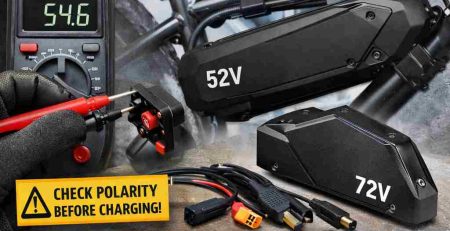
Field note: Two connectors may look identical while using different polarity or wiring. Always verify the electrical layout before connecting a replacement battery.
For Compatible 48V Systems

EM3ev 36V Battery Options
For eBikes built for a 36V system.
- Confirm frame dimensions and mount type
- Match BMS output to controller demand
- Use the correct charger for the pack
For Compatible 52V Systems
EM3ev 48V Battery Options
For compatible 48V systems.
- Choose watt-hours for the normal route
- Check controller current and BMS output
- Confirm the connector and charger
For Compatible 48V Systems
EM3ev 52V Battery Options
For systems that clearly support 52V use and charging voltage.
Confirm the full system, not one component
Check controller and display limits
Use a charger designed for the battery
For Compatible 52V Systems
EM3ev 72V Battery Options
For high-power builds requiring maximum performance and 72V voltage.
Confirm frame space and heavy-duty mounts
Check motor and controller 72V limits
Match BMS output to extreme demands
Fast Decision Guide
- Short, flat trips: Favor lower weight with enough reserve.
- Mixed daily use: Balance range, case size, and weight.
- Hills or cargo: Favor more energy and stronger BMS output.
- Long rides: Favor more watt-hours when the frame can hold the pack.
Compare eBike Battery Options
Use your current battery, controller, charger, and frame dimensions as the starting point when comparing replacement packs.
Frequently Asked Questions
The right battery meets your riding needs without exceeding the electrical or physical limits of the bike.
What does eBike battery size mean?
It can mean voltage, amp-hours, watt-hours, BMS current capability, or physical case dimensions. All five factors can affect compatibility.
How many watt-hours do I need for an eBike?
The answer depends on distance, hills, load, speed, assistance level, weather, and desired reserve. No single watt-hour value suits every rider.
How many Ah do I need?
Amp-hours must be considered with voltage. Use watt-hours when you need a clearer comparison of stored energy.
Is 48V better than 36V?
Not by itself. The correct voltage is the one that the complete eBike system is designed to use.
Can I install a higher-voltage battery?
Only when the controller, display, charger, motor system, and other electrical parts are rated for that voltage.
What BMS current rating do I need?
The BMS should support the controller’s continuous and peak current demand. Check both ratings before ordering.
How do I know whether the battery will fit?
Measure the available case area and check the rail, key, connector, cable path, and removal direction. A cardboard model can reveal problems that a dimension list may miss.
Final Battery Sizing Checklist
Confirm voltage first, then watt-hours, BMS output, case fit, connector, and charger compatibility.
When asking “what size battery do I need for an eBike,” do not begin with the largest Ah number. Start with the bike’s electrical limits, then choose enough stored energy for your normal route and difficult conditions.
A well-matched battery does more than increase range. It fits the frame, works with the controller, uses the correct charger, and supplies the current the motor system requires. That complete match is the real meaning of the right eBike battery size.



LEAVE A COMMENT