




Bike Battery Cable Guide: Sizing, Types & Wiring Connections
The Complete Guide to Bike Battery Cables and Connectors
A bike battery cable is a conductive wire assembly designed to transfer electrical power from a battery to a motor or electrical system. In electric bicycles, these cables handle propulsion power, while in motorcycles and dirt bikes, they primarily manage 12V starting, lighting, and accessory charging functions.
📖 What Is a Bike Battery Cable? (E-Bike vs. Motorcycle)
A bike battery cable functions as the main electrical artery for your ride. For e-bikes, it delivers continuous high-voltage power to the motor. For motorcycles, it provides brief, high-amperage bursts to the starter and sustains the 12V electrical system.
I’ll never forget the time my electric bike stalled halfway up a steep hill in my neighborhood. I had recently spliced in a cheap, undersized replacement wire, thinking all cables were created equal. To be honest, I was completely wrong. The voltage drop was real, and the wire literally melted under the load. That hands-on failure taught me exactly why choosing the correct bike battery cable is crucial for safety and performance.
Actually, the term “bike battery cable” is split right down the middle in the riding world. It covers two entirely different mechanical applications:
- Electric Bicycles (E-Bikes) & Scooters: These use low-voltage DC systems (usually 36V, 48V, or 52V). An electric bike battery cable acts as a discharge wire, carrying continuous current from the battery pack to the controller.
- Motorcycles & Dirt Bikes: These rely on 12V powersports batteries. A 12v motorcycle battery cable is mostly about connecting to the starter motor (requiring thick wire for brief, massive power) or attaching small pigtails for trickle chargers and heated gear.

💡 Why distinguishing between the two matters
In my case, swapping out an e-bike battery discharge cable requires different gauge considerations and terminal ends than wiring a battery wire harness for bike accessories on a Harley. Mixing up these standards isn’t just inefficient; it’s a fire hazard.
Mini Q&A: E-Bike vs. Motorcycle Cables
What is the difference between an e-bike discharge cable and a charging cable?
A discharge cable connects the battery to the motor controller and handles high continuous current, requiring thicker wire. A charging cable connects the battery to a wall charger, managing much lower current, so it uses thinner wire.
Can I use a 12V motorcycle wire for an e-bike?
It depends on the wire gauge, but generally, no. Motorcycle starter cables are often too thick and inflexible for e-bike controllers, while motorcycle accessory wires are too thin to handle an e-bike’s continuous 20-30 amp motor draw.
⚡ Street Bike Battery Cable Size and Wire Gauge Guide
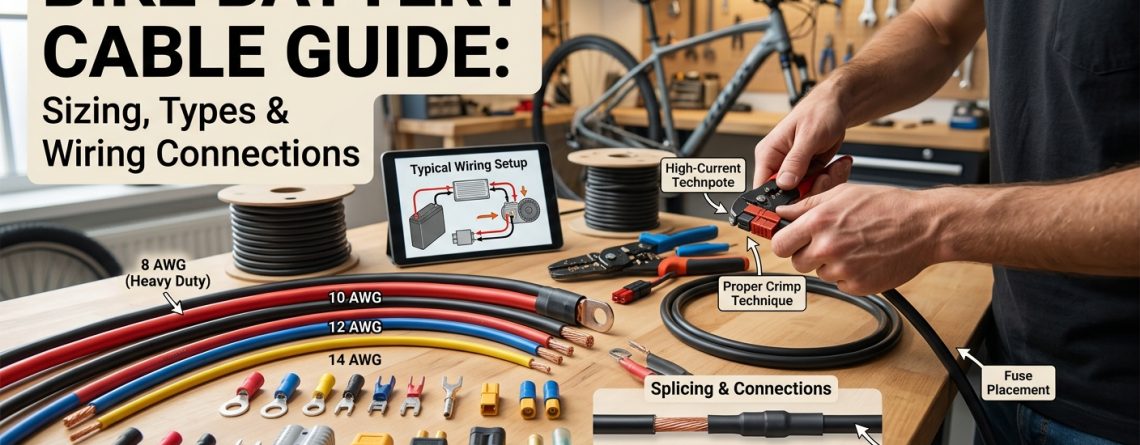
Selecting the right street bike battery cable size depends on the current (Amps) the system draws. E-bikes typically require 10 AWG to 14 AWG wire for motor power, whereas motorcycle starter cables need much thicker 4 AWG to 8 AWG wire to handle high cranking amps.
If you’re upgrading your setup or performing a bike battery power cable replacement, the AWG (American Wire Gauge) is your most important metric. Remember, a lower AWG number means a thicker wire. When I tested voltage drop across a 14 AWG wire on a 1000W Bafang mid-drive, the wire got noticeably warm. Switching to a 10 AWG e-bike battery wire solved the heat issue immediately.
| Vehicle Type | Application | Recommended AWG | Typical Amperage |
|---|---|---|---|
| E-Bike / Scooter | Main Discharge (Motor) | 10 AWG – 12 AWG | 20A – 40A |
| E-Bike / Scooter | Charging Port | 14 AWG – 18 AWG | 2A – 5A |
| Motorcycle / Street Bike | Starter Lead (Heavy-duty) | 4 AWG – 8 AWG | 100A+ (burst) |
| Motorcycle / Dirt Bike | 12V Accessory / Trickle Charger | 16 AWG – 18 AWG | 1A – 10A |
💡 Common Bike Battery Connector Types and Cable Ends
Bike battery cables utilize specific connectors to maintain secure, vibration-proof connections. Common types include terminal ring connectors for motorcycles, SAE plugs for 12V accessories, and XT60 or Anderson connectors for high-current e-bike batteries.
You can’t just twist wires together and wrap them in electrical tape. Whether you are looking for dirt bike battery cable ends or an e-bike battery connector plug with cable, here is what you need to know:
- Terminal Ring Connector: The gold standard for motorcycles. These slip over the battery posts and are bolted down tight. Look for copper core wire with heavy-duty crimped rings.
- SAE Connection Cable: A two-pin, quick-disconnect plug. It is almost universally used for motorcycle battery charging leads (like a Battery Tender) and heated riding gear.
- XT60 / XT90 Adapters: Highly popular in the e-bike and RC world. They are polarized, meaning you can’t plug them in backward, which prevents catastrophic short circuits.
- Anderson Powerpole: Excellent for battery cable for e bike setups where you might need to swap battery packs frequently. They are modular and handle high current well.
Mini Q&A: Wire Gauge and Sizing
What gauge wire should I use for a bike battery cable?
For a standard 250W-500W electric bike, 12 AWG to 14 AWG is sufficient. For high-performance e-bikes over 750W, use 10 AWG. For starting a motorcycle, use 4 AWG to 6 AWG.
Can you use any wire for the negative terminal on a motorcycle?
No. The negative battery wire for motorcycle applications must be the exact same gauge (or thicker) as the positive wire, as all electrical current must return to the battery through this path.
🚀 How to Safely Replace or Extend a Bike Battery Cable
To replace a bike battery cable safely, always disconnect the negative terminal first to prevent shorts. Cut the wire to the necessary length, strip the ends, firmly crimp the new connectors, and seal the joint tightly with heat shrink tubing to prevent moisture ingress.
Whether you’re fixing a frayed pocket bike battery cable or installing a fused bike battery harness, the process demands attention to detail. Based on my time spent in the garage rebuilding a 1970s street bike and wiring a modern lithium battery pack lead, here is the safest workflow:
- Disconnect Power: Always remove the negative (-) cable first. If your wrench hits the frame while loosening the negative bolt, nothing happens.
- Measure and Cut: Keep the cable as short as reasonably possible. Excess wire increases resistance and causes voltage drop.
- Crimp, Don’t Just Solder: For environments with high vibration (like a dirt bike), a proper mechanical crimp connector is vastly superior to soldering alone, which can become brittle and snap.
- Apply Heat Shrink Tubing: Slide a piece of marine-grade, adhesive-lined heat shrink over the joint before crimping, then shrink it down. This makes it a truly waterproof bike battery cable.
- Check Polarity: Red is positive (+), black is negative (-). Reversing this on an e-bike controller will instantly fry the internal capacitors.
⚠️ Safety Note: Always incorporate an inline fuse on the positive lead as close to the battery terminal as possible. If the wire shorts against the bike’s metal frame, the fuse will blow before the battery catches fire. Always refer to your vehicle’s service manual and local electrical guidelines.
🌱 Frequently Asked Questions About Bike Battery Cables
How do I fix a loose motorcycle battery terminal cable?
First, remove the bolt and clean the terminal and the ring connector with a wire brush to remove corrosion. Reattach the cable and tighten the bolt firmly. If the ring terminal itself is loose on the wire, the cable must be cut and a new end firmly crimped on.
What is a quick disconnect bike battery cable?
Usually referring to an SAE connection cable, this is a harness that attaches permanently to a motorcycle battery via ring terminals, leaving a small plug accessible under the seat. It allows you to quickly plug in a battery maintainer without removing body panels.
Can I use a scooter and bike battery pack cable interchangeably?
Yes, provided the voltage rating, wire gauge, and connector types match. An electric scooter and an e-bike often use similar 36V or 48V systems with XT60 or XT90 connectors.
Why is my e-bike battery extension cable getting hot?
Heat indicates resistance. The extension cable may be too long, the wire gauge may be too thin (e.g., using 14 AWG when you need 10 AWG), or the connector contacts may be dirty or poorly soldered. Stop using it immediately to prevent melting.
Final Thoughts
Whether you’re wrenching on a heavy v-twin motorcycle or upgrading a high-speed electric commuter, treating your wiring with respect is paramount. The right bike battery positive negative lead paired with a solid mechanical connection ensures your ride stays reliable, mile after mile. Remember: don’t skimp on copper, always double-check your polarity, and never skip the inline fuse.
Customer Insights & Field Notes: “Upgrading from 14 AWG to a 10 AWG silicone wire harness on my custom e-bike completely eliminated the power cut-outs I experienced on steep hills.” — Anonymous Rider
Disclaimer: This article shares expert experiences and general maintenance practices. Always follow your specific equipment’s user manual and consult a certified technician if you are unsure about electrical repairs.
References for Further Reading:









LEAVE A COMMENT