




Bicycle Brake Types: Essential Secrets to Better Braking
Bicycle brake types are the specialized mechanical or hydraulic systems used to control speed by generating friction. Mastering the different types of bike brakes—from lightweight rim calipers to powerful hub-mounted discs—is essential for ensuring maximum stopping power and rider safety in diverse weather conditions.
At a Glance: Which Type of Bike Brakes Should You Choose?
- Rim Brakes (Caliper/V-Brake): Best for lightweight road bikes and fair-weather commuting where simplicity and low weight are priorities.
- Mechanical Disc Brakes: The ideal middle ground for commuters; they offer all-weather reliability using standard cables without the cost of hydraulics.
- Hydraulic Disc Brakes: The gold standard for e-bikes, cargo bikes, and mountain biking, providing maximum stopping power with minimal hand effort.
- Coaster Brakes: Traditional back-pedal brakes found on cruisers; they are virtually maintenance-free but offer limited modulation for performance riding.
I still remember my first “real” bike ride through a steep mountain pass. To be honest, I was obsessed with my climbing speed and how light my frame felt.I didn’t give a second thought to my braking system until the descent. Halfway down, a sudden mist turned the road into a slick, unpredictable mess. Every time I squeezed my rim brake levers, there was a terrifying two-second delay—a “dead zone” where the pads were just sliding over wet metal without biting. That moment of helplessness is something every rider should avoid.
Actually, stopping a bicycle is one of the most underappreciated feats of engineering we interact with daily. You are essentially asking two small pieces of rubber or metal compound to stop a moving mass of 150 to 250 pounds (or much more if you’re on a heavy e-bike) by converting kinetic energy into heat. In physics terms, your brakes are a heat management system. If you choose the wrong types of bicycle brakes for your specific environment, you’re not just compromising on performance—you’re compromising on safety.
The Science of Friction: Why Different Systems Matter
To understand why there are so many different types of bike brakes, we have to look at how they handle friction. Rim brakes use the outer edge of your wheel as the braking surface. This is brilliant for saving weight because you’re using a part that’s already there. However, because that surface is so close to the ground, it gets covered in road grit, oil, and water almost instantly when the weather turns. This is why many riders are moving toward disc systems.
Disc brakes move the braking surface to a dedicated rotor attached to the hub. This small change has massive implications. By moving the friction zone away from the rim, the system stays cleaner and cooler. In my case, switching to a disc setup felt like moving from a manual typewriter to a modern computer—the precision and “feel” were on a completely different level. Whether you are dealing with the “banshee squeal” of contaminated pads or the frustrating “spongy” feel of an old cable, the root cause usually lies in how your specific types of brakes on bikes interact with the elements.

Common Rider Pain Points: Wet-Weather and Maintenance
We’ve all been there: you’re enjoying a peaceful ride when suddenly your brakes start making a sound like a screaming bird. Or perhaps you’ve noticed that you have to pull your levers almost to the handlebars just to get a slight slowdown. These are not just annoyances; they are critical signals from your braking system. Actually, many of these issues come down to the limitations of certain brake setups. For instance, rim brakes often suffer from “rim wear,” where the braking surface itself eventually thins out and needs replacement—a costly repair that disc brake users never have to face.
On the other hand, the complexity of modern systems can be a deterrent. To be honest, not everyone wants to carry a hydraulic bleed kit on a weekend bikepacking trip. This is why the “best” brake isn’t always the most powerful one—it’s the one that matches your willingness to maintain it and the conditions you actually ride in.
Are Your Brakes Ready for the Road?
Understanding the technical differences is just the start. Let’s look at the specific systems and how they perform under pressure.
Bike brake systems: the main options and how they differ
The two most common brake setups are rim brakes and disc brakes; rim brakes provide lightweight, simple stopping for road use, while disc brakes offer superior power and consistency in all weather conditions.
Actually, when you dive into the different types of bicycle brakes, you aren’t just looking at metal and rubber. You are looking at two completely different philosophies of how a bike should handle. Types of bike brakes that grab the rim have been around for a century, focusing on weight and simplicity. On the other hand, types of brakes for bicycles that use a central hub rotor—the disc brakes—prioritize sheer force and reliability.
Rim Brakes: The Lightweight Classics
Rim Brakes utilize the wheel’s outer edge as a friction surface, offering a lightweight and simple mechanical solution for road and vintage cycles.
Actually, the diversity within rim systems is what allowed early bicycles to conquer different terrains. For high-speed road racing, pull caliper brakes—especially the dual-pivot side-pull variety—became the industry standard because of their aerodynamic profile and precise centering capabilities. However, when bikes moved into mud or required wider tires, the cantilever brake became the legendary choice for riders. To be honest, a cantilever brake setup provides a distinct mechanical advantage by mounting the arms to individual frame bosses, offering massive clearance that pull caliper brakes simply cannot match. In my case, I’ve found that while they require more patience to align, the reliability of a well-tuned cantilever on a touring bike is second to none.
V-Brake vs Cantilever: Which Rim System is Better?
When choosing between these road bike brake types, the decision often comes down to tire clearance and leverage. V-brakes (linear-pull) offer superior raw power and easier adjustment, making them the standard for flat-bar commuters. In contrast, cantilever brakes provide massive mud clearance, remaining the preferred choice for vintage touring bikes and traditional cyclocross builds.
Disc Brakes: Mechanical vs Hydraulic
Disc brakes move the braking surface to a hub-mounted rotor, providing immense power that remains unaffected by wet rims or bent wheels.
This is where the real choice happens. You have two ways to activate a disc brake:
• Mechanical Disc Brakes: These use a standard bicycle brake cable. They are great for DIY mechanics who want the “bite” of a disc without needing to learn how to bleed fluid lines.
• Hydraulic Disc Brakes: These use a sealed line of fluid. To be honest, once you feel the effortless, butter-smooth pull of a hydraulic lever, it’s hard to go back to cables.
For those exploring mountain bike brake types, performance in extreme terrain is non-negotiable. While mechanical discs are reliable, hydraulic disc brakes utilize a sealed fluid system to provide effortless “one-finger” braking. This precision is vital for technical descents where modulating speed without hand fatigue determines your control over the trail.
Bicycle Brake Types Comparison (Rim vs Mechanical Disc vs Hydraulic Disc)
| Performance Metric | Rim Brakes | Mechanical Disc | Hydraulic Disc |
|---|---|---|---|
| Stopping Power | Moderate | High | Maximum |
| Wet Performance | Low | High | Very High |
| Maintenance Need | Simple/Frequent | Moderate | Infrequent |
| Hand Effort | Highest | Moderate | Lowest |
| System Weight | Lightest | Medium | High |

How braking works
Braking occurs through a chain of energy: your hand pressure moves a cable or fluid, forcing the caliper to pinch pads against a moving surface to create friction.
Actually, it’s a simple mechanical advantage system. When you pull the lever, that force is multiplied. If you are using various bicycle brake caliper types, the design of the “arms” determines how much force actually reaches the pads. This is also where bicycle brake cable types matter—old, crusty cables can steal up to 30% of your stopping power just through internal friction.
Brake system check in 5 steps
- Lever Feel: Squeeze the lever; it should feel firm and stop well before the handlebar.
- Pad Thickness: Check your bicycle brake pads types. If they are under 1.5mm, replace them immediately.
- Surface Cleanliness: Look for oil or road grime on the rotors or rims.
- Cable Integrity: Check for fraying at the pinch bolts of your bicycle brake cable types.
- Alignment: Ensure the caliper is centered and not rubbing the wheel when spinning freely.
Experience verification workflow (Methodology)
To accurately diagnose braking issues without guessing, we follow this field-tested isolate-and-test sequence:
• Step 1: Isolate the Sound. If you hear a squeal, clean the surface with 90% isopropyl alcohol. If it stops, the issue was dirt.
• Step 2: Test the “Bite”. If the lever is firm but the bike won’t stop, your pads are likely “glazed” from heat.
• Step 3: Check for Air. For hydraulics, if the lever feel changes every time you pull it, there is air in the line.
• Step 4: Verify Alignment. Loosen the mounting bolts, hold the brake lever down, and retighten to center the caliper.
Choose the right brake setup for your bike and riding
Match your brakes to your environment: choose lightweight rim brakes for sunny road riding, and prioritize hydraulic disc brakes for heavy e-bikes, cargo hauling, or steep, wet terrain.
To be honest, the “best” brake isn’t always the most expensive one; it’s the one that matches the job you are asking your bike to do. I’ve seen riders put professional-grade hydraulic racing brakes on a simple beach cruiser, which is a bit like putting a jet engine on a lawnmower—actually, it’s a waste of money and makes maintenance much harder than it needs to be. In my case, I’ve learned that the secret to a happy ride is balancing stopping power with simplicity.
When you are looking at different types of brakes for bicycles, you have to consider the “Total System Weight.” If you are a 200-pound rider on a 50-pound e-bike carrying 30 pounds of groceries, you are trying to stop nearly 300 pounds of momentum. In that scenario, a standard rim brake will struggle to dissipate the heat, leading to “brake fade” where the lever feels firm but the bike just won’t stop. This is where the physics of bicycle brakes types becomes a life-saving bit of knowledge.
Decision Matrix: Which System Fits Your Style?
- IF you ride a carbon road bike and only go out in the sun THEN Rim Brakes are your best friend. They keep the bike incredibly light and aerodynamic.
- IF you commute 10+ miles daily through city traffic THEN Mechanical Disc Brakes are the smart choice. They stop in the rain but use simple cables you can fix in five minutes.
- IF you ride off-road, carry heavy cargo, or use an e-bike THEN Hydraulic Disc Brakes are mandatory. You need that “one-finger” stopping power when things get steep.
- IF you want a maintenance-free bike for short trips to the coffee shop THEN a Coaster Brake (back-pedal) is a classic, clean-looking option.
Special Considerations for E-Bikes and Heavy Loads
Actually, e-bikes have changed the conversation around bicycle brakes types entirely. Because e-bikes maintain higher average speeds and weigh significantly more than traditional bikes, they put immense stress on the braking surface. To be honest, I always recommend looking for “E-bike Ready” systems. These often feature thicker rotors (2.0mm instead of 1.8mm) and larger pads to handle the extra heat.
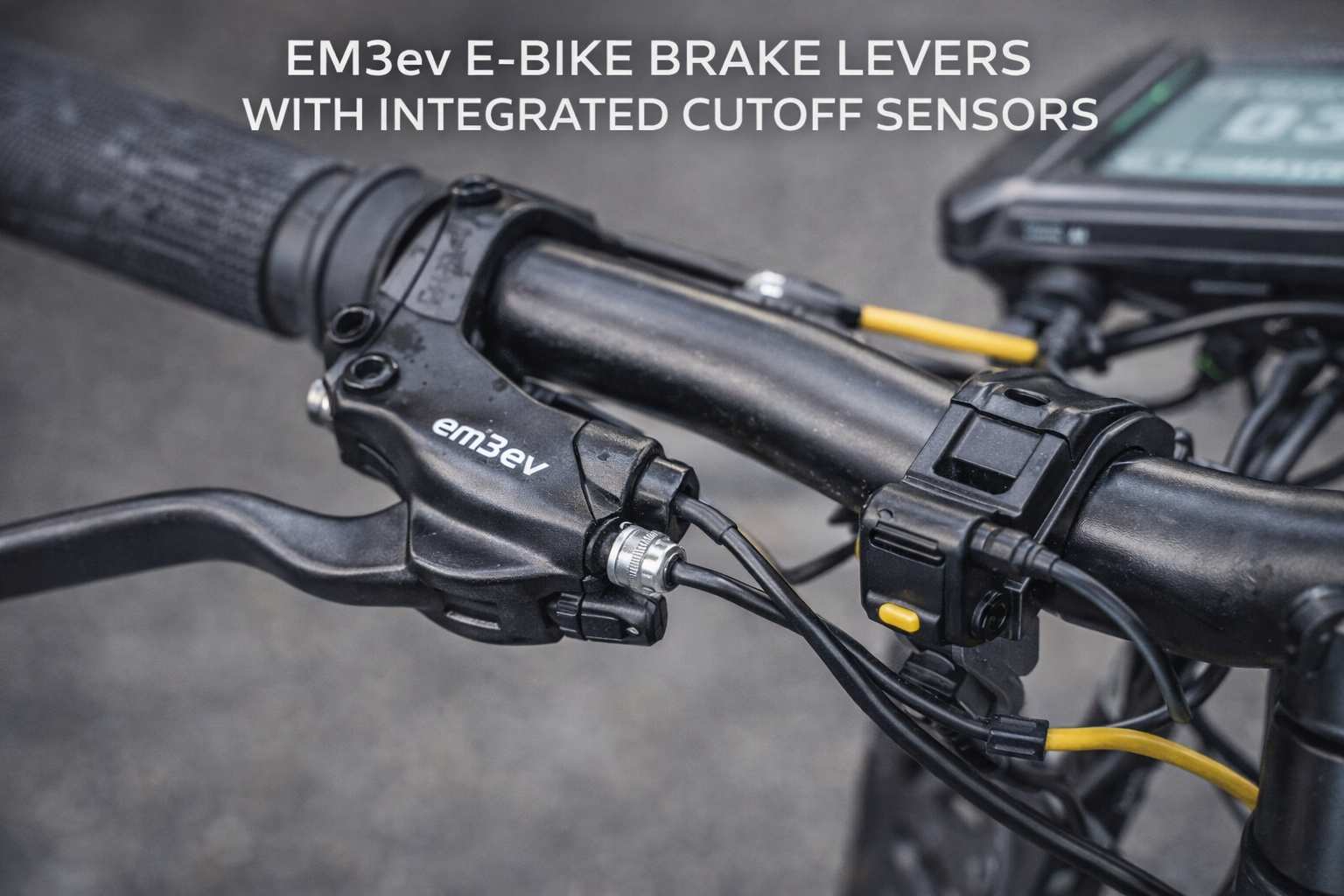
Another critical detail is the “motor cutoff” sensor. When you pull your brake lever on an e-bike, you want the motor to stop pushing immediately. This is where specific bicycle brake caliper types and compatible levers become a safety requirement rather than an option. If your brakes and motor are fighting each other, you’ll wear through your pads in weeks rather than months.
Recommended Brake Components & Compatibility

EM3ev Hydraulic E-Brake Kit
High-torque hydraulic levers featuring built-in motor cutoff switches. Perfect for mid-drive and high-power hub motor builds.
- System: Hydraulic Disc
- Feature: Higo 2-pin/3-pin Cutoff
- Best for: E-Bikes & Cargo
Universal Mechanical Brake Sensors
Add smart cutoff functionality to your existing mechanical bicycle brake cable types without replacing your favorite levers.
- System: Universal Cable
- Feature: Magnetic Sensor Tech
- Best for: Retrofits & Commuters
Pro Tip: Organic vs. Sintered Pads
Don’t forget the pads! Your choice of bicycle brake pads types changes everything:
• Organic (Resin): Quiet, fast “bite,” but wears out quickly in the mud.
• Sintered (Metallic): Noisy when wet, but lasts forever and handles extreme heat perfectly.
• Semi-Metallic: The best “everyday” middle ground for most riders.
Unsure About Your Frame Compatibility?
Matching the right caliper mount to your fork or frame can be tricky. View our detailed compatibility charts to ensure a perfect fit.
Frequently Asked Questions
The primary systems are rim brakes (including calipers and V-brakes) and disc brakes (mechanical or hydraulic). Rim brakes are preferred for lightweight road cycles, while disc brakes provide the all-weather power needed for modern MTBs and e-bikes.
Mechanical discs are easier to maintain for home mechanics using standard cables. Hydraulic systems offer superior modulation and “one-finger” stopping power, though they require periodic fluid bleeding to maintain performance.
V-brakes provide more leverage and stronger braking for flat-bar bikes. Cantilevers offer greater tire and mud clearance, making them ideal for traditional touring and cyclocross bikes.
Yes. Because the braking surface (rotor) is located at the hub, it stays away from road spray. This allows disc brakes to bite immediately, unlike rim brakes which may have a delay while water is wiped off the rim.
Cutoff sensors (ebrake sensors) instantly stop the motor when you brake. This prevents the motor from “fighting” your brakes, reducing wear on pads and ensuring controlled stops in emergency situations.
Choose Organic (Resin) pads for quiet, smooth stopping in dry weather. Use Sintered (Metallic) pads for long-lasting performance in wet, muddy, or steep conditions where heat management is critical.
Squealing is usually caused by pad contamination or misalignment. Clean your rotors or rims with 90% isopropyl alcohol and ensure your calipers are perfectly centered to eliminate vibrations.
Generally, no. Road calipers use a “short-pull” ratio, while most MTB V-brakes use “long-pull.” You must match your lever’s pull-ratio to your caliper type to ensure safe and effective braking.
Final Thoughts on Stopping Power
To be honest, after thousands of miles on the road, I’ve realized that the “best” types of bicycle brakes are the ones you trust. Whether you prefer the classic look of rim brakes or the raw stopping power of hydraulic discs, regular maintenance is what keeps you safe. Actually, your brakes are a conversation between you and the road. If the levers feel firm and the pads are clean, you can ride with the confidence to push your limits.
Remember, when you are looking for different types of bike brakes, consider your total weight and the weather you are likely to face. If you’re building a high-speed e-bike, don’t cut corners on your stopping power. It’s better to have too much brake than not enough when that unexpected car pulls out in front of you.
Ready for a Safer Ride?
Explore our selection of e-bike compatible brake kits and high-performance replacement pads today.




LEAVE A COMMENT