





How to Choose Safe E Batteries: 7 Expert Tips
E batteries act as the fuel tank for your electric bike or scooter. These rechargeable packs use lithium-ion cells to store energy. The most common systems are 36V, 48V, and 52V. These numbers determine your vehicle’s speed and climbing power.
What is an E Battery?
An e battery (or e-bike battery) is a high-capacity rechargeable power unit designed specifically for electric bicycles and scooters. Unlike standard car batteries, these packs use lightweight lithium-ion cells (typically 18650 or 21700 types) managed by a BMS to deliver sustained power for propulsion. They are defined by their Voltage (V), which dictates speed, and Amp Hours (Ah), which determine range.

The “Range Anxiety” Reality Check
I still remember the first time my battery died on me. I was testing a generic e-bike conversion kit, feeling confident with a 50% charge indicator on the display. But halfway up a steep 12% grade hill—about five miles from home—the motor stuttered and cut out completely.
Suddenly, my agile bike became a heavy, 60-pound anchor. That long walk home taught me a lesson. Not all power packs are equal. You need more than just raw power. You must understand how that power is delivered and managed.
Whether you are looking for a replacement pack or building a high-performance DIY scooter, understanding the chemistry and specifications is the difference between a joyride and a strand. In this guide, we will break down voltage, capacity, and safety without the confusing jargon. We will help you find the best energy storage solution for your needs.
Quick Replacement Guide: Which Battery Do You Need?
| Your Riding Style | Recommended Voltage | Ideal Capacity | Top Pick |
|---|---|---|---|
| Daily Commuter (Flat roads, <20 miles) | 36V or 48V | 10Ah – 14Ah | Super Shark (Compact) |
| Hill Climber / Speed (Steep hills, 25+ mph) | 52V (High Power) | 17Ah – 20Ah | Jumbo Shark (High Discharge) |
| Long Range Tour (40+ miles range) | 48V or 52V | 20Ah+ | Triangle / Custom Pack |
1. Understanding Battery Types: Lithium vs. Lead-Acid
When shopping for energy storage for your ride, you will primarily encounter two chemistries. Lead-acid batteries used to be the standard. Today, the industry has shifted to lithium. This matters for your ride.
Lithium-Ion Batteries (Li-ion)
These are the gold standard for modern electric vehicles. Lithium-ion technology offers a high energy density, meaning they pack a significant amount of power into a small, lightweight package. If you plan to carry your pack indoors to charge, this is practically your only viable option.
Most batteries designed for modern e-bikes use 18650 or 21700 cells. These look like large AA batteries welded together to create a pack.
Lead-Acid Batteries (SLA)
You might find these on older, heavy electric scooters or very budget-friendly conversion kits. They are bulky, heavy, and have a short lifespan. I generally recommend avoiding these unless you are restoring a vintage unit or have extremely strict budget constraints.
Comparison: Lithium-Ion vs. Lead-Acid
| Feature | Lithium-Ion (Li-ion) | Lead-Acid (SLA) |
| Weight | Lightweight (5–8 lbs avg) | Heavy (15–30 lbs avg) |
| Lifespan | 500–1,000+ cycles | 200–300 cycles |
| Energy Density | High (Longer range per lb) | Low (Shorter range per lb) |
| Voltage Sag | Low (Consistent power) | High (Power drops quickly) |
| Maintenance | Low (Managed by BMS) | Moderate (Sensitive) |
2. Decoding the Specs: Volts, Amps, and Watts
If you want to choose the right e batteries, you need to speak the language. Think of electricity like water flowing through a pipe. This analogy helps simplify the technical terms.
- Voltage (V) = Water Pressure:
Voltage acts like water pressure. It decides how fast energy moves. It gives your motor its “push.” Common options are 36V, 48V, or 52V. A higher voltage system gives you faster acceleration. You also get a higher top speed and better hill-climbing power. - Amp Hours (Ah) = Water Tank Size:
This is your capacity. A 10Ah battery is a small tank; a 20Ah battery is a large tank. The more Amp Hours you have, the longer you can ride before recharging. - Watt Hours (Wh) = Total Energy:
Calculated as Volts × Amp Hours. This is the truest measure of range. For example, a 48V 14Ah battery has 672 Watt Hours (48 x 14 = 672).

The “Voltage Sag” Phenomenon
In my experience testing different packs, one thing often surprises riders: voltage sag. As you drain the battery, voltage drops. A 48V battery fully charged is actually around 54.6V. However, when it is near empty, it drops to roughly 39V.
This is why your e-bike feels “zippier” when you first leave the house and sluggish on the way back. Buying a higher quality battery with better cells helps minimize this effect, keeping your speed consistent for longer.
3. Deep Dive: What is Inside the Black Box?
A battery is not just a plastic brick; it is a complex system. To get a high-quality unit, you must look at the components inside.
The Cells: 18650 vs. 21700
The individual cells are the fuel tanks of your battery.
- 18650 Cells: These have been the industry standard for years. They are reliable and widely available.
- 21700 Cells: These are the new standard (used by companies like Tesla). They are slightly larger but hold significantly more energy. This allows us to build batteries designed to be smaller while providing the same range.
Pro Tip: Always check the brand of the cells. Look for Tier 1 manufacturers like Samsung, LG, Panasonic, or Sanyo. Avoid generic “Chinese cells” if you want longevity and safety. Generic cells often overstate their capacity and degrade safely.
The C-Rating (Discharge Rate)
This specification is often overlooked. The C-rating tells you how much current the battery can deliver safely at one time.
- Low C-Rating: Good for low-speed cruising on flat ground.
- High C-Rating: Required for high-performance motors, heavy riders, or steep hills. If your motor pulls more amps than your battery can provide, the battery will overheat and shut down.
The BMS (Battery Management System)
The BMS is the “brain” of the battery. It is a circuit board that sits inside the case. Its job is critical:
- Overcharge Protection: Stops charging when full.
- Over-discharge Protection: Cuts power before the battery drains dangerously low.
- Balancing: Ensures all cell groups remain at the same voltage.
- Temperature Monitoring: Shuts down the pack if it gets too hot.
At EM3ev, we use “Smart BMS” technology in many packs. This allows you to connect via Bluetooth to monitor the health of individual cell groups from your phone.
Note: Our Smart BMS is engineered specifically for light electric vehicles (LEVs) like e-bikes and e-scooters. It is not compatible with full-sized electric cars (EVs) which require different high-voltage management protocols.
4. Safety Standards and Regulations
Safety is the most critical topic in the industry right now. With the rise of generic, poorly made batteries, fire risks have become a concern.
UL Certification
In the United States, UL 2849 is the gold standard for safety. This certification proves the battery, motor, and charger are safe. It ensures they work together to prevent fires or shocks. Are you buying a complete e-bike? Always look for this mark. If you are buying a kit or a replacement battery, look for UN38.3 certification, which ensures the battery is safe for transport.
Construction Quality
Safety starts with assembly. High-quality packs use:
- Cell Holders: Plastic frames that keep cells separated to prevent short circuits and aid cooling.
- Pure Nickel Strips: For connecting cells (cheaper packs use nickel-plated steel, which has higher resistance and heat).
- Individual Fusing: Some advanced packs fuse each cell group. If one cell fails, the fuse blows, isolating the bad cell and saving the rest of the pack.
5. Weather and Performance: Winter Riding
Did you know that temperature drastically affects your range? Lithium ions move slower in the cold.
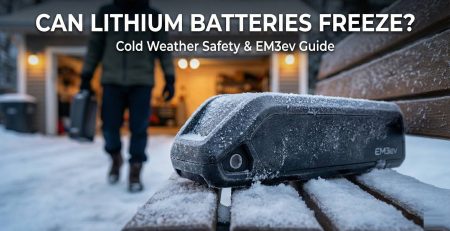
- The Freeze Rule: Never charge a cold battery. If it is below 32°F (0°C), do not plug it in. This damages the battery permanently. It even creates a fire risk.
- Range Loss: Also, expect range loss. At freezing temperatures, you might lose 20-30% of your range.
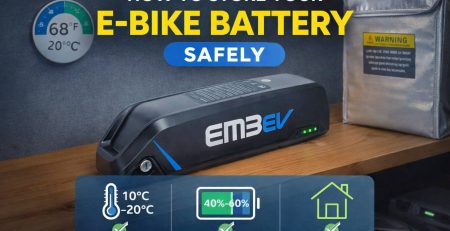
- Storage: If you are storing your bike for winter, do not leave it at 100% or 0%. The ideal storage charge is roughly 50% to 60% (often 3.8V per cell). Store it indoors at room temperature.
6. Buying Guide: How to Choose a Replacement Battery
Buying e batteries can be tricky because the market is flooded with generic options. Whether you are looking for a replacement or a custom build, follow these steps.
Step 1: Match the Voltage
Your battery voltage must match your controller.
- 36V Controller: Needs a 36V battery.
- 48V Controller: Needs a 48V or 52V battery (check if your controller supports 52V).
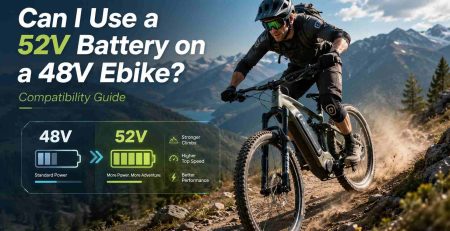
- 52V Battery Benefit: A 52V battery on a 48V system provides more power and maintains higher speed as the battery drains.
Step 2: Determine Physical Fit
Batteries come in various shapes:
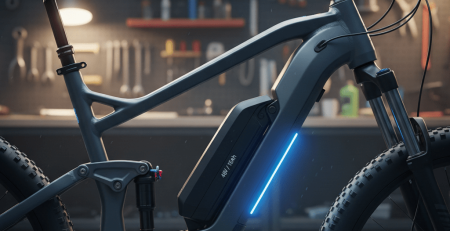
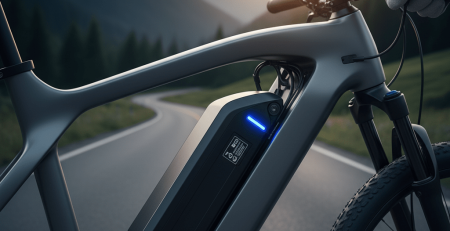
- Downtube (Shark/Dolphin): Mounts to the water bottle holes. Best for weight balance.
- Rear Rack: Good for step-through bikes but makes the bike “tail heavy.”
- Triangle Pack: Fits inside the frame triangle. Best for massive capacity and high power.
Step 3: Check the Connector
There is no universal standard in the United States or Europe. Common connectors include:
- XT60 / XT90: Yellow connectors, very common for high power.
- Anderson Powerpole: Red/Black connectors.
- Barrel Plug: Common for charging ports but not for discharge.
Ensure the battery connector matches your motor controller, or be prepared to solder a new one.
Recommended Configurations
Based on typical use cases, here are the configurations I recommend:
BEST FOR COMMUTING

EM3ev The Daily Commuter (36V 10-13Ah)
Perfect for flat city riding and distances under 20 miles. Lightweight and easy to remove for office charging.
Weight:~5-6 lbs
Voltage:36V
Range Est:15–25 miles
HIGH PERFORMANCE
EM3ev The Hill Climber (48V/52V 17-20Ah)
High voltage ensures consistent and reliable power on inclines. High capacity supports long-distance touring.
Weight:~10-12 lbs
Voltage:48V or 52V
Range Est:35–50+ miles
7. Shipping and Disposal
Because lithium batteries are classified as Class 9 Dangerous Goods, shipping them is strictly regulated.
Shipping Constraints
In the United States, shipping high-capacity batteries usually requires ground transport (FedEx Ground or UPS Ground) with specific Hazmat labeling. This is why shipping can sometimes take longer than standard parcels. Avoid sellers who ship loose batteries in plain boxes without foam padding; this is a safety violation.
Eco-Friendly Disposal
Lithium batteries contain cobalt, nickel, and copper. They should never end up in a landfill. When your battery reaches the end of its life (usually after 3-5 years), do not throw it in the trash.
- Look for Call2Recycle drop-off locations.
- Visit local hardware stores or bike shops; many have recycling programs.
Frequently Asked Questions (FAQ)
Here are answers to common questions about power packs, derived from real rider queries.
How long do e-bike batteries last?
Typically, a high-quality lithium-ion battery lasts between 3 to 5 years, or roughly 500 to 1,000 full charge cycles. After this, the capacity will drop to about 80%. The battery will still work, but you will notice a reduction in range.
Can I use a higher voltage battery on my e-bike?
It depends on your controller components. Most 48V controllers can handle a 52V battery, which provides a nice speed boost. However, putting a 48V battery on a 36V system may fry the electronics (specifically the capacitors). Always check your controller’s maximum voltage rating first.
What is the difference between Ah and Wh?
Ah (Amp Hours) measures the fuel tank size. Wh (Watt Hours) measures the total energy work the battery can do. Watt Hours is more accurate for comparing batteries of different voltages. Formula: Volts x Ah = Wh.
Are these batteries waterproof?
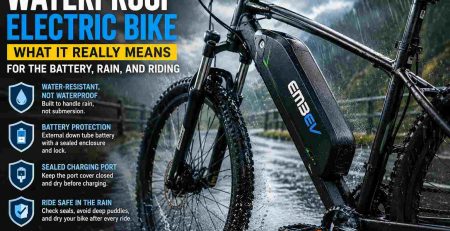
Most are water-resistant (IP65 rated), meaning they can handle rain and splashes. However, they are not submersible. Never use a high-pressure washer directly on the battery casing or the electrical contacts.
Is it better to drain the battery completely before charging?
No. Unlike old nickel-cadmium batteries, modern Li-ion batteries do not have a “memory effect.” Deep discharging (running it to 0%) actually stresses the cells. It is better to top them off after every few rides. We recommend keeping the charge between 20% and 80% for maximum longevity.
Can I fly with my e-bike battery?
Generally, no. The limit for airline carry-on is usually 100Wh (some allow up to 160Wh with permission). Most e-bike batteries are 400Wh to 800Wh, making them strictly prohibited on passenger planes.
Why are customized batteries better?
Generic batteries often use weak welds and cheap cells. Batteries designed by specialists use reinforced nickel strips. They also feature authentic Tier 1 cells. This ensures the pack can handle road vibrations. It will not fail when you need it most.
Final Thoughts on Choosing Your E Battery
Choosing the right power source feels technical, but it ultimately comes down to matching the voltage to your motor and the capacity to your desired range. Whether you are commuting daily or exploring trails, investing in a quality lithium pack is the best upgrade you can make for your electric vehicle.
Stay safe, charge smart, and enjoy the ride.
Disclaimer: Always consult your vehicle’s manual before modifying electrical components. Working with high-capacity lithium batteries carries inherent risks.



LEAVE A COMMENT