






48V vs 52V E-Bike Battery
Choosing between a 48V vs 52V eBike battery comes down to full-system compatibility and usable watt-hours. A 52V pack can provide more voltage headroom on a system designed for 58.8V at full charge, but it is not automatically faster, longer-range or compatible with a 48V bike. Check the controller, display, motor electronics, lights, charger, low-voltage cutoff, connector and frame fit before changing voltage.
If an eBike feels weaker on a hill, the cause may be voltage sag, a low state of charge, cold cells, an undersized battery, controller limits or motor temperature. Battery voltage is only one part of the diagnosis.
A 52V swap can damage or confuse components that were designed only for a 48V battery. The correct question is not whether the connector fits, but whether every connected component is approved for a 58.8V fully charged pack.

Quick Comparison: 48V vs 52V at a Glance
The table below compares common 13-series and 14-series lithium-ion packs. Values are typical, not universal; the battery and controller manufacturer specifications take priority.
48V vs 52V E-Bike Battery Comparison
| Metric (Series) | 48V Battery (13S) | 52V Battery (14S) | Compatibility and Performance Note |
|---|---|---|---|
| Full Charge | 54.6V | 58.8V | Higher voltage headroom on compatible systems |
| Nominal Voltage | 48.1V | 52.0V | At the same electrical power, higher voltage can mean lower current |
| Cutoff (Empty) | Controller/BMS dependent | Controller/BMS dependent | Use the specified low-voltage cutoff |
| System Compatibility | Controller, display and charger rated for 54.6V full charge | Controller, display and charger rated for 58.8V full charge | Motor wattage alone does not determine battery voltage |
| BMS and Pack Current | Model-specific; match controller battery current | Model-specific; match controller battery current | Cells, BMS, wiring and controller must all support the load |
Thinking about an upgrade?
Before changing voltage, verify the complete electrical system—not only the motor. The controller input limit, display profile, lighting circuit, charger, low-voltage cutoff and connector all matter.
The Math Behind the Power: 13S vs 14S
To understand why a higher voltage battery feels different, we have to look inside. Lithium-ion batteries are made of individual cells. A 48V battery is typically a “13S” pack (13 cells in a series), while a 52V pack is a “14S” pack.
Voltage Fact Check:
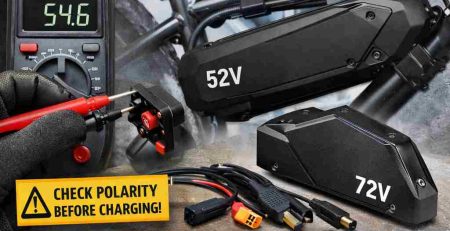
- 48V (13S): A typical lithium-ion pack reaches 54.6V when full. The usable lower limit varies by cell, BMS and controller.
- 52V (14S): A typical lithium-ion pack reaches 58.8V when full. The usable lower limit varies by cell, BMS and controller.
A 14S pack starts at a higher voltage than a 13S pack. On compatible electronics, that can provide more voltage headroom as the pack discharges, but actual speed, torque and range also depend on controller settings, motor characteristics, watt-hours and load.
Compare current EM3ev 48V and 52V battery options
Choose 48V for broad compatibility and balanced everyday performance. Choose 52V only after confirming that the controller, display and charger support a 58.8V fully charged pack.
Why Hill Climbing Feels Different: Solving Voltage Sag
Voltage sag is the temporary voltage drop seen when the motor draws current, especially during acceleration or climbing. Its size depends on current demand, cell resistance, state of charge, temperature, battery age, pack configuration, wiring and connectors.
A 52V pack begins at a higher voltage, but it does not automatically have less sag. Compare voltage drop under the same current or power using packs with similar condition and appropriate cells. Hill-climbing performance remains limited by the controller, motor, gearing, temperature and battery current capability.

Is a 52V charger different?
Yes. A typical 48V lithium-ion charger outputs 54.6V, while a typical 52V charger outputs 58.8V. Use only the charger supplied or explicitly approved for the exact battery, with matching output voltage, connector, polarity and charge current.
Can I Use a 52V Battery on a 48V Controller?
Some systems sold as 48V also support a 52V battery, while others do not. Compatibility must be confirmed in the controller and system manufacturer’s specifications. A capacitor marked 63V is only one component rating and does not prove that the controller, display, lights or firmware support a 58.8V input.
The 52V Safety Checklist
- Confirm the controller input limit: A 63V capacitor marking alone is not a compatibility guarantee. Check the controller manufacturer’s maximum input voltage and approved battery profiles.
- Low Voltage Cutoff (LVC): Your 48V controller might think the 52V battery is “full” when it’s actually half-empty, or it might not protect it from over-discharging.
- Display Compatibility: Some displays will show the wrong battery percentage (e.g., showing 100% until the battery is nearly dead).
Model-Specific Bafang and CYC Compatibility
Bafang and CYC product families include different controller versions, firmware and approved voltage ranges. Do not assume compatibility from the motor name alone. Check the exact model, controller label, display settings and current manufacturer documentation before connecting a 52V battery.
What to Verify on a CYC System
For a CYC system, use the voltage range, battery profile and current limits published for the exact motor and controller generation. Do not rely on a fixed RPM or speed increase without a controlled test, because gearing, wheel size, firmware, load and thermal conditions change the result.
- Connector: Use the connector type, polarity and current rating specified for the system; do not change connectors without qualified installation.
- Battery current: Match the pack’s verified continuous current rating to the configured controller battery-current limit.
- Firmware and display: Select only a battery profile approved for the exact system, and confirm low-voltage protection and state-of-charge display behaviour.
Watt-Hours vs Amp-Hours: The Range Formula
Don’t get distracted by just the voltage. Power and range depend on the total energy, measured in Watt-hours (Wh). While Amp-hours (Ah) measures “capacity,” Watt-hours measures the “total fuel”.
Formula: Volts (V) × Amp-hours (Ah) = Watt-hours (Wh)
Example: A 48V 10Ah battery has 480Wh. A 52V 10Ah battery has 520Wh. Even though the “Ah” is the same, the 52v and 48v batteries differ in total energy—the 52V pack actually gives you ~8% more total capacity.

Premium 48V 17Ah Battery
- ⚡ Cells: Genuine LG/Samsung 18650
- Energy: About 816Wh at nominal voltage; actual range depends on Wh per mile
- Compatibility: Verify controller input voltage, current, connector, charger and fit
High-Power 52V 20Ah Pack
- Performance: Depends on cells, pack resistance, current demand and state of charge
- Current: Match the exact pack rating to the configured controller current
- Energy: About 1,040Wh at nominal voltage; actual range depends on Wh per mile
Final Verdict: 48V or 52V?
Choose 48V when it is the voltage specified for your existing system or when broad parts compatibility is the priority. Choose 52V only when the complete system supports a 58.8V full-charge input and the additional voltage headroom serves a clear performance goal. For range alone, compare watt-hours before changing voltage.
Frequently Asked Questions
Q: Will a 52V battery burn out my 48V motor?
A: It can damage the controller, display, lights or other electronics if they are not rated for 58.8V. The motor may also be affected indirectly through higher speed, current or heat. Verify every connected component before use.
Q: Does 52V increase range?
A: A 52V pack has more nominal watt-hours than a 48V pack at the same Ah, but range also depends on usable capacity, efficiency, speed, terrain and rider input. Compare Wh rather than voltage alone.
Q: Can I use my 48V display with a 52V battery?
A: Not necessarily. Some displays do not support 52V and may show an incorrect state of charge or fail. Confirm the display’s maximum input voltage and available battery profile.
Q: What is the real-world speed difference between a 48V and 52V battery?
A: There is no universal mph increase. The result depends on motor speed constant, controller settings, current limits, wheel size, gearing, load and battery condition. A compatible 52V system can have more voltage headroom, but measure the specific setup rather than relying on a fixed number.
Q: Does the BMS rating affect my ebike’s power output?
A: The BMS current limit can restrict delivery, but a higher BMS number does not make a pack more powerful by itself. The cells, parallel configuration, wiring, connectors and controller must all support the requested current.
Safety note: Follow the battery, controller, motor and bicycle manufacturer instructions and local rules. Do not change system voltage unless every connected component is confirmed compatible.





LEAVE A COMMENT