




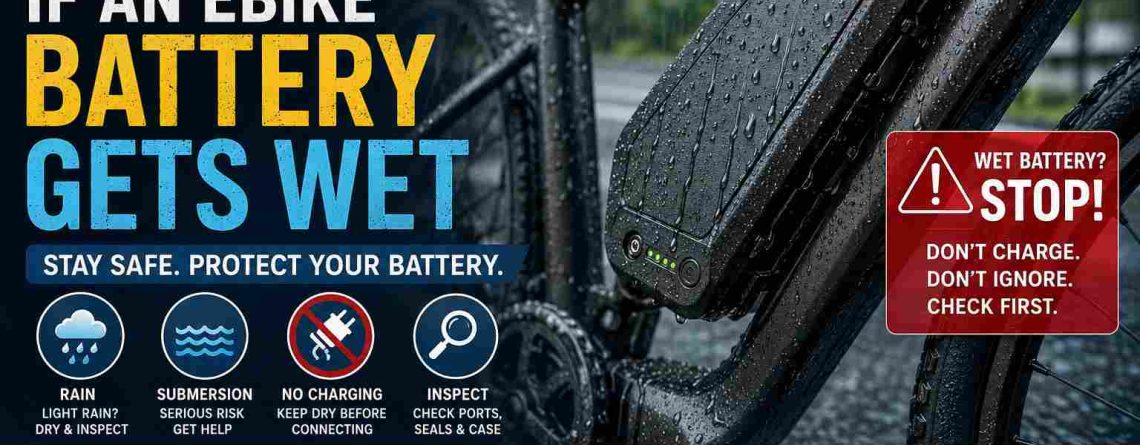
Urgent Guide: What to Do If eBike Battery Gets Wet
Knowing what to do if ebike battery gets wet can save your pack from permanent damage and costly replacements. Fortunately, rain does not always ruin a battery; many enclosed systems can handle normal road spray and light rain when their cases, seals, ports, and connectors are in good condition.
If your eBike battery gets wet, stop using it, keep it disconnected from the charger, and determine whether the water stayed on the outside or may have entered the case or terminals.
Do not assume that the battery is safe because it still turns on. Internal moisture can cause corrosion, electrical leakage, short circuits, or faults that appear later.
Quick Answer: What Should You Do With a Wet eBike Battery?
Turn off the bike and disconnect the charger if this can be done without touching wet or damaged electrical parts. Do not charge the battery while its case, charging port, mount, or terminals are wet.
If the battery was only exposed to light rain, dry the exterior and connector area, inspect it, and follow the manufacturer’s instructions before reconnecting it.
If the battery was submerged, exposed to floodwater or saltwater, has water inside the case, or shows heat, swelling, smoke, hissing, leakage, or an unusual smell, stop using it and arrange professional inspection or damaged-battery disposal.
How Serious Is the Water Exposure?
The correct response depends on how the battery became wet. A few drops on a closed battery case are not the same as a battery that fell into a river.
| Type of exposure | Risk level | Recommended response |
|---|---|---|
| Light rain on an intact, closed case | Usually lower | Turn off the bike, dry the exterior and connectors, inspect the seals, and follow the battery manual. |
| Heavy road spray or deep puddles | Moderate | Inspect the mount, discharge contacts, charging port, cables, and underside of the case before reuse. |
| Open charging port exposed to water | High | Do not connect the charger. Keep the battery off until the port and internal condition have been assessed. |
| High-pressure hose or pressure washer | High | Stop using the battery. Pressurized water may pass seals that resist ordinary rain. |
| Freshwater submersion | Serious | Do not charge or power on the battery. Obtain professional advice before moving, testing, shipping, or disposing of it. |
| Saltwater or floodwater submersion | Severe | Treat the battery as damaged. Do not attempt to restart, charge, open, or repair it yourself. |
| Heat, smoke, hissing, swelling, or leakage | Emergency | Move away, keep others away, and contact emergency services. Do not touch or move an actively failing battery. |
What to Do Immediately If an eBike Battery Gets Wet
- Stop riding. Turn off the bike. Do not continue riding to “dry it out,” because electrical current may make an internal water problem more serious.
- Disconnect the charger only if it is safe. If the battery is charging, switch off power at the outlet before approaching it. Do not touch wet plugs, exposed wires, or electrical parts.
- Do not press the power button repeatedly. Repeated attempts to restart the bike can energize wet terminals or damaged internal circuits.
- Move away from traffic and direct sunlight. Place the bike in a dry, shaded, ventilated location if it can be moved safely.
- Remove the battery only when conditions are safe. Remove it only if it is cool, stable, not smoking, and designed to be removable. Do not handle a battery that is rapidly heating, hissing, swelling, leaking, or producing smoke.
- Keep it away from combustible materials. Do not place a suspected damaged battery beside paper, fuel, clothing, bedding, or other batteries.
- Do not charge it. Connecting a charger to wet or contaminated terminals can create a short circuit, corrosion, heat, or further internal damage.
- Document the exposure. Record whether the battery saw rain, a puddle, freshwater, saltwater, floodwater, or high-pressure washing. Take photos of the case, port, connectors, and mount.
Move Away and Call for Help If the Battery:
- Begins smoking or releasing vapor
- Makes hissing, popping, or crackling sounds
- Becomes hot very quickly
- Swells or changes shape
- Leaks fluid
- Produces a strong chemical or burnt smell
- Shows flame or glowing material
Do not attempt to carry an actively failing battery outdoors. Move people away and contact emergency services.
Light Rain Is Different From Battery Submersion
Many eBike batteries use sealed cases that provide protection against ordinary rain and road spray. That protection depends on the case being undamaged and the charging-port cover being fully closed.
Weather resistance does not make a battery waterproof. Water can still enter through:
- An open or damaged charging port
- A cracked case
- A worn case gasket
- Loose cable glands
- Battery-mount terminals
- Damaged discharge cables
- Drainage paths blocked by dirt
- Pressure washing
A battery that was briefly ridden in normal rain may only need exterior drying and inspection. A submerged battery should not be treated as a wet version of the same situation.
Shimano battery instructions warn against placing a battery in fresh or sea water and against allowing the battery terminals to become wet. Bosch also advises against direct high-pressure washing and recommends keeping the battery mount and connector area clean so moisture can drain and dry.
Can You Charge an eBike Battery After It Gets Wet?
Do not charge an eBike battery while the battery case, charging port, terminals, connector, mount, or charger is wet.
A charging plug may appear dry on the outside while moisture remains inside the socket. Connecting it can energize contaminated contacts and cause corrosion, electrical tracking, heat, or short circuits.
Before charging a battery exposed only to normal rain:
- Confirm that the case is not cracked or deformed
- Dry the charging-port cover and surrounding area
- Check that no water is collected inside the port
- Inspect the charger plug for moisture and corrosion
- Follow the battery manufacturer’s drying instructions
- Use only the correct charger for that battery
Do not charge a battery that was submerged, exposed to saltwater or floodwater, or suspected of having water inside. Ask the manufacturer or a qualified lithium-battery technician how it should be handled.
How to Dry an eBike Battery Safely
If the battery only has rainwater on the outside and shows no damage, dry it in a shaded, ventilated area.
Safe exterior-drying steps
- Turn off and remove the battery when it is safe to do so.
- Use a clean, dry cloth to wipe the case.
- Wipe around the charging-port cover and discharge connector.
- Keep the battery upright in its normal orientation.
- Allow moisture around external contacts to evaporate naturally.
- Inspect the mount before reinstalling the battery.

Do not use:
- A hair dryer or heat gun
- An oven, microwave, heater, or direct flame
- Compressed refrigerant
- A pressure washer or high-pressure air jet
- Rice or other material that can enter connectors
- Solvents or electrical sprays not approved by the manufacturer
- Metal tools inside the charging port or battery contacts
Do not open the battery enclosure to speed up drying. Opening the pack can expose live conductors and cells, damage seals, and increase the risk of a short circuit.
There Is No Universal Safe Drying Time
Waiting a fixed number of hours does not prove that the inside of the battery is dry. The correct response depends on the case design, depth of exposure, water type, damaged seals, and whether moisture reached the terminals or internal electronics.
Signs That Water May Have Damaged the Battery
Water damage is not always visible immediately. Stop using the battery if you notice any of the following after rain or water exposure:
- The bike turns off without warning
- The battery no longer charges normally
- The charger changes color unexpectedly
- The display shows unstable battery levels
- The battery becomes warmer than before
- The BMS reports a new fault
- There is corrosion on the terminals
- The charging port looks discolored
- The battery or connector produces a burnt smell
- Water can be heard moving inside the case
- Moisture appears behind a display or transparent section
- The case, cable gland, or port cover is cracked
A battery turning on after drying does not confirm that it is safe. Resting voltage also cannot show whether hidden corrosion or insulation damage is present.
What If the Battery Fell Into Saltwater or Floodwater?
Saltwater and floodwater exposure should be treated as serious battery damage.
Saltwater is highly conductive and can leave corrosive deposits on electrical parts. Floodwater may contain salt, mud, chemicals, sewage, and conductive debris.
After saltwater or floodwater exposure:
- Do not press the power button
- Do not connect a charger
- Do not connect the battery to the bike
- Do not open the case
- Do not rinse the assembled battery with more water
- Do not ship it through ordinary parcel services
- Do not place it in household trash or curbside recycling
Contact the battery manufacturer, a qualified battery specialist, or your municipal household hazardous-waste program. Tell them that the battery is a water-damaged lithium-ion eBike battery before transporting it.
Damaged lithium-ion batteries require different handling from normal end-of-life batteries and may not be accepted at ordinary retail battery collection boxes.
Can a Wet eBike Battery Be Used Again?
A battery exposed only to light rain may be usable again if its case, ports, connectors, and seals remain intact and the manufacturer’s inspection instructions are followed.
Professional assessment is more appropriate when:
- The battery was fully or partly submerged
- Water entered the charging port
- The case has cracks or impact damage
- The battery was pressure-washed
- Saltwater or floodwater was involved
- The battery cuts out or will not charge
- Corrosion is visible on the terminals
- The battery becomes hot during light use
- A BMS fault appeared after the exposure
A technician may need to evaluate insulation, connector resistance, voltage behavior, BMS records, and case integrity. Do not ask an inexperienced repair shop to bypass the BMS or open a sealed battery.
How to Prevent eBike Battery Water Damage
Close the charging-port cover
Check the port cover before every wet-weather ride. Replace a loose, cracked, or missing cover.

Keep the battery locked into its mount
A battery that is not fully seated may leave electrical contacts exposed to road spray.
Avoid deep puddles
Water may reach the battery mount, controller, motor cables, and low-mounted connectors even if the top of the battery remains dry.
Do not use a pressure washer
High-pressure water can pass through seals that resist normal rain. Use a damp cloth or low-pressure cleaning method approved by the bike manufacturer.
Inspect seals and cables
Look for cracks, loose cable glands, damaged insulation, and missing port covers. Repair these problems before riding in wet conditions.
Do not store the battery while wet
Dry the battery, mount, and connector area before indoor storage. Do not cover a wet battery with an airtight cover.
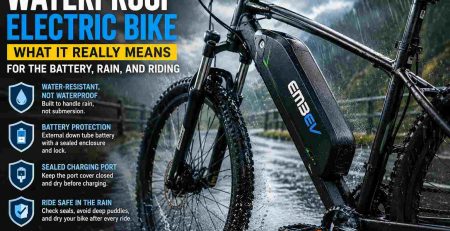
Read the EM3ev waterproof eBike battery and rain guide for more information about riding, charging ports, connectors, and weather-resistant battery cases.
When Should a Water-Damaged Battery Be Replaced?
Replacement may be the safer choice when water has entered the enclosure, corrosion is spreading, the case seal is damaged, or the battery no longer charges and discharges normally.
Do not buy a replacement until you confirm:
- The bike’s required voltage
- The controller’s continuous and peak current
- The required charging voltage
- The connector type and polarity
- The available frame dimensions
- The mounting-rail type
- The charger compatibility
A new battery will not correct a water-damaged controller, display, wiring harness, motor connector, or charger. Inspect the complete electrical system before connecting a replacement pack.
For Compatible 48V Systems

EM3ev 48V Super Shark eBike Battery
The EM3ev 48V Super Shark is a compact rail-mounted battery for compatible 48V systems. Selected Super Shark configurations use a weather-resistant enclosure, water and dust sealing, cell-level fusing, and a Smart BMS.
- 48V nominal, 13-series battery system
- Genuine name-brand cell options
- Smart BMS on applicable configurations
- Cell-level fusing
- Water and dust sealing during final assembly
- Compact Reention Super Shark rail format
Weather resistance does not mean the battery can be submerged or pressure-washed. Confirm controller current, charger, connector, polarity, rail fit, and frame dimensions before ordering.
Replace a water-damaged battery only after the controller, charger, wiring, mount, and connectors have also been checked.
For Compatible 52V Systems
EM3ev 52V Jumbo Shark 17Ah eBike Battery
The EM3ev 52V Jumbo Shark is a larger rail-mounted pack for compatible 52V systems. It uses Samsung cells, a Smart BMS, and an IP65-rated case on the listed product configuration.
- 52V nominal, 14S5P configuration
- 17Ah capacity
- Samsung 35E cells
- 40A Smart BMS
- IP65-rated enclosure on the listed configuration
- Designed for compatible 52V controllers
An IP65 case is not designed for submersion. Do not install a 52V battery on a 48V system unless the controller, display, lighting circuit, charger, and other electrical components have been verified for 52V operation.
Select a battery according to system compatibility, not water resistance alone.
Frequently Asked Questions
Will rain damage an eBike battery?
Light rain does not automatically damage an intact weather-resistant battery. Risk increases when seals, port covers, connectors, or cases are damaged, or when the battery is exposed to deep water or high-pressure washing.
Can I ride my eBike after the battery gets wet?
Do not ride until the exterior, mount, terminals, and charging port have been dried and inspected. A submerged battery or one suspected of internal water entry should not be used until professionally assessed.
Can I charge an eBike battery after riding in the rain?
Only after the battery, charging port, charger plug, and connector area are fully dry and undamaged. Do not charge a submerged battery or one with suspected internal moisture.
How long should an eBike battery dry before charging?
There is no universal drying time. Exterior dryness does not prove the inside is dry. Follow the battery manufacturer’s instructions and obtain professional advice after serious water exposure.
Can I use a hair dryer on a wet eBike battery?
No. Do not apply concentrated heat to a lithium-ion battery. Wipe exterior moisture away and allow natural drying in a shaded, ventilated area.
What should I do if my eBike battery falls into water?
Do not power it on or connect a charger. If it is smoking, hot, hissing, or swollen, move away and call emergency services. Otherwise, contact the manufacturer or a qualified battery specialist for handling instructions.
Is an IP65 eBike battery waterproof?
No. An IP65-rated case provides weather protection under its specified test conditions, but it is not designed for submersion. Seals, ports, cables, connectors, and installation quality also affect real-world water protection.
Can a wet battery be placed in household trash?
No. Lithium-ion batteries should not be placed in household trash or curbside recycling. A damaged or water-exposed battery may require special handling through a household hazardous-waste facility or qualified battery recycler.
Final Answer
If an eBike battery gets wet, stop using it and do not connect the charger until the type of exposure has been identified.
Light rain on an intact battery may require only careful exterior drying and inspection. Water inside the charging port, full submersion, pressure-washing, saltwater, floodwater, visible damage, heat, smoke, or unusual smells require a much more cautious response.
Never open the pack, bypass the BMS, apply strong heat, or repeatedly restart a battery to see whether it still works.
When internal water entry is possible, contact the battery manufacturer or a qualified lithium-battery professional before charging, riding, transporting, or disposing of the pack.
Safety and Compatibility Note
Battery water resistance varies by product, case condition, installation, connectors, seals, and charging-port design. Always follow the instructions supplied by the battery and bicycle manufacturer.
EM3ev batteries are aftermarket battery systems. Voltage, controller current, charger, connector, polarity, mounting rail, and frame fit must be confirmed before installation.
Reference Sources


LEAVE A COMMENT