




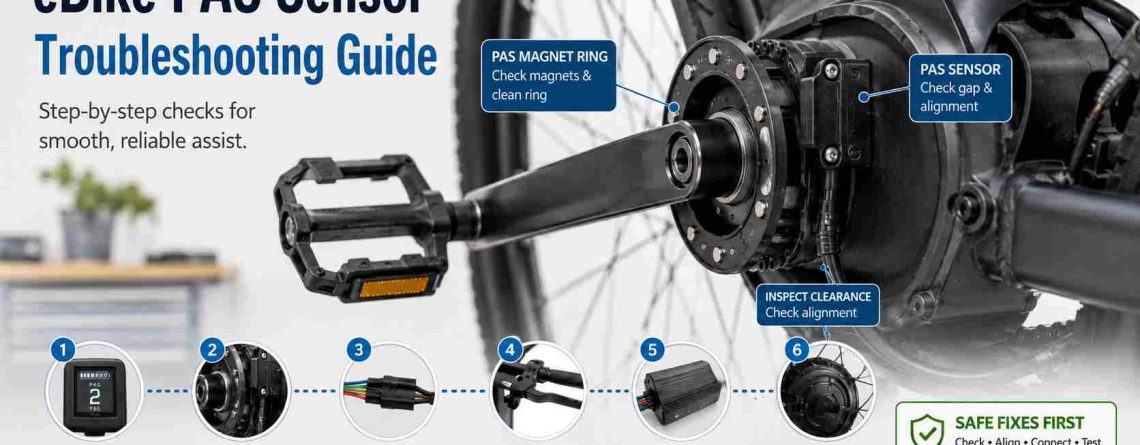
eBike PAS Sensor Not Working? Causes & Safe Fixes
If your eBike PAS sensor is not working, the problem is usually somewhere in the pedal-assist signal path. Common causes include an incorrect assist setting, a shifted cadence sensor or magnet ring, damaged wiring, a loose connector, an active brake cutoff, or a controller input fault. Start with simple external checks before replacing parts.
Quick Answer
- Make sure pedal assist is enabled and the assist level is above zero.
- Identify whether the bike uses a cadence sensor or a torque sensor.
- On a cadence system, inspect the sensor and magnet ring for movement or damage.
- Check accessible PAS wiring and connectors only with the bike safely powered down.
- Make sure the brake levers fully release and are not keeping motor cutoff active.
- Use display error codes and the bike’s service information before replacing the sensor.
An eBike can power on normally yet provide no motor help when you pedal. The display may work. The battery may show a normal charge. On bikes with a throttle, the throttle may even continue to run the motor.
That does not automatically mean the PAS sensor itself has failed.
Pedal assist depends on several parts working together. The sensor has to detect pedaling, its signal has to reach the controller, the controller has to allow assist, and safety inputs such as brake cutoffs must not be active.
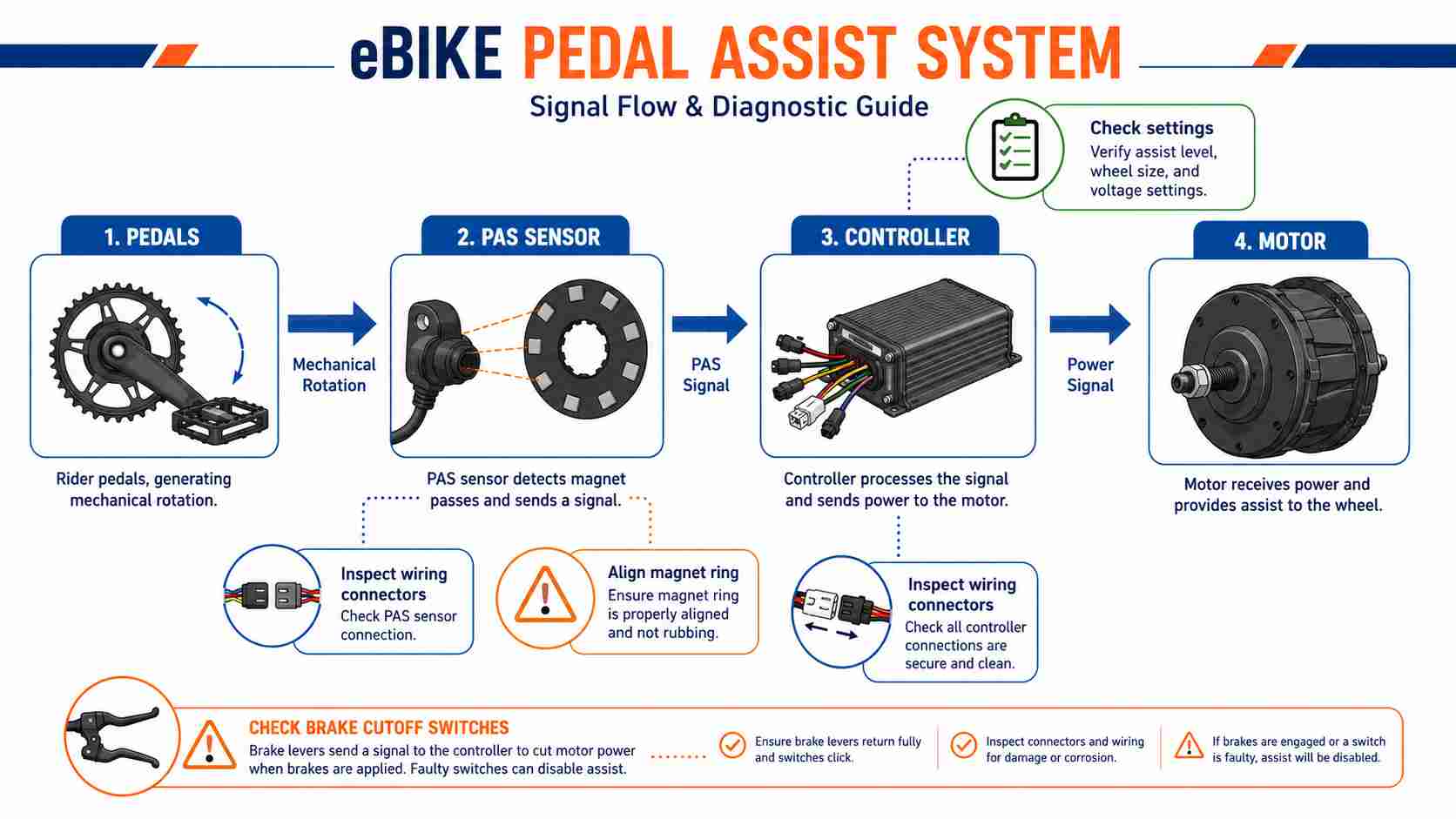
What Does the PAS Sensor Do?
The pedal-assist sensor tells the controller that you are pedaling so the controller can decide when to provide motor assistance.
PAS stands for pedal assist system. The sensor used by that system can vary.
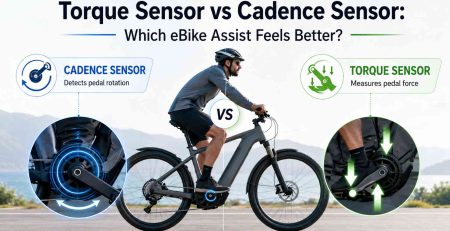
A common cadence PAS uses a rotating magnetic ring near the crank and a fixed magnetic sensor. As the crank turns, the passing magnets create pulses that tell the controller that the rider is pedaling.
A torque-sensing system works differently. It measures rider force and may combine that information with cadence data.
That difference matters during troubleshooting. A visible magnet-ring alignment check applies to many cadence sensors, but it does not apply to every torque-sensing or internally integrated system.
If you are unsure which type your bike uses, see the torque sensor vs cadence sensor guide. This article stays focused on why pedal assist stops working.
Step 1: Check the Display and PAS Setting
Before touching the sensor, confirm that pedal assist is actually enabled and that the selected assist level allows motor support.
Some apparent PAS faults are setting problems.
Turn the system on normally and check:
- The display powers up without a relevant fault message.
- The selected pedal-assist level is above zero.
- No walk mode, service mode, or other setting is blocking normal assist.
- The display has not reset to an unexpected PAS setting.
If the screen shows an error code, record it exactly and use the service information for that controller or display. Error codes are not universal across eBike systems.
Do not clear or ignore repeated errors simply to make the motor run again.
Step 2: Inspect the PAS Magnet Ring and Sensor
On a cadence-based PAS, a shifted, loose, damaged, or poorly aligned sensing ring can stop the controller from detecting pedal movement.
Look near the crank or bottom-bracket area. Many external cadence systems have a rotating ring or disc with magnets and a fixed pickup next to it.
With the bike powered off, inspect the area for:
- A magnet ring that has moved sideways.
- A cracked or warped ring.
- A loose sensor bracket.
- A sensor that no longer faces the sensing ring correctly.
- Dirt or debris that prevents the parts from sitting normally.
- Damage caused by a chain, crank service, impact, or cable movement.
Do not force the ring closer to the sensor based on a generic internet measurement. PAS designs differ. Use the alignment marks or spacing given for your specific sensor when available.
f pedal assist stopped immediately after crank or bottom-bracket service, alignment is especially worth checking because those repairs can disturb the PAS parts.
Step 3: Check the PAS Cable and Connector
A healthy sensor cannot control pedal assist if its power, ground, or signal connection to the controller is interrupted.
PAS wiring often runs close to the crank and lower frame. That area can be exposed to movement, road spray, debris, and cable strain.
Power the bike off before inspecting electrical connections. If the battery is removable and the service instructions call for removal, remove it before disconnecting accessible plugs.
Look for:
- A connector that is not fully seated.
- Bent or recessed connector pins.
- Pinched or crushed sensor cable.
- Damaged insulation.
- Corrosion or moisture around the connector.
- A cable stretched tightly around the frame or bottom bracket.
Do not assume that matching connector shapes mean matching pinouts. Do not probe powered connectors or splice wires without verified wiring information.
If moving the cable changes the symptom, stop testing until the damaged connection is identified.
Step 4: Make Sure the Brake Cutoff Is Not Active
A brake cutoff signal can prevent motor assistance even when the PAS sensor itself is working normally.
Many eBikes disable motor output when a brake lever is pulled. This is a separate safety input to the controller.
Check that each brake lever returns fully after you release it. Look for an obviously damaged, loose, or misaligned external brake sensor.
Do not bypass the brake cutoff as a normal repair method.
If the brake system appears to be holding the motor cutoff active, use the dedicated eBike brake sensor guide rather than turning this PAS article into a brake-sensor repair guide.
What If the Throttle Works but Pedal Assist Does Not?
A working throttle with dead pedal assist usually narrows the problem toward the PAS input path, but it does not prove that every controller circuit is healthy.
If your eBike has a throttle and the motor responds normally to it, the battery and main motor power path are at least able to operate under that condition.
That makes these areas more useful to check first:
- PAS settings.
- Cadence sensor alignment.
- PAS connector and wiring.
- Brake cutoff status.
- The controller’s PAS input.
Do not replace the battery simply because pedal assist has stopped while other powered functions remain normal.
If both throttle and pedal assist fail, the fault is broader and may involve the controller, motor, battery supply, display, or main wiring.
Why Does Pedal Assist Cut In and Out?
Intermittent pedal assist often points to an unstable sensor signal, loose connection, shifting magnet ring, or another controller input that changes while riding.
Notice when the problem happens.
| Symptom | Useful Area to Check |
|---|---|
| No assist at all when pedaling | PAS setting, sensor, connector, brake cutoff |
| Assist starts after several pedal turns | Cadence sensor alignment and controller response |
| Assist cuts in and out on rough roads | Loose connector, cable damage, sensor mount |
| PAS stopped after crank work | Sensor and magnet-ring position |
| Display shows a fault | Use the system-specific error-code procedure |
| Whole bike loses power | Look beyond PAS at the main electrical system |
The pattern can narrow the search, but it is not proof of one failed component.
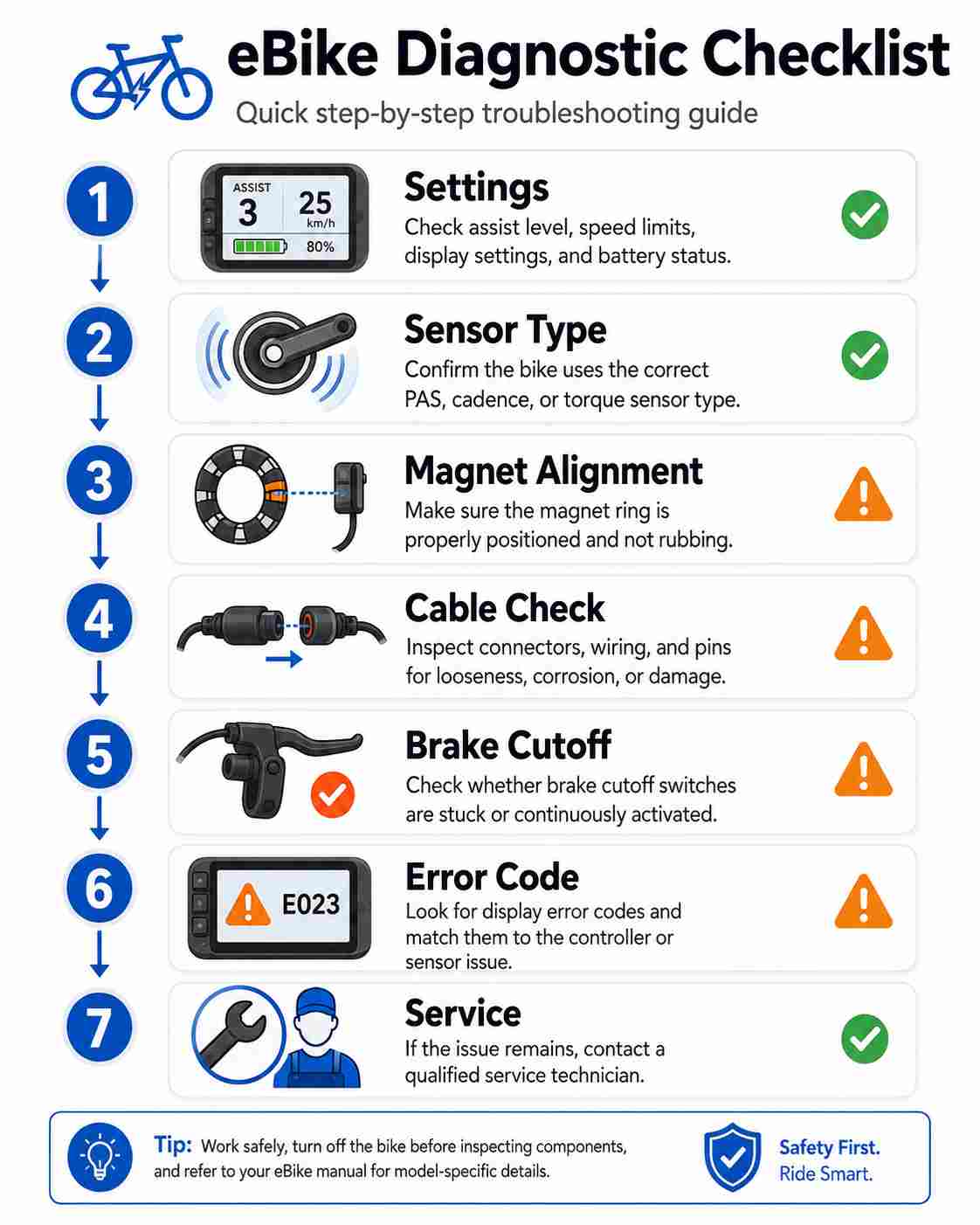
A Safe PAS Troubleshooting Order
Use a simple sequence so you do not replace the PAS sensor before ruling out settings, alignment, connectors, and safety inputs.
- Record the symptom. Note whether assist is completely absent, delayed, or intermittent.
- Check the display. Confirm PAS is enabled and record any error code.
- Identify the sensor type. Do not apply cadence-sensor instructions to an integrated torque sensor.
- Inspect external PAS parts. Look for movement, impact damage, or an out-of-position magnet ring.
- Inspect the cable. Look for obvious abrasion, pinching, or a loose connector.
- Check brake release. Make sure the controller is not receiving a false braking signal.
- Review recent work. Think about any crank, bottom-bracket, wiring, or controller changes made before the fault began.
- Use documented diagnostics. Follow the correct error-code or electrical test procedure for your system.
If the bike can engage the motor unexpectedly, stop troubleshooting with the drive wheel on the ground. Do not continue riding an eBike with unpredictable motor engagement.
When Should You Replace the PAS Sensor?
Replace the sensor only after the basic external checks point to a failed PAS component and the replacement is confirmed compatible with the controller.
Replacement becomes more reasonable when the sensor or sensing ring is physically damaged, the cable has failed, or documented testing confirms that the PAS signal is missing even though power and connections are correct.
Do not buy a replacement only because it looks similar.
Confirm the sensor type, connector, pinout, mounting method, sensing ring, controller compatibility, and any system settings required by the replacement.
Integrated torque sensors and motor-integrated PAS systems may require a different service process and should not be treated as generic plug-in parts.
Frequently Asked Questions
Why is my eBike PAS sensor not working?
Common causes include PAS being set to zero, a shifted cadence sensor or magnet ring, a loose connector, damaged wiring, an active brake cutoff, or a controller input problem.
Why does my eBike power on but have no pedal assist?
The display and battery can still power up even when the controller receives no valid PAS signal. Check the assist setting, sensor, magnet ring, wiring, connectors, and brake cutoff.
Can a misaligned PAS sensor stop pedal assist?
Yes, on cadence systems that use an external magnetic sensing ring. If the sensor or ring moves out of its intended position, the controller may stop receiving pedal-rotation pulses.
Why does pedal assist work only sometimes?
Intermittent assist can come from a loose sensor, shifting magnet ring, damaged cable, poor connector, brake-cutoff signal, or another intermittent controller input.
Does a bad battery cause the PAS sensor to stop working?
A battery problem can affect the whole eBike, but an isolated PAS fault does not automatically mean the battery is bad. If other powered functions remain normal, diagnose the pedal-assist signal path first.
Can I replace an eBike PAS sensor myself?
Some external cadence sensors can be replaced when the correct compatible part and procedure are available. Integrated or torque-sensing systems may require professional service or calibration.
Final Answer
If your eBike PAS sensor is not working, start with the simple parts of the pedal-assist signal path before replacing hardware.
Check the PAS level and display first. Identify the sensor type. On a cadence system, inspect the magnet ring and sensor position. Then check accessible wiring, connectors, and brake-lever release with the bike safely powered down.
If the throttle works but pedal assist does not, that is a useful clue, but it does not prove the controller is completely fault-free.
Do not replace the battery for an isolated pedal-assist problem unless other testing shows a battery-side fault.
If assist engages unpredictably, wiring is damaged, or documented checks do not identify the cause, stop riding and have the PAS and controller input tested by a qualified eBike technician.


LEAVE A COMMENT