




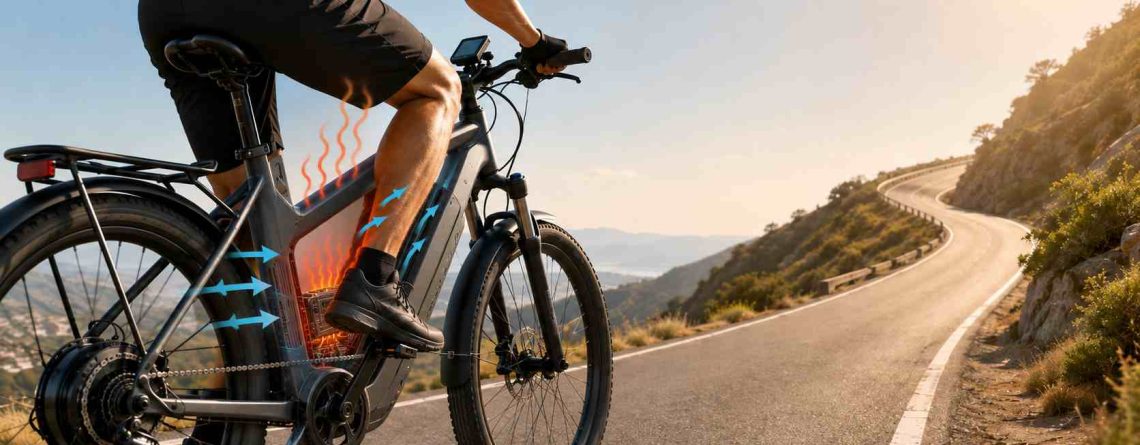
eBike Controller Overheating: Causes, Symptoms & Safe Fixes
eBike controller overheating happens when the controller produces heat faster than its housing and airflow can remove it. Long climbs, high current, heavy loads, hot weather, poor ventilation, incorrect settings, or electrical faults can all raise temperature. Repeated thermal shutdowns are a warning to reduce load and inspect the system rather than keep restarting it.
Quick Answer
- A warm controller is not automatically faulty. Its metal case often acts as a heat sink.
- Long, slow climbs and sustained high current are common overheating triggers.
- Poor airflow or mounting the controller inside an insulated space can reduce cooling.
- Power that fades and returns after cooling can indicate thermal protection. Other faults can look similar.
- Do not open, bypass, drill, or modify a sealed controller without an approved service procedure.
An eBike controller sits between the battery and motor. It switches battery power rapidly to control motor torque and speed. That process is not perfectly efficient. Some electrical energy becomes heat.

Why Does an eBike Controller Overheat?
Controller temperature rises when electrical losses and outside heat exceed the controller’s ability to shed heat.
Power MOSFETs inside the controller carry and switch current to the motor. Part of their conduction loss follows the I²R relationship. This means higher current can increase resistive heating quickly.
Switching losses also add heat as the controller turns its power devices on and off.
That is why overheating often appears during demanding riding rather than easy cruising. Common triggers include:
- Long or steep climbs.
- Repeated hard acceleration.
- Heavy rider or cargo loads.
- High assist or sustained throttle use.
- Hot ambient temperatures.
- A controller enclosed in a bag or tight frame cavity.
- Current limits set above the controller’s practical continuous capability.
- Damaged or high-resistance electrical connections.
Peak output and continuous output are not the same. How much load a controller can sustain depends on its design, mounting, airflow, and ambient temperature.
Is a Hot eBike Controller Always a Problem?
No. A controller housing can become warm or hot during normal operation because the case is often part of the heat-dissipation path.
There is no universal case-temperature number that proves every eBike controller is safe or unsafe.
Internal sensors differ. Semiconductor limits differ. Enclosure design, potting, heat sinks, and thermal interfaces also vary between controllers.
For that reason, use the controller’s own specifications and riding behavior rather than a generic “too hot to touch” rule.
| What You Notice | What It May Mean | Next Step |
|---|---|---|
| Warm controller, normal power | Normal heat transfer may be occurring | Keep cooling surfaces clear and monitor the bike |
| Power gradually drops on a long climb | Thermal rollback may be active | Reduce load and allow cooling |
| Power returns after cooling | A thermal protection state is possible | Check load, airflow, and current settings |
| Burning smell, smoke, or melted connector | Electrical damage or severe overheating | Stop using the bike and arrange inspection |
Why Does the Controller Overheat on Hills?
Steep, slow climbing can keep current high while cooling airflow is limited, creating a difficult thermal condition for the controller.
Climbing requires more motor torque. The controller must supply the current needed to create that torque.
If the climb is slow and long, the controller may stay under heavy electrical load for several minutes. At the same time, the bike may have less airflow than it would at a higher road speed.
Hot weather can add more heat. Cargo adds more load. Low tire pressure increases rolling resistance. Repeated starts on a steep slope can also increase demand.
If power begins to fade, do not keep increasing throttle or assist to force the bike uphill. Pedal more if possible. Reduce the requested assist. Stop in a safe place and let the system cool.
How Airflow and Mounting Affect Controller Cooling
A controller that can transfer heat to moving air or a suitable heat-spreading surface can handle sustained load better than the same controller trapped in an insulated space.
Many controller housings use aluminum to help move heat away from the power electronics.
A closed bag can reduce that heat transfer. Thick insulation can do the same. Blocking cooling fins or surrounding the unit with luggage can also reduce airflow.
Follow the mounting instructions for your controller. Keep intended cooling surfaces clear.
Do not drill the controller case. Do not remove potting or open a sealed enclosure just to add cooling. Those changes can damage sealing, insulation, or electrical clearances.
Check Current Limits and Electrical Matching
A controller can overheat when its settings or connected system keep it above its practical continuous current capability.
Check the controller documentation for battery voltage, maximum battery current, phase-current limits, and thermal protection settings.
If programmable current limits have been changed, return to a supported configuration before assuming the hardware is defective.
Higher current can improve acceleration. It also raises electrical and thermal stress.
The battery must also stay inside the controller’s supported voltage range. It must be able to supply the current the controller requests.
Battery voltage sag or BMS protection can cause power loss, but that is a different diagnosis from controller overheating.
If the entire bike shuts off instantly during acceleration or on hills, see the eBike battery cuts out under load guide for battery-side causes.
Safe Troubleshooting for eBike Controller Overheating
Troubleshoot from the outside first: record the conditions, reduce load, inspect accessible parts, and compare system ratings.
- Record the trigger. Note the hill, speed, assist level, weather, load, and whether the display stays on.
- Let the system cool. Stop in a safe place. Power the bike down.
- Reduce the load. Test later on flatter ground and at a lower assist level.
- Check airflow. Make sure luggage or insulation is not blocking the controller’s cooling path.
- Inspect accessible connectors. Look for discoloration, melted plastic, loose pins, corrosion, damaged insulation, or a burnt smell.
- Compare ratings. Verify battery voltage, controller voltage range, controller battery-current limit, and battery/BMS continuous current capability.
- Read fault codes. Follow the service information for any temperature or controller error shown on the display.
Do not repeatedly reproduce an overheating event at full power. If the same fault returns after the unit has cooled, the bike needs further diagnosis.

Controller Overheating or Battery Cutout?
The timing of the power loss can help separate controller thermal protection from a battery, BMS, connector, or motor fault.
A thermal event often develops after sustained load. The bike may gradually lose power. Performance may then return after cooling.
An immediate whole-bike shutdown during hard acceleration can point more strongly toward battery voltage sag, BMS protection, or a main power connection.
If the display stays on while motor output fades, the fault may be farther downstream in the controller or motor system.
If the whole bike goes dark, inspect the battery-side power path too.
These patterns are clues. They are not final proof. Several electrical faults can create similar symptoms.
Will a 52V or 72V Battery Fix Controller Overheating?
No. A higher-voltage battery is not a cooling fix, and an unsupported battery voltage can damage the controller.
Do not change system voltage simply to solve a heat problem. Identify why the existing controller is overheating first.
If diagnosis shows that the battery itself needs replacement, choose a pack that matches the controller’s supported voltage and current.
A 52V lithium-ion eBike battery is typically a 14S system. It reaches about 58.8V at full charge.
A 72V lithium-ion system reaches about 84V at full charge.
The controller and the rest of the electrical system must explicitly support those voltages.

52V eBike Batteries
For compatible 52V/14S systems only. Confirm controller voltage, current requirements, connector, mounting, and charger compatibility.
72V eBike Batteries
For compatible 72V/84V-full-charge systems only. Confirm that the controller and the rest of the electrical system are rated for this voltage
Frequently Asked Questions
Why does my eBike controller get hot?
The controller produces heat while switching current to the motor. High current, hills, repeated acceleration, hot weather, and poor cooling can raise its temperature further.
Can an eBike controller shut down from overheating?
Some controllers use thermal rollback or thermal shutdown. They may reduce current or stop motor output when temperature reaches a protection threshold. The exact behavior and threshold depend on the controller.
How can I cool an eBike controller safely?
Reduce sustained load. Keep the controller mounted according to its cooling instructions. Keep intended airflow and heat-transfer surfaces unobstructed. Do not open or modify a sealed controller without an approved procedure.
Why does my controller overheat only on hills?
Climbing can require high torque and sustained current. Slow uphill speed can also reduce cooling airflow. The controller may therefore heat faster than it does during easier riding.
Can the battery cause controller overheating?
A mismatched electrical system can contribute to abnormal operation, but battery faults and controller overheating are different diagnoses. Confirm voltage and current compatibility. Then identify which component is actually heating or entering protection.
Final Answer
If your eBike controller is overheating, treat it as a load and cooling problem until the cause is confirmed.
Long climbs, high current, hot weather, poor airflow, aggressive settings, and damaged connections can all raise controller temperature.
Reduce the load. Allow the system to cool. Inspect accessible connections and mounting. Then compare the battery and controller ratings.
Do not force the bike through repeated thermal shutdowns. Do not use a higher-voltage battery as a shortcut.
If the controller repeatedly cuts power, smells burnt, melts connectors, or behaves abnormally after cooling, stop riding and arrange a qualified electrical inspection.

LEAVE A COMMENT