





Avoid Battery Fire: Get the Perfect e Bike Charger Now
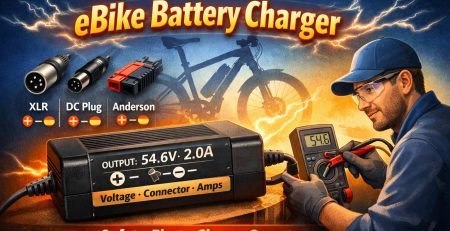
An e bike charger is a dedicated power supply designed to convert wall outlet electricity into the specific DC voltage and current required to replenish battery chargers for eBike battery packs safely. It must precisely match the battery’s chemical architecture and voltage to ensure performance and longevity.
Quick Navigation: Ready to upgrade? Ensure your safety by selecting the right charging equipment.
Actually, I learned the hard way that not all plugs are created equal. I once grabbed a generic charger for my 52V system that turned out to be for a 48V pack—the connector fit, but it wouldn’t charge, and the heat it generated was worrying. Buying the wrong charger usually leads to a battery that won’t charge, an overheated brick, or a permanent connector mismatch.
Quick Selection Guide
- Voltage Match: Must match your system (36V, 48V, 52V, etc.).
- Connector & Polarity: Verify physical fit and +/- alignment.
- Current (Amps): Balanced for speed vs. battery health.
- Safety Features: Look for auto-cutoff and heat management.

Need a Reliable Replacement?
Browse compatible battery chargers for eBike battery packs based on your specific voltage and connector type.
How to choose an eBike battery charger for your battery pack
E-Bike Charger Port & Pinout Guide
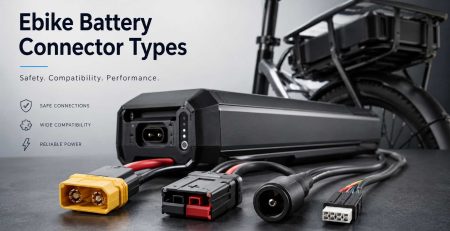
Verifying the physical charger port and pin configuration is essential to avoid short circuits. Below are the most common pinout definitions for e-bike charging adapters.
| Connector Type | Pin 1 | Pin 2 | Typical Use Cases |
|---|---|---|---|
| XLR (3-Pin) | Positive (+) | Negative (-) | Common on generic 36V/48V aluminum chargers. |
| DC Barrel (5.5×2.1) | Center Pin (+) | Outer Sleeve (-) | Lightweight 2A portable ebike charging adapters. |
| XT60 / XT90 | Flat Side (+) | Angled Side (-) | High-current DIY and performance battery packs. |
Select a charger by matching the exact system voltage, verifying connector polarity, and ensuring the current (Amps) is within your battery pack’s safe charging limits.
To ensure safe eBike battery charging, follow this checklist before your first use:
- Confirm the output voltage matches your battery’s nominal voltage.
- Check connector type (XLR, DC Barrel, XT60, etc.) and pin polarity.
- Ensure the Amp rating doesn’t exceed the battery’s maximum charge rate.
- Look for LED indicators that signal charging status.
- Verify the charger has thermal protection.
- Check for BMS compatibility.
- Establish a habit of charging on a non-flammable surface.
Understanding Your e Bike Charger Indicator Light
The indicator light is your first line of defense in monitoring battery health. Typically, a solid Red light means active charging, while a solid Green light indicates the pack has reached its peak voltage and the BMS is balancing the cells. If you see a flashing light or an unexpected color, disconnect the power immediately, as this indicates a charging fault or a potential cell imbalance.
Charger voltage compatibility for eBike battery packs
Your charger’s output voltage must strictly match the pack’s system voltage to prevent undercharging or fire hazards.
| Pack System (V) | Typical Charger Output (V) | Notes |
|---|---|---|
| 36V | 42.0V | Standard for 10S packs |
| 48V | 54.6V | Standard for 13S packs |
| 52V | 58.8V | High-performance 14S packs |
| 60V | 67.2V | Heavy duty 16S packs |
| 72V | 84.0V | High-speed 20S packs |
Caution: No Such Thing as a “Universal” eBike Battery Charger
Many retailers claim to sell a universal ebike battery charger, but using one is a major fire hazard. Lithium packs require specific CCCV (Constant Current, Constant Voltage) profiles. A 48V charger will not work on a 52V pack, and using the wrong charger can bypass your BMS protections, leading to cell thermal runaway.
Charging current (amps): faster charging vs battery pack stress
While higher-amp chargers reduce wait times, they can increase heat and stress, potentially shortening the overall lifespan of eBike battery packs.
Q: Is a portable eBike charging adapter slower?
A: Often, yes. To keep them light, they frequently use lower Amps (1-2A), which is safer for long-term battery health but slower than home stations.
Safe charging workflow (ride → charge → store)
Maximize battery life by allowing packs to cool before charging and ensuring the charging environment is dry and room-temperature.
Optimization Note: Energy Cost & Cell Health
Charging Cost: Charging a typical 48V 17.5Ah (840Wh) pack costs approximately $0.10 – $0.15 depending on local electricity rates. It is significantly cheaper than gasoline alternatives.
Lifespan Tip: To extend your cell lifespan, avoid leaving the pack at 100% charge for weeks. If storing, keep the battery at 50-60% capacity in a cool, dry place.
Experience Verification Workflow
To verify a new charger for your eBike battery pack, we suggest this methodology:
Step 1: Identify Specs. Cross-reference the pack label with the charger label (Voltage/Amps).
Step 2: Initial Supervision. Conduct the first charge in a visible area where you can monitor the equipment. Check the temperature of the charger brick and the battery pack every 15 minutes during the initial hour.
If you notice unusual heat, a burning smell, or a high-pitched whining noise, disconnect the power immediately. These symptoms often indicate an internal component failure or a hidden cell imbalance that requires professional inspection.
Step 3: Thermal Management. Never charge immediately after a ride; let the cells stabilize for at least 30 minutes to ensure chemical stability before applying current.
Step 4: Cold Weather Care. If the bike was stored in a freezing garage, bring the pack inside and let it reach room temperature before plugging in to avoid permanent lithium plating damage.
Which charger should you buy for your eBike battery pack?
Your choice depends on your primary need: standard home charging requires reliability, while travel demands a lightweight, portable eBike charging adapter.
Priority Decision Rules
- Voltage: Non-negotiable match.
- Connector/Polarity: Must be a perfect physical and electrical fit.
- Amps: Low to Medium for daily use; High only if BMS and cells support it.
- Safety: Certified protection is a must.

EM3ev Ebike Battery With Standard 2A Charger
Voltage: 36V or 48V
- Slow and safe charging
- No loud fan noise
- Good for battery life
EM3ev Ebike Battery With Fast 4A Charger
Voltage: 48V or 52V
- Cuts charging time in half
- Has a built-in fan
- Works with EM3ev batteries
If you need a charger specifically for a 48V battery pack, see our 48V eBike battery charger guide for compatibility, connector, and charging-speed basics.
Common Questions
No. A 48V charger only reaches 54.6V, while a 52V pack needs 58.8V to full charge. It will result in a partially charged, unbalanced pack.
Plugging in reversed polarity can cause an immediate short circuit, potentially damaging the BMS, the charger, or causing a fire. Always verify polarity.
Not necessarily. While it’s faster, it generates more heat. Low-amp charging is generally “healthier” for the internal chemistry of the cells.
Standard chargers are required. Emergency options like a solar solar eBike charger exist, but they still require a charge controller to regulate voltage.
It depends on the pack capacity (Wh) and motor usage. High-capacity packs on low assist can last all day, while high-power use may deplete them in an hour.
Never charge a frozen battery. Bring the pack inside and let it reach room temperature first to avoid permanent cell damage.
No. Brands like Bosch use proprietary communication protocols between the charger and battery. You must use a dedicated charger designed for those specific closed-loop systems.


LEAVE A COMMENT