




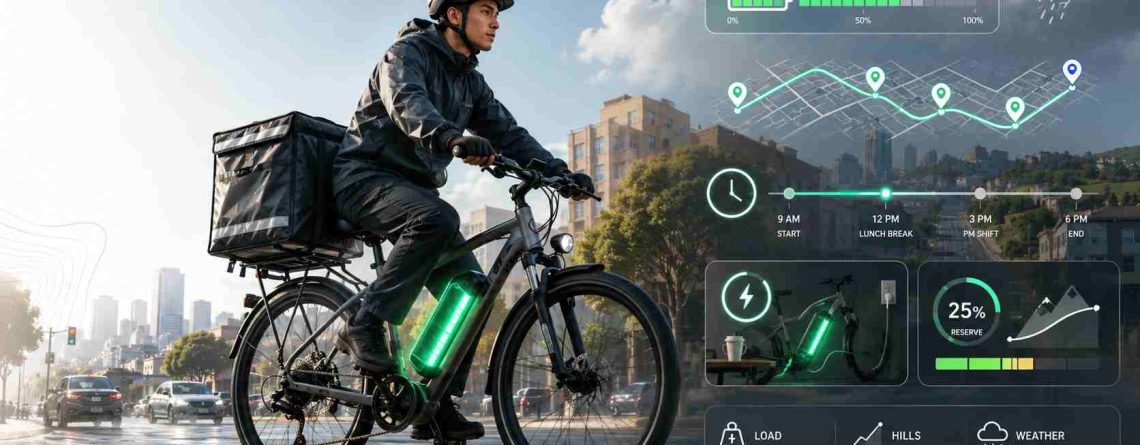
eBike Battery for Delivery Bike: How to Size for a Work Shift
Choosing an eBike battery for delivery bike use starts with two questions: will it work with your bike, and can it support the distance between reliable charging or battery swaps? A food delivery shift includes waits for food, changes of route, frequent stops, and the ride home. Hours at work alone cannot tell you how much energy you need.
Quick answer: Check that the battery works with your bike and fits its frame. Then work out your route energy in watt-hours (Wh). Leave spare energy for extra orders, hills, and bad weather. Finally, choose a charging or spare-battery plan that fits your schedule. A 48V or 52V pack is suitable only when the complete bike system supports it.
Start With Your Delivery Route, Not Your Shift Length
Two riders working six hours may cover very different distances. One might wait between nearby orders; another could travel across a wider delivery area. Their battery requirements will differ even if they use similar bikes.
Plan for a busy day that you could expect to work. Include travel to the delivery area, trips between restaurants and customers, repositioning between orders, and the journey home. Then allow for things that use more energy:
- Repeated acceleration with the rider, bike, and delivery load.
- Climbing, headwinds, and sustained use of higher assistance levels.
- Cold conditions and reduced capacity in an aging battery.
- Low tire pressure or mechanical drag that makes riding harder.
Plan for the distance you ride between places where you can charge or swap packs. That might be one lunch shift, both lunch and dinner, or the entire working day.

Calculate a Delivery Battery Budget in Watt-Hours
Watt-hours show how much energy a battery stores. They help you compare packs better than amp-hours alone. Use the battery maker’s stated Wh rating when listed. If you calculate it yourself, use the pack’s specified nominal voltage and rated capacity rather than its fully charged voltage.
Route energy (Wh) = distance (km) × average consumption (Wh/km).
Planning capacity (Wh) = route energy ÷ fraction of capacity allocated to the route.
For example, allocating 80% to riding leaves a 20% planning reserve. This allowance is an example. It is not a fixed rule or a promise of usable energy. Leave more spare energy if the route, weather, or battery health is uncertain.
| Distance between charging or swaps | Assumed consumption | Route energy | Planning capacity |
|---|---|---|---|
| 30 km / 19 miles | 10 Wh/km | 300 Wh | 375 Wh |
| 50 km / 31 miles | 15 Wh/km | 750 Wh | 938 Wh |
| 70 km / 43 miles | 20 Wh/km | 1,400 Wh | 1,750 Wh |
These are calculation examples, not measured rider averages or EM3ev range tests. Use figures from your own bike in place of these assumed values. If the result is too high for one pack, plan a shorter work block or a battery swap.
If your system records energy consumption, divide battery energy used by distance traveled. Dashboard battery bars are only a rough reference, while electricity measured at a wall outlet includes charging losses. Keep these measurements separate when comparing results.
Check Compatibility Before Comparing 48V and 52V Packs
A larger battery still has to work with your bike’s electrical system. Begin with the bike manufacturer’s requirements or the documentation for your conversion kit. A plug that fits or a case that looks the same does not prove the pack will work.
- Voltage: Confirm the supported operating range, including the proposed battery’s fully charged voltage.
- Current: Match the controller’s maximum battery-current demand to the pack’s specified discharge capability, BMS limits, and connection ratings.
- Interfaces: Check connector type, polarity, display requirements, and any proprietary communication system.
- Charging: Verify charger voltage, charging current, connector, and manufacturer approval.
- Installation: Check case dimensions, mounting hardware, cable clearance, and room to remove the battery.
A compatible 48V bike may need more capacity without needing a voltage change. For a proposed upgrade, read our guide to 52V battery and 48V controller compatibility before ordering. Higher voltage alone does not mean more delivery range.
For European delivery work, check the rules in the country where you ride. For example, UK electric bike rules include requirements concerning motor power and assisted speed. A battery’s voltage label does not establish the road classification of the complete bike.
Choose Between One Battery, Break-Time Charging, and a Spare
Your work routine helps you decide how much extra energy is worth carrying. Compare the practical options before spending money on a larger pack.
| Arrangement | Useful when | Check first |
|---|---|---|
| One compatible battery | A normal work block fits within its energy budget | Reserve, frame fit, weight, and overnight charging access |
| Charging during a break | A dependable charging location fits your schedule | Permission, supervision, charger compatibility, and realistic charging time |
| A compatible spare battery | Lunch and dinner shifts exceed one pack’s practical range | Matching interfaces, secure storage, and a planned swap location |
Do not assume a short restaurant wait will restore enough energy for the next work block. Charging depends on starting charge, charger output, battery limits, temperature, and the slower final stage. Check how much charge you actually gain during a break with the approved charger.
For a removable spare, stop and switch the bike off before following the manufacturer’s replacement procedure. Secure the spare against movement and protect its terminals. Carrying a spare is different from connecting two batteries together. To use both at once, you need a system designed for that purpose.
Check the Daily Handling Before You Buy
Think through a complete shift with the new pack. Can you remove it without taking off the delivery bag? Is there space to lift or slide it out? Can you reach the lock and keep the key somewhere secure? These small details matter when you swap packs in a short break.
Check the weight of the whole setup, including a spare, tools, and orders. Stay within the bike and rack load limits. A large pack that fits on paper may still make stairs, storage, or daily removal awkward. Ask for a dimension drawing before ordering.
Where a 52V 20Ah Battery Fits Into the Plan
A 52V 20Ah-class pack is worth evaluating when your electrical system supports the voltage and your shift energy budget calls for approximately 1 kWh (1,000 Wh) of nominal capacity.
For example, the EM3ev King Shark (14S4P) is rated at 50.4V nominal, 19.6Ah, and 988Wh. When sizing your setup, use this 988Wh figure against your delivery route calculation rather than the nominal Ah label alone. Remember that cell configuration defines voltage and current limits, not your total delivery range.
Considering this battery size for your delivery bike? See whether a 52V 20Ah battery is enough for food delivery for worked range examples and a check of when one pack may cover your route or a spare may be needed.
Depending on your controller’s operating limits, compare your route requirements across compatible 48V and 52V platforms:

48V eBike Batteries for Delivery Use
Engineered for direct-replacement delivery setups. Compare available options by usable watt-hours (Wh), continuous BMS output, case dimensions, and frame mounting clearances.
52V (14S4P) 21700 King Shark
Ideal for extended shifts and compatible 52V systems. Evaluate packs by real Wh energy, Smart BMS continuous current, and clearance for fast swaps.
Validate Your Choice Across Representative Delivery Shifts
Once the pack is checked and fitted, keep notes from several work blocks. Include a normal route and a more demanding day, while keeping enough reserve to return safely. Record:
- Distance traveled, including travel before and after deliveries.
- Starting and finishing charge, plus measured energy use if available.
- Assistance setting, typical load, hills, temperature, and wind.
- Charging or swap stops and the time they required.
- Unexpected cutouts, unusual heat, or loose mounting hardware.
Use the record to adjust your distance limit and charging schedule. Recheck it as temperatures change or the battery ages. If comfortable reserve disappears on ordinary days, shorten the work block or arrange a compatible replacement or spare. Have faults checked before you keep using the bike for deliveries.
Set a point at which you stop taking new orders and head back to charge. Base that limit on the distance home and the hardest part of the route. Do not wait for the last battery bar before making the decision. If a planned charging stop is closed, you should still have a clear way home.
For a spare-battery routine, label the packs and keep a separate record for each. One may lose range sooner than the other. Swap access also matters: a spare stored across town will not help much if reaching it uses most of your remaining energy.
Frequently Asked Questions
What is the best battery capacity for food delivery?
The right pack covers the distance between charging stops and leaves enough spare energy. Calculate route energy from distance and measured consumption, then verify that a suitable pack fits your electrical system and frame. No single Ah rating suits every delivery rider.
Can one battery last an eight-hour delivery shift?
Sometimes, but eight hours at work do not mean eight hours of riding. Distance, assistance, hills, load, and waiting time change the result. Use your route records to decide whether one battery can cover the shift.
How often should a courier replace an eBike battery?
Follow the maker’s advice and judge the pack by its condition, not a fixed age. Watch for lost range. Have the pack checked if power keeps cutting out or it gets unusually hot. Stop using a damaged, swollen, or leaking pack.
Prepare These Details Before Buying
Send your bike or conversion-kit model, controller specifications, current battery label, connector photos, available mounting space, and expected delivery distance. Include your charging opportunities and country. With those details, ask EM3ev for battery fitment advice and compare options against your actual working routine.



LEAVE A COMMENT