




eBike Battery C Rating: What It Means and How to Use It
eBike battery C rating describes charge or discharge current relative to battery capacity. To convert C rate to amps, multiply the C rate by the battery capacity in Ah. The finished pack may still have a lower limit set by its BMS, cells, wiring, connectors, or design.
Quick Answer
- C rate links battery capacity to current.
- At 1C, current in amps equals the battery’s Ah value.
- Use amps = C × Ah to convert C rate to current.
- Continuous and peak ratings are not the same.
- The lowest verified pack or BMS limit is the one that matters.
C rating can look simple until two batteries with different capacities are compared.
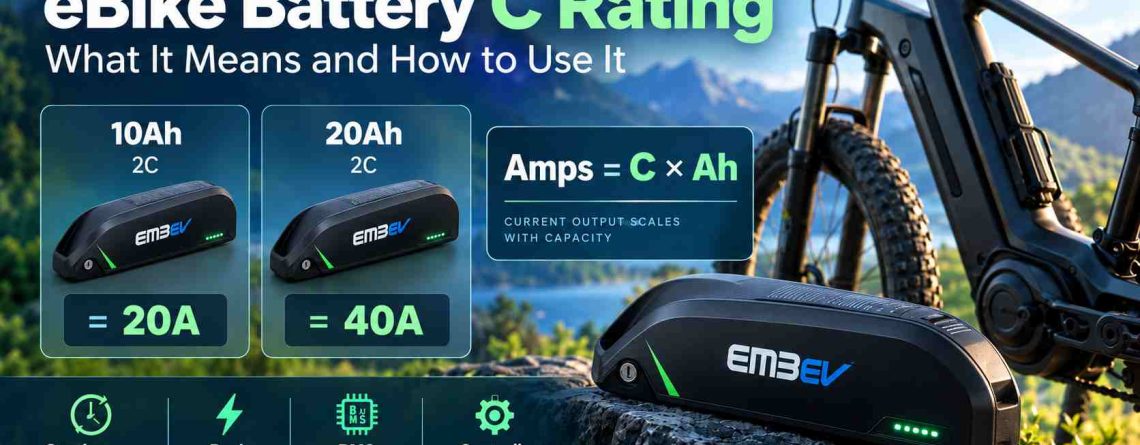
Imagine one battery is 10Ah and another is 20Ah. Both are marked 2C. The C number is the same, but the current is not.
In this mathematical example, the 10Ah pack at 2C equals 20A. The 20Ah pack at 2C equals 40A. That is why C rating should not be read as an amp value by itself.

What Does C Rating Mean on an eBike Battery?
C rating shows battery current as a multiple of capacity, so the same C rate can represent different amp values on different batteries.
The letter C refers to a rate based on battery capacity. The C-rate expresses charge or discharge current relative to the battery’s rated capacity. This makes the number easy to scale across packs of different sizes.
For example, 1C on a 10Ah battery means 10A. On a 20Ah battery, 1C means 20A. The battery capacity changes the current represented by the same rate.
C Rating vs Amps
C rating and amps describe related ideas, but they are not the same unit. C rate is relative. Amps are an actual current value.
For eBike system matching, amps are usually easier to compare. Controllers and BMS limits are often listed in amps, so converting C rate into amps puts the numbers into the same format.
Current (A) = C Rate × Battery Capacity (Ah)
Why Capacity Changes the Same C Rate
A larger Ah battery can produce a larger calculated current at the same C rate because the rate is tied to capacity.
This is also why saying that a battery is “2C” does not tell you enough. You still need the Ah value before you can calculate current.
Discharge C Rate vs Charge C Rate
A battery can have different rates for charging and discharging. Discharge rate refers to current leaving the pack while the bike is used. Charge rate refers to current entering the pack during charging.
Do not assume a discharge C rating can also be used as the charging limit. Charging must follow the limits set for the finished battery.
Continuous Rating vs Peak Rating
A continuous rating describes current that can be supported under the conditions defined by the battery maker.
A peak rating is different. It usually applies only for a shorter period or under specific conditions. A peak number should not be treated as a continuous current rating.
What does 1C mean on an eBike battery?
At 1C, the current in amps equals the battery capacity in Ah. A 15Ah battery at 1C represents 15A.
Is C rating the same as amps?
No. C rating is a rate relative to capacity. Amps measure actual current. You need the battery’s Ah value to convert C rate into amps.
Can the same C rating mean different current?
Yes. A larger Ah battery produces a larger calculated current at the same C rate.
How to Convert C Rate Into Amps
Multiply the battery’s C rate by its capacity in Ah to convert the rating into amps.
The math is simple. The harder part is making sure you are using the correct rating.
- Find the battery capacity in Ah.
- Find the stated C rate.
- Check whether it is a charge or discharge rate.
- Check whether the rating is continuous or peak.
- Multiply C rate by Ah to get amps.
- Check the finished pack’s current specification.
- Check the BMS current limit.
- Compare the verified current limit with controller demand.
Calculate eBike Battery C Rating to Amps
Current (A) = C × Ah
C Rate = Current (A) ÷ Ah
Suppose a 15Ah battery has a stated continuous rate of 2C. The calculated current is 30A.
This is only a math example. It does not mean every 15Ah eBike battery should supply 30A. The finished battery may have a lower current limit.
You can also work backward. If a 20Ah battery supplies 20A, that current equals 1C. If it supplies 40A, that equals 2C.
How do I calculate amps from C rating?
Multiply the C rate by the battery capacity in Ah. A 2C rate on a 12Ah battery gives a calculated current of 24A.
How do I calculate C rate from amps?
Divide current in amps by battery capacity in Ah. For example, 20A divided by 20Ah equals 1C.
Does voltage change the C-rate formula?
No. The basic C-rate-to-current formula uses C rate and Ah. Voltage is important for the eBike system, but it does not change that calculation.
Understand Continuous and Peak Discharge Current
eBike battery continuous discharge current is the current a finished battery can support on an ongoing basis within its stated limits.
eBike battery peak discharge current is a short-duration figure. It may be useful for brief demand, but it should not replace the continuous rating when checking normal controller load.
This difference matters because a controller can draw substantial current for more than an instant. A battery that only meets the demand at its peak limit may not be a good match.
What is continuous discharge current?
It is the verified current a battery can support continuously within the conditions set by the battery maker.
What is peak discharge current?
It is a higher current allowed only for a limited period or under specific conditions.
Can I size a battery from peak current alone?
No. Continuous current is more useful for normal system matching. Peak current should be treated as a separate short-duration limit.
C Rating vs BMS and Pack Current Limits
eBike battery C rating and BMS are connected, but they describe different limits.
C rate may describe the capability of a cell or a battery design. The BMS has its own current limit and protection behavior.
This means an ebike battery cell C rating should not be treated as the final output rating of the complete pack.
The finished battery can also be limited by cell configuration, wiring, connectors, thermal conditions, pack construction, and manufacturer settings.
For real system matching, the complete ebike battery pack C rating and published amp limits are more useful than a cell specification on its own.
Is C rating the same as BMS amp rating?
No. C rating is based on capacity. A BMS amp rating is a current limit. Convert C rate to amps before comparing the two.
Can high-C cells still be limited by the BMS?
Yes. Cell capability does not override the finished pack’s BMS, connectors, wiring, or design limits.
Should I use the cell rating or pack rating?
Use the finished battery’s verified specification when matching the pack to an eBike system.
eBike Battery C Rating and Current Terms
| Term | What It Describes | How to Use It |
|---|---|---|
| Ah | Battery capacity | Use with C rate to calculate amps |
| C rate | Current relative to capacity | Convert to amps before matching |
| Continuous current | Sustained verified output | Compare with controller demand |
| Peak current | Short-duration output | Do not treat as continuous |
| BMS limit | Pack current boundary | Check against battery and controller |
| Controller current | Current the system may request | Keep within verified battery limits |
Experience Validation Process
When a battery specification includes C rate, use a simple verification process before matching it to a controller.
- Read the finished battery specification, not only the cell data.
- Record battery capacity in Ah.
- Record the stated C rate and note whether it is continuous or peak.
- Convert the C rate into amps.
- Check the battery’s published continuous-current limit.
- Check the BMS continuous-current limit.
- Compare the lowest verified battery limit with controller current demand.
If one published limit is lower than the calculated C-rate current, use the lower verified number for system matching.
If the required specification is missing, ask the battery maker rather than guessing from the cell model or pack size.
How to Tell If a Battery Can Supply Enough Current
A battery should meet controller demand without exceeding the finished pack’s verified continuous-current or BMS limits.
Match Battery Discharge Capability to Controller Current
eBike battery C rating and controller current should be compared in the same unit.
If the battery specification is given in C rate, convert it to amps first. Then compare that current with the controller’s battery-current demand.
For a broader system-level check, see our eBike battery sizing guide .
Do not compare C rate directly with motor watts. Motor power and battery current are related through the system, but they are not the same specification.
This also explains why there is no single answer to what C rating does an ebike battery need. The required rate depends on battery capacity and controller current.
Why C Rating Can Affect Voltage Sag
eBike battery C rating and voltage sag can be related because current demand places load on the cells and pack.
When a battery is working closer to its practical current limit, voltage may drop more under load. However, C rate is not the only factor.
Voltage sag also depends on cell resistance, battery temperature, state of charge, pack design, wiring, and the amount of current being drawn.
For that reason, a high C-rating number alone does not predict exactly how much voltage sag a finished eBike battery will show.
Does a Higher C Rating Improve eBike Performance?
Does C rating affect eBike performance? It can affect how well the battery handles current demand, but a higher rating does not automatically make the bike faster or increase its range.
If the original battery cannot safely supply the current requested by the controller, a battery with adequate current capability may improve system behavior.
But once the battery already meets the controller’s needs, a higher C rating does not force the controller to draw more current.
It also does not raise battery voltage or add stored energy by itself. Those are separate battery specifications.
Does a higher C rating make an eBike faster?
Not by itself. Speed depends on the full electrical and mechanical system. The controller will not draw extra current simply because the battery has a higher C rating.
Does a higher C rating increase range?
Not directly. Range depends more on stored energy in Wh and how much energy the bike uses.
What happens if battery current capability is too low?
The battery may experience excessive voltage drop, poor performance, or BMS protection under demanding conditions. Exact behavior depends on the system.
Can This eBike Battery Support the Controller?
- Correct battery voltage: YES / NO
- Battery Ah known: YES / NO
- Continuous C rate or amp limit known: YES / NO
- C rate converted to amps: YES / NO
- BMS continuous limit known: YES / NO
- Controller battery current known: YES / NO
- Battery continuous output meets demand: YES / NO
Any NO or UNKNOWN: confirm the missing specification before relying on the match.
Use C Rating as One Part of Battery Matching
C rate tells you about current relative to capacity. Battery sizing also requires the correct voltage, Wh, BMS limit, controller demand, charger, connector, and physical fit.
eBike Battery C Rating FAQ
C rating becomes useful for eBike matching after it is converted into amps and checked against the finished pack, BMS, and controller limits.
What is C rating on an eBike battery?
C rating describes current relative to battery capacity. Multiply C rate by Ah to convert it into amps.
What does 1C mean for an eBike battery?
At 1C, current in amps equals the battery capacity in Ah. A 20Ah battery at 1C represents 20A.
How do I calculate eBike battery C rating in amps?
Multiply C rating by battery capacity in Ah. For example, 2C on a 15Ah battery equals a calculated current of 30A.
Is C rating the same as the BMS amp rating?
No. C rating is based on battery capacity. The BMS rating is an amp limit. The finished pack may be limited by the lower value.
What is the difference between continuous and peak C rating?
Continuous rating applies to sustained use within stated limits. Peak rating applies only for a shorter period or under specific conditions.
Does a higher C rating reduce voltage sag?
It may help if the pack has stronger current capability, but voltage sag also depends on cells, resistance, temperature, state of charge, pack design, and current draw.
Does a higher C rating increase eBike range?
Not directly. C rating relates to current capability. Range depends more on battery energy in Wh and how much energy the bike uses.
What C rating does my eBike battery need?
There is no universal C rating. Convert C rate to amps and choose a finished battery whose verified continuous output can meet the controller’s current demand.
Conclusion
Read C rating in four steps: convert it to amps, check the pack limit, check the BMS limit, then compare the result with controller demand.
C rating is useful because it gives a common way to describe current relative to battery capacity.
But the C number alone is not enough for eBike battery matching. A 2C battery can represent very different amp values depending on Ah.
After converting the rate to amps, check the finished battery specification. Then check the BMS and controller.
If several current limits are listed, the lowest verified limit is the safest one to use for system matching.
That keeps the process simple: C rate → amps → pack/BMS limit → controller demand.


LEAVE A COMMENT