



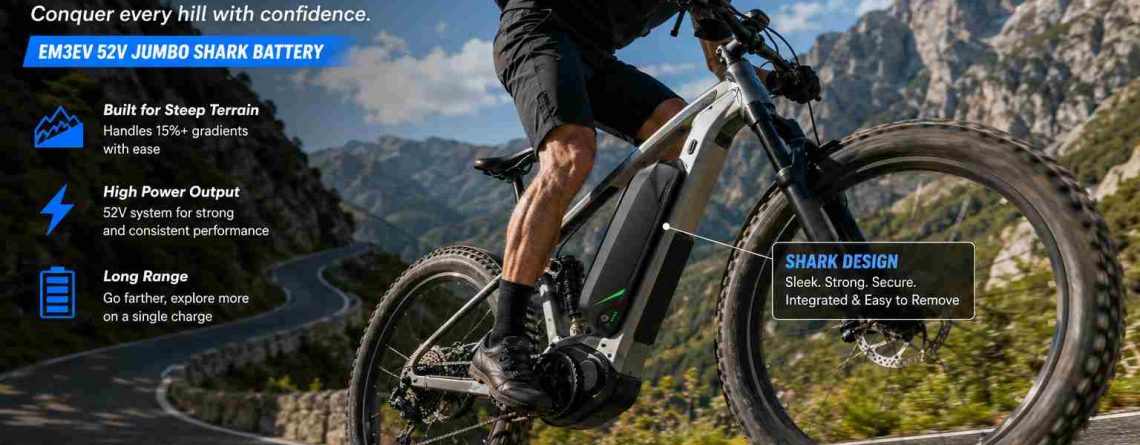
Best eBike Battery for Steep Hills: How to Choose the Right Pack
The best eBike battery for steep hills is not simply the pack with the highest voltage or largest amp-hour rating. It must fit the whole system, support the controller’s current demand, and store enough energy for repeated climbs.

Quick Answer: What Battery Is Best for Steep Hills?
Choose a battery that meets four needs. Its voltage must match the controller and other electronics. Its battery management system, or BMS, must support the controller’s current draw. It should store enough watt-hours for the route and limit voltage sag during hard starts or long grades.
A 52V pack is often useful for a 48V/52V conversion system rated for a 14-series lithium battery. Never install one unless the controller, display, lights, charger, and other electrical parts support 52V.
Why Hills Put More Stress on an eBike Battery
An eBike needs more power on a hill than it needs on flat ground. The motor must move the bike, rider, battery, and cargo against gravity.
As the grade gets steeper, the controller may ask for more current. This can cause a short drop in battery voltage, known as voltage sag. Some sag is normal, but heavy sag can make the bike feel weak or cause the BMS or controller to cut power.
Long climbs also create heat in the battery, controller, motor, wires, and connectors. A well-matched pack often works with less strain than a small pack operating near its current limit.
Is 48V or 52V Better for Steep Hills?
At the same current, a compatible 52V system can supply more electrical power than a 48V system. That does not mean every rider should upgrade.
A 48V battery is often the correct choice for a bike designed around a 48V controller. It can work well for commuting, moderate hills, and many Bafang or hub motor systems.
A 52V battery may suit riders who face long climbs, carry more weight, or want less performance loss as the charge level falls. The result still depends on the controller limit, motor efficiency, gearing, wheel size, and total load.
Before changing from 48V to 52V, confirm that the controller can accept a fully charged 52V battery. You must also check the display, lights, charger, and any other part connected to battery voltage.

Battery Current Matters on Steep Grades
Many buyers focus on amp-hours, but the discharge rating is just as important on hills. A controller may draw high current during a hard start, steep section, or slow climb.
The battery’s continuous current rating should meet or exceed the controller’s normal maximum battery current. A weak match may cause heavy voltage sag, heat, early BMS shutdown, or poor hill performance.
Do not choose a battery from the motor watt label alone. Two bikes with the same motor rating may use different controllers. Check the controller voltage and battery-current limit first.
How Much Battery Capacity Do You Need?
Amp-hours show charge capacity, but watt-hours are more useful when comparing batteries with different voltages. Estimate watt-hours by multiplying nominal voltage by amp-hours.
Hill riding uses more energy than easy riding on flat roads. Rider weight, cargo, headwind, soft tires, cold weather, and frequent acceleration can raise energy use.
A compact pack may handle a short ride with one moderate climb. Long routes, repeated steep hills, cargo bikes, and trail bikes usually need more reserve. This helps prevent the battery from reaching a low charge level too early.
| Riding Situation | Battery Priority |
|---|---|
| Short rides with moderate hills | Correct voltage and enough current |
| Long or repeated climbs | Higher watt-hour capacity |
| Cargo or heavier riders | Current support and extra energy reserve |
| High-power conversion builds | Battery, BMS, controller, and wiring compatibility |
Best EM3ev Battery Options for Steep Hills
The best option depends on controller voltage, current demand, frame space, mounting method, and route length.

EM3ev 48V King Shark: Best for 48V-Only Systems
Riders who must stay with a 48V controller can consider the EM3ev King Shark 1304. It uses a 48V 19.6Ah layout with about 917Wh and a 40A smart BMS.
This can be a better choice than changing to 52V when the existing controller, display, or other electronics are designed only for a 48V battery.

EM3ev 52V Rhino 5P: Best for Long, Repeated Climbs
The EM3ev Rhino 5P is a 52V 25Ah rectangle battery with about 1260Wh. Its larger capacity gives more reserve for long routes, heavy cargo, and repeated climbs.
A large rectangle pack needs secure mounting and enough space in the frame or cargo area. It is not a drop-in replacement for every bicycle.
Do You Need a 72V Battery for Hills?
Most riders do not need 72V simply because their route is steep. A 72V pack is made for a complete high-voltage build.
The controller, motor, display, charger, wiring, connectors, and protection settings must support 72V nominal and about 84V at full charge. Never connect a 72V battery to a 48V or 52V bike. It can damage parts and create a serious safety risk.
The Motor and Gearing Matter Too
A strong battery cannot fix an unsuitable motor or poor gearing. A mid-drive can use the bicycle’s gears, which often helps it climb at a more efficient motor speed. Shift into a lower gear before the hill becomes very steep.
A hub motor may build heat when it climbs slowly under a heavy load. Avoid full throttle at very low speed for long periods. Stop and let the system cool if power drops or parts become unusually hot.
Frequently Asked Questions
Is a 52V Battery Better Than a 48V Battery for Hills?
A compatible 52V system can provide more power at the same current and may maintain performance better as the battery discharges. However, a 52V battery should only be used when the controller, display, lights, charger, and other electrical parts support a 52V battery.
Does a Larger eBike Battery Improve Hill Climbing?
More watt-hours increase range, but capacity alone does not create more climbing torque. Hill performance also depends on the battery’s current capability, controller limit, motor, gearing, wheel size, rider weight, and slope.
Why Does My eBike Battery Cut Out on Steep Hills?
A battery may cut out when climbing because of voltage sag, excessive controller current, a low state of charge, weak cells, overheating, loose connectors, or BMS protection. Stop using the bike if the battery, connector, or wiring becomes unusually hot.
Do I Need a 72V Battery for Steep Hills?
Most riders do not need a 72V battery simply for hill climbing. A properly matched 48V or 52V system can handle many steep routes. A 72V battery requires a controller, motor, charger, display, wiring, and connectors designed for a complete 72V system.
Final Recommendation
For many compatible conversion bikes, the best eBike battery for steep hills is a quality 52V pack with enough current output and watt-hour capacity for the route.
The 52V Jumbo Shark is a balanced option for regular hills. The Rhino 5P offers more energy for long routes, heavy loads, and repeated climbs. A high-capacity 48V pack is better when the controller does not support 52V.
Before buying, check voltage, current, charger, connector, frame space, and mount strength. A well-matched system will climb better and work with less stress than a battery chosen by voltage or capacity alone.

LEAVE A COMMENT