





New Electric Snow Bike Battery Pack Strategy
In winter, an electric snow bike needs a battery built for the cold. Low temperatures raise the battery’s resistance. That makes the voltage drop when you hit the throttle. Many standard packs then shut down early, even when they still have charge left.
Quick Comparison: 48V vs 52V Snow Bike Packs
| Metric | Standard 48V Pack | High-Output 52V Pack |
|---|---|---|
| Peak Performance | Standard Delivery | Maximum Punch (Lower Sag) |
| BMS Amp Limit | 30A Continuous | 50A Continuous |
| Winter Efficiency | Moderate Range Drop | Optimized Voltage Buffer |
| Best For | Packed Trails / Commuting | Deep Powder / Moonbikes / Hills |
I remember my first real winter ride on a fully electric powered snow bike conversion. The display read 80% battery. I hit the throttle to climb a small slope. Then everything went dark. The motor shut off. I had to push the bike through knee-deep snow. The battery wasn’t empty—it was just too cold. The voltage dropped, and the BMS treated it like a dead pack.
To be honest, most riders don’t realize how much winter chemistry changes the rules. It’s not just about having a “big battery”; it’s about managing heat, voltage sag, and compatibility.

Quick Takeaways: Managing Cold Packs
- Cold = Resistance: Freezing temps increase internal resistance, causing voltage to drop (sag) instantly under load.
- “Warm before you draw”: A warm battery performs significantly better. Avoid hard throttle if the pack has been sitting in the cold.
- Charging Safety: Never charge a frozen battery. It can cause permanent lithium plating.
- Condensation is the enemy: bringing a cold pack into a warm house creates moisture inside the case.
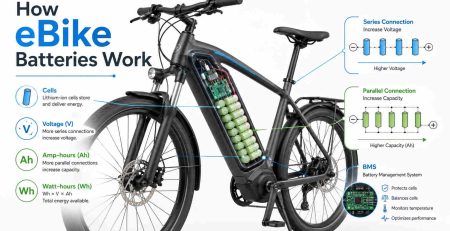
- Compatibility: If you use a 48V or 52V pack, make sure the BMS can handle high, steady current. Snow riding can demand it.
Looking for a winter-ready replacement?
If your current pack cuts out too early, check out compatible high-discharge options.
Electric snow bike battery pack: winter basics & quick fixes
Conclusion: Cold weather raises resistance inside the battery. When you accelerate, voltage drops fast. The BMS may then shut the pack down sooner than you expect.
In snow, the motor works much harder than it does on pavement. A cold battery also delivers power more slowly. So the pack may cut out early—not because it’s empty, but because voltage drops below a safe limit.
Why cold triggers BMS/controller cutoff
Key factor: Under load, voltage drops. The BMS reads that drop as “low battery” and cuts power to protect the cells.
Actually, this is a protective mechanism working too well. In freezing weather, ions move slower through the electrolyte. If you demand 30 Amps for a hill climb, the voltage might instantly drop from 48V to 41V.
Example: If the controller cutoff is 42V, a hard pull can drop voltage below 42V for a moment. The system shuts down, even if voltage rebounds to 47V right after.
Checklist: eBike battery pack for snow riding in cold weather
Before you head out into the powder, run through this quick mental checklist to prevent being stranded:
- Pre-Ride Warmth: Keep the battery inside at room temperature until the very last moment before riding.
- Insulation: Use a neoprene battery cover or thermal wrap to retain heat generated during use.
- Start Gentle: Ride in a lower assist mode for the first 10 minutes to let internal resistance generate some self-heating.
- Monitor Voltage, Not %: Percentage bars are inaccurate in the cold. Watch your voltage sag when you hit the throttle.
Expert Tip: The “Sag” Test
If your voltage drops more than 4-5V when you accelerate, your pack is either too cold, too small (insufficient C-rating), or aging. A healthy, warm pack should only sag 1-2V under moderate load.
Technical Deep Dive: Solving Battery Sag in Cold Weather
Solving battery sag in cold weather requires understanding internal resistance. In sub-zero temperatures, the electrolyte becomes viscous, hindering ion flow. When you demand high current for an electric snow bike climb, the voltage drops instantly. High-output packs, particularly 52V systems, provide the necessary voltage “headroom” to stay above the BMS cutoff threshold during peak draw.
Winter range drop & cutoff troubleshooting
Reality check: In sub-freezing weather, expect 30–50% less range. Snow adds drag, and cold makes the battery less efficient.
If your bike cuts out, don’t assume the battery is broken. Most shutdowns happen because the pack is cold and the power demand is high.
Q: Can I use an eBike battery pack while riding in snow safely?
A: Yes, but keep it covered. Snow spray can melt on the connectors, causing shorts. Use dielectric grease on connections and ensure the pack is IP65 rated or better.
Q: Why does my battery show full but die on the first hill?
A: This is classic “Voltage Sag.” The cold cells cannot sustain the amperage needed for the climb, dropping voltage below the controller’s cutoff point instantly.
Table: Electric snow bike battery pack winter actions
| Scenario | Goal | Recommended Action |
|---|---|---|
| Pre-Ride | Maximize Output | Charge to 100% indoors; mount battery only when ready to leave. |
| Riding | Prevent Cutoff | Use neoprene cover; avoid “Turbo” mode until pack self-heats. |
| Stop/Rest | Retain Heat | Don’t leave bike off for long (>15 mins) in wind; park in sun if possible. |
| Post-Ride | Safety | Wipe dry immediately; bring indoors but do not charge yet. |
| Charging | Prevent Damage | Wait 2–4 hours until case feels like room temperature (Wait-to-Charge). |
| Storage | Longevity | Store at 40-60% charge if not riding for weeks; keep dry. |
Experience Validation Workflow: Testing Your Pack
To verify if your current pack can handle a snow conversion without guessing, follow this validation method (no lab required, just a safe test loop):
- The Control Run: Use a fully charged, room-temperature pack. Find a short, steep hill. Ride up at max assist. Note the lowest voltage number seen on your display (Minimum Voltage).
- The Cold Soak: Let the bike/battery sit outside for 30 minutes (monitored).
- The Test Run: Repeat the same hill at the same assist level.
- Comparison: If the voltage drops dangerously close to your controller’s cutoff (usually 39V–41V for 48V systems), that pack is not safe for deep backcountry snow rides. You need a higher capacity or higher C-rate pack.
Charging a cold-soaked eBike battery pack in winter
Critical Rule: Never charge a lithium battery that is below freezing (0°C/32°F); it causes permanent metallic plating on the anode, ruining the cell.
This is the most common way riders kill their expensive packs. You come inside from a ride, the battery is freezing cold, and you plug it in immediately. Don’t do it.
Safe Method: Bring the pack inside, place it on a dry surface, and wait. I usually give it 3 to 4 hours. Touch the case—if it feels like room temperature, then you can plug in the charger.
Storage & transport after snow rides
Risk: Condensation forms inside the battery case when you bring a cold object into a warm, humid room.
When you bring your battery in, moisture from the air will condense on the cold casing (and potentially the BMS inside). The Fix: Place the battery in a sealed plastic bag before bringing it inside. Let it warm up inside the bag. The condensation will form on the outside of the bag, not on your battery electronics.
Compatibility for snow eBike builds
Priority: Ensure your battery voltage matches your controller (48V vs 52V) and the discharge rate (Amps) exceeds your motor’s peak draw.
Snow riding puts a continuous heavy load on the electric motor, unlike street riding where you coast often. If your motor pulls 30A continuous, but your battery BMS is rated for 25A continuous, it will cut out or overheat.
- 48V eBike battery pack: The standard. Good availability. Ensure it is a “High Output” version if using a snow track kit.
- 52V eBike battery pack: Better for snow. The higher voltage combats the “sag” effect better, keeping you above the cutoff threshold longer.

The Reliable All-Rounder (48V)
- Spec: 48V / 17.5Ah / 30A BMS
- Best For: Groomed trails, lighter riders.
- Why: Standard compatibility, lighter weight.
The “Snow Day” Beast (52V)
- Spec: 52V / 20Ah / 50A BMS
- Best For: Heavy snow, deep powder, track kits.
- Why: Higher voltage reduces sag; high BMS limit prevents cutoffs.
The “Snow Day” Beast (52V)
- Spec: 52V / 20Ah / 50A BMS
- Best For: Heavy snow, deep powder, track kits.
- Why: Higher voltage reduces sag; high BMS limit prevents cutoffs.
The Reliable All-Rounder (48V)
- Spec: 48V / 17.5Ah / 30A BMS
- Best For: Groomed trails, lighter riders.
- Why: Standard compatibility, lighter weight.
Decision Guide: Which pack for you?
Commuting on packed snow? A standard 48V pack is likely fine if you insulate it.
Climbing mountains with a track kit? You absolutely need a 52V pack with high-discharge cells (Samsung 50S or Molicel) to handle the load.
FAQ: Advanced Snow Bike Power Solutions
1. How can I prevent battery sag in cold weather?
Pre-warm your pack indoors and use a 4mm neoprene thermal sleeve. Starting your ride in low PAS mode for 10 minutes allows the cells to generate internal heat safely, reducing the internal resistance that causes sag.
2. What is the best battery for Moonbikes or track conversions?
For Moonbikes and high-drag track kits, we recommend the 52V Jumbo Shark with Molicel P42A cells. This offers the highest discharge rate to counteract the extreme drag of deep snow and low-temperature resistance.
3. Why does an eBike battery pack cut off sooner in snow?
Cold temperatures increase internal resistance, causing voltage to drop significantly when you accelerate. This “tricks” the controller into hitting the low-voltage cutoff threshold even if energy remains in the cells.
4. Should I charge a cold-soaked eBike battery pack?
No. Charging below freezing causes lithium plating on the anode, which permanently degrades performance and creates safety hazards. Always warm the battery to room temperature before plugging in.
5. How do I store an eBike battery pack after snow rides?
Clean off moisture immediately. If bringing it into a warm house, use a sealed bag to prevent internal condensation. Store at 40-60% charge in a dry, room-temperature environment.
6. Is a 52V eBike battery pack better for winter snow riding?
Yes. A 52V pack starts at a higher voltage (58.8V vs 54.6V), providing more “headroom” against voltage sag. This keeps the system operational longer before hitting the controller’s cutoff point.
Final Thoughts
Riding an electric snow bike is exhilarating, but it demands respect for the battery chemistry. To keep your rides fun and walk-free:
- Keep it warm: Thermal covers and indoor storage are free performance boosters.
- Respect the sag: Don’t push full throttle on a cold battery.
- Dry it out: Moisture is the silent killer of BMS units in winter.

LEAVE A COMMENT