



The Ultimate Guide: How Much Do Electric Bikes Weigh?
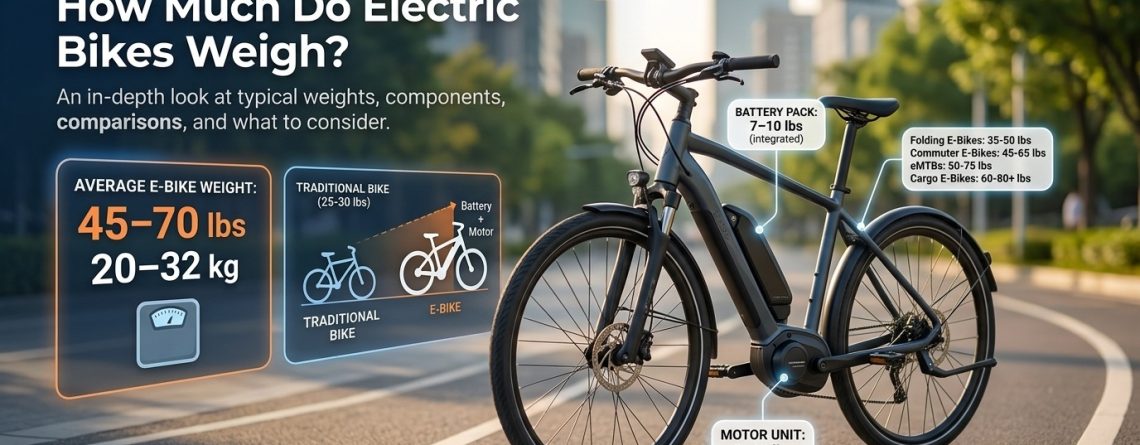
Most electric bikes weigh between 45 and 70 pounds (20 to 32 kg), compared to traditional bicycles which typically weigh between 20 and 30 pounds. This extra weight comes primarily from the motor, the lithium battery, and the reinforced frame materials needed to support the power assistance system.
If you have ever tried to lift an e-bike onto a rear car rack, you already know the truth: these machines are robust. The question of how much do electric bikes weigh is usually the first thing that comes to mind when you feel that unexpected heft.
Actually, it is a common experience among new riders. You might be used to tossing a regular bicycle over your shoulder to carry it up a flight of stairs. But when you transition to an electric model, you are suddenly dealing with a totally different weight class. Why is the average weight of electric bike models so much higher? Well, it is a trade-off. You are exchanging lightweight portability for effortless hill-climbing power and extended range.

Let’s look at the basic numbers. When researching how much does an ebike weigh, the data shows a clear electric bike weight range. While a traditional bike sits comfortably around 20 to 30 lbs, the average ebike weight is significantly higher. But not all e-bikes are built the same. A lightweight folding e-bike will feel vastly different than a massive, cargo-hauling machine with fat tires.
⚡ Why Are Electric Bikes So Heavy?
To understand how much do ebikes weigh, you have to look at the anatomy of the bike itself. What exactly is adding those extra 20 to 40 pounds? It boils down to three main components: the motor, the battery pack, and the reinforced structural elements.
The Motor: Hub Motor vs. Mid-Mounted Motor
The motor is the heart of your power assistance. Generally, an e-bike motor adds anywhere from 4.5 to 11 pounds (2 to 5 kg) to the overall ebike weight. A hub motor (located in the center of the wheel) tends to be slightly heavier and shifts the bike’s center of gravity. A mid-mounted motor (located near the pedals) often provides better balance and handling, even if the weight remains similar.
The Battery Pack: The Heavy Lifter
Next up is the lithium battery. Depending on the capacity (measured in Watt-hours or Ah), a standard e-bike battery adds roughly 6 to 12 pounds. If you are looking at dual-battery setups for long-range touring, you can expect that number to double. Interestingly, battery technology is improving, meaning the ebike average weight might decrease in the future as energy density improves, but for now, those cells carry serious mass.
Frame Materials and Reinforced Components
Because the bike has to support a heavy motor and battery—and travel at higher speeds—the frame material must be incredibly durable. While some high-end models use carbon fiber to reduce the average weight of an ebike, most utilize a reinforced aluminum frame. Furthermore, to provide stability and prevent flats at high speeds, e-bikes often feature thicker spokes, heavier suspension forks, and wider tires.
🌱 Average Weights by E-Bike Type
When someone asks, “how heavy is an electric bike?“, the most accurate answer is: it depends on the style. Here is a clear ebike weight comparison to help you understand the differences.
| E-Bike Type | Average Weight (lbs) | Average Weight (kg) | Best For |
|---|---|---|---|
| Folding E-Bikes | 35 – 50 lbs | 16 – 23 kg | Commuters, tight storage, public transit |
| Urban/Commuter E-Bikes | 40 – 60 lbs | 18 – 27 kg | Daily city riding, paved paths |
| Electric Mountain Bikes | 50 – 70 lbs | 23 – 32 kg | Off-road trails, steep hills, rugged terrain |
| Cargo E-Bikes | 60 – 80+ lbs | 27 – 36+ kg | Hauling groceries, carrying kids, deliveries |
Natural Q&A: Understanding the Bulk
Are there lightweight options available?
Yes. If you are worried about the average weight of e bikes, the market has responded with “lightweight ebike” models. By using smaller motors and integrating lower-capacity batteries into carbon fiber frames, some models weigh as little as 28 to 35 lbs. However, they sacrifice overall range and raw power.
How much do fat tire electric bikes weigh?
Fat tire electric bikes are typically on the heavier end of the spectrum. Due to the massive tires, reinforced rims, and larger frames required to house them, these bikes often tip the scales between 65 and 80 lbs.
🚀 E-Bike Weight Limits and Capacity
There is a big difference between the weight of the bike itself and the ebike weight limits it can safely carry. A heavier bike doesn’t always mean it can carry an infinite amount of weight. Most standard e-bikes have a total payload capacity (rider plus cargo) of around 250 to 300 pounds.
However, if you are looking at a cargo ebike, the frame is specifically engineered to handle massive loads. Some heavy-duty cargo models can support up to 400 or even 500 pounds. It is vital to check your manufacturer’s specific ebike weight limit to ensure safe operation, as exceeding this limit puts dangerous stress on the brakes and the motor and battery systems.
💡 Field Testing Insight: In practical tests, trying to stop a 70-lb e-bike carrying a 200-lb rider going 20 mph requires serious stopping power. This is exactly why almost all modern e-bikes are equipped with hydraulic disc brakes instead of the rim brakes found on a regular bicycle.
⚖️ How E-Bike Weight Affects Handling and Transport
Does an e-bike’s weight affect riding? To be honest, while the pedal assist is engaged, you barely notice the extra 30 pounds. The power assistance masks the bulk entirely on flat ground and hills.
The reality check happens when the battery dies, or when you need to transport it. Pedaling a 65-lb dead e-bike uphill is a grueling workout. Furthermore, portability is a major factor. Standard car roof racks usually cannot handle ebikes weight safely; you almost always need a hitch-mounted rack specifically rated for heavy electric bicycles.
For those needing to carry their bike upstairs, folding ebike weight is a crucial metric. Even folding models average 40 lbs, so it is less about carrying it long distances and more about fitting it compactly into a trunk or train car.
Standard Commuter Profile
- Category: Urban Commuter
- Est. Weight: 50 lbs (22.5 kg)
- Pros: Balanced handling, moderate lifting difficulty.
- Cons: Still requires a specialized car rack.
Heavy Duty 1,000W Motor
- Category: Utility / Cargo/Offroad
- Est. Weight: 57+ lbs (26+ kg)
- Pros: Massive Power Capacity
- Cons: Could be difficult to lift; may requires ground-level storage if used with a cargo bike.
📖 Frequently Asked Questions
How much do electric mountain bikes weigh?
Electric mountain bikes (eMTBs) typically weigh between 50 and 70 pounds. They require heavy-duty suspension systems, robust frames to withstand trail impacts, and powerful mid-drive motors to conquer steep, uneven terrain.
Is ebike weight kg measurements standard globally?
Yes, outside of the United States, ebike weight kg is the standard metric. For quick conversion, simply divide the pound weight by 2.2. So, a 50 lb e-bike is roughly 22.7 kg.
Can I still ride my e-bike if the battery dies?
Absolutely. An e-bike functions just like a traditional bike when the motor is off. However, because of the high e bike weight, it will require significantly more physical effort to pedal, especially on inclines.
Why is my ebike so much heavier than my friend’s regular bike?
Your friend’s regular bicycle doesn’t house a 10-pound lithium-ion battery, an 8-pound electric motor, or the thicker frame material required to safely accommodate the torque generated by that motor.4
Final Thoughts
When asking how much does an electric bike weigh, the simple answer is 45 to 70 pounds. But the real takeaway is that this extra weight is the price of admission for incredible power, extended range, and sweat-free commutes. By understanding the electric bike weight range, you can make an informed decision on whether you need an ultra-light commuter for walk-up apartments or a heavy-duty cargo bike for family transport.
Ready to find the perfect fit?
Explore different models to find the right balance of weight, power, and portability for your lifestyle.
Disclaimer: This article shares expert experiences, field observations, and general safety guidelines, and was organized with AI assistance. Always consult your specific manufacturer’s manual regarding exact product weights, weight limits, and safe transportation regulations.
Data references on battery chemistry and weight ratios are sourced from general industry standards such as Kalkoff Bikes











LEAVE A COMMENT