




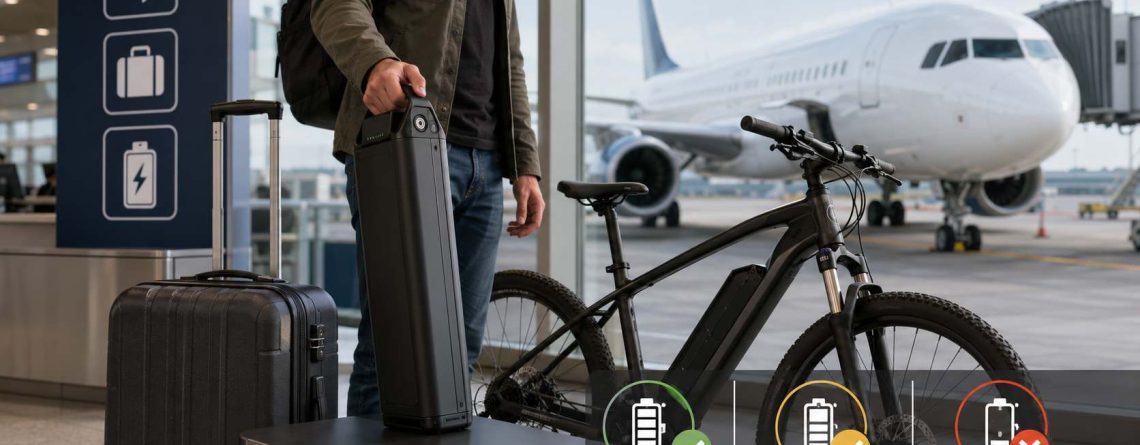
Can You Take an eBike Battery on a Plane? Ultimate Rules
Can you take an eBike battery on a plane? In most cases, no. A normal eBike battery is much larger than the limit for passenger baggage. This is true even when the battery is removable or almost empty.
Airlines use the battery’s watt-hour rating to decide what may travel. Batteries rated at 100Wh or less are usually allowed. Batteries above 100Wh and up to 160Wh need airline approval. Most batteries above 160Wh cannot go in carry-on or checked baggage on a passenger flight.
Quick Answer
Most 36V, 48V, 52V, and 72V eBike batteries are over 160Wh. For that reason, they cannot travel as normal passenger baggage.
- 100Wh or less: Usually allowed, subject to airline rules.
- More than 100Wh and up to 160Wh: Airline approval is required.
- More than 160Wh: Not allowed as normal carry-on or checked baggage.
Spare lithium batteries must stay in carry-on baggage. They must also be protected from damage and short circuits. Always check the rules of every airline that will operate your trip.

What Are the Airline Limits for eBike Batteries?
Airlines do not judge an eBike battery by voltage alone. They use watt-hours, shown as Wh. Watt-hours measure how much energy the battery can store.
Current U.S. guidance uses three main groups. The table below gives a simple overview.
| Battery Rating | Carry-On | Checked Baggage | Approval |
|---|---|---|---|
| 100Wh or less | Usually allowed | Installed batteries may be allowed under set conditions | Usually not needed |
| More than 100Wh and up to 160Wh | May be allowed | Spare batteries are not allowed | Airline approval is required |
| More than 160Wh | Not allowed as normal passenger baggage | Not allowed as normal passenger baggage | Normal passenger approval does not remove the limit |
A passenger may usually carry no more than two spare batteries in the 101–160Wh range. The airline must approve them before the flight.
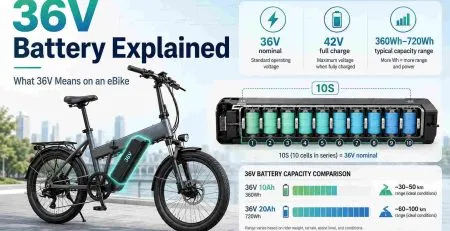
Most eBike packs are much larger. A 36V 10Ah battery is about 360Wh. A 48V 15Ah battery is about 720Wh. A 52V 17Ah battery is about 884Wh. These common packs are well above the passenger limit.
Important: Airline approval only helps with batteries above 100Wh and up to 160Wh. It does not make a 500Wh or 800Wh battery acceptable as normal passenger baggage.
How Do You Calculate an eBike Battery’s Watt-Hours?
First, read the battery label. Many labels show voltage, amp-hours, and watt-hours. You may also find these details in the product manual.
When watt-hours are not listed, use this formula:
Nominal voltage × amp-hours = watt-hours
For example, a 48V 14Ah battery is about 672Wh:
48 × 14 = 672Wh
Use the nominal voltage printed by the maker. Do not use the full-charge voltage. A battery sold as 48V may reach about 54.6V when full, but it is still described as a 48V battery.
Common Battery Sizes
| Battery | Approximate Energy | Likely Passenger Result |
|---|---|---|
| 36V 2.5Ah | 90Wh | May be allowed |
| 36V 4Ah | 144Wh | Airline approval is required |
| 36V 10Ah | 360Wh | Not allowed as normal passenger baggage |
| 48V 15Ah | 720Wh | Not allowed as normal passenger baggage |
| 52V 17Ah | 884Wh | Not allowed as normal passenger baggage |
| 72V 15Ah | 1,080Wh | Not allowed as normal passenger baggage |
Does a Low Charge Reduce the Official Rating?
No. A low charge does not change the watt-hour rating. A 720Wh battery is still rated at 720Wh when it is almost empty.
The rule is based on the battery’s designed capacity. It is not based on the amount of energy left on the day of travel.
Why Are Large eBike Batteries Restricted?
Lithium-ion batteries hold a lot of energy. A damaged or faulty cell can heat very quickly. In rare cases, it can enter thermal runaway.
Thermal runaway is a fast rise in heat and pressure. One hot cell may also heat nearby cells. This can cause smoke, fire, or repeated ignition.
Phones and laptops use smaller batteries. A full-size eBike battery stores far more energy. That makes a serious battery event harder to control.
Spare batteries must stay in the cabin because the crew can see and respond to a problem sooner. This rule does not mean that a large eBike battery is safe to carry. The watt-hour limit still applies.
Can You Put an eBike Battery in Carry-On Luggage?
Only a battery within the allowed watt-hour range may go in carry-on luggage. A spare battery of 100Wh or less is usually allowed. A battery above 100Wh and up to 160Wh needs airline approval.
The terminals must be protected. They must not touch keys, coins, tools, or other metal items. Use the original package, a battery case, a terminal cover, or nonconductive tape.
Pack the battery so it cannot move, bend, or get crushed. Keep it away from sharp objects. Do not carry a battery that is swollen, leaking, recalled, punctured, or unusually hot.
A removed eBike battery is a spare battery. Removing a 600Wh battery from the frame does not make it legal for carry-on baggage.
Can You Put an eBike Battery in Checked Luggage?
A spare lithium battery must not go in checked baggage. It must remain with the passenger in the cabin, and it must still meet the watt-hour limit.
An installed battery may follow different rules for some devices. Yet the battery size still matters. Keeping a 500Wh eBike battery attached to the bike does not create an exception.
Your carry-on bag may be checked at the gate when the cabin is full. Remove all spare lithium batteries before you hand over the bag. Keep those batteries with you.
Who Decides Whether the Battery Can Fly?
Several groups may be involved. In the United States, the FAA sets safety rules for dangerous goods on aircraft. TSA officers screen passengers and bags. The airline applies its own policy and gives any needed approval.
An airline may set a stricter rule than the general limit. It may also ask for a clear battery label, a manual, or a product data sheet.
Contact the airline before you book. Give it the battery model, voltage, amp-hours, and watt-hours. Ask for the answer in writing.
Written approval helps when a battery is in the 101–160Wh range. It does not guarantee that every airport worker will accept the item. Bring the battery label and the airline’s message to check-in.
What Battery Details Should You Bring?
Bring clear proof of the battery rating. The label should show the maker, model, voltage, amp-hours, and watt-hours. Take a photo of the label before you leave home.
Also save the product page or manual on your phone. A paper copy can help when your phone has no signal. Keep any airline approval with your travel papers.
Staff may refuse a battery when the rating is missing or hard to read. Your own math may help, but it may not replace a clear label or maker’s document.
Do not change, cover, or remove the battery label. Do not claim that the battery is smaller than it is. Give the airline the full and correct details.
What About International Flights?
International trips can involve more than one set of rules. You may need to check the departure country, the destination, transit airports, and every airline on the booking.
One airline may sell the ticket while another airline operates the flight. Check the operating airline for each part of the trip.
IATA passenger guidance uses the same main watt-hour groups: up to 100Wh, more than 100Wh and up to 160Wh with approval, and above 160Wh. An airline or country may add tighter limits.
Check the return trip too. A battery accepted on the first flight may face a different process at another airport.
Do Mobility Aids Follow the Same Rules?
Battery-powered wheelchairs and other mobility aids follow separate rules. Airlines may accept larger batteries when the device is needed for personal mobility.
These cases may need special approval, safe handling, and more documents. The airline may also need details about how the battery is attached and whether it can be removed.
A normal eBike does not become a mobility aid just because it is used for transport. Contact the airline’s accessibility team when the device is medically needed.
What Can You Do When the Battery Is Over 160Wh?
Most riders need another plan. The best choice depends on the route, the length of the trip, and whether a matching battery is available at the destination.

1. Fly With the Bike but Leave the Battery at Home
Some airlines accept a bike as checked sports equipment after the battery is removed. Ask whether the airline accepts an eBike with no battery.
Protect the empty mount and all loose wires. Cover open connectors so they cannot collect dirt or moisture. Follow the airline’s rules for bike boxes, size, weight, and fees.
2. Rent an eBike at the Destination
Renting a complete eBike is often the easiest choice for a short trip. It avoids shipping, delays, and battery fit problems.
Check the bike type, range, charger access, deposit, and return rules before you reserve it.
3. Rent or Borrow a Matching Battery
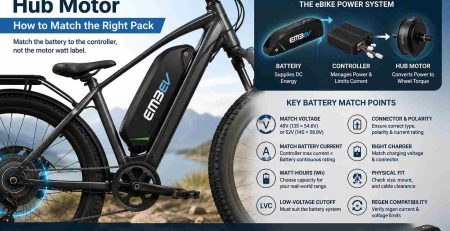
A local battery must match the bike. The same voltage does not prove that two batteries are compatible.
Check these points before use:
- Nominal voltage and full-charge voltage
- Battery mount and case shape
- Connector type and polarity
- Controller current demand
- Battery discharge rating
- Communication or lock system
- Charger voltage and plug
- Space and cable clearance
Some factory eBikes use a special case, data link, or digital key. A battery that fits the frame may still fail to power the bike.
4. Use a Qualified Battery Shipping Service
Large lithium batteries may travel through approved cargo or ground services. They are regulated dangerous goods, so normal parcel service may not accept them.
Use a carrier, freight company, or battery shipping service that clearly accepts your exact pack. Ask about packaging, labels, documents, insurance, delivery time, and return shipping.
Never hide the battery in a bike box. Do not remove the label or describe it as normal bike parts. False information can create safety and legal problems.
5. Keep a Battery at a Place You Visit Often
A second battery may make sense when you often visit the same location. Store it in a dry and secure area. Keep it away from heat, direct sun, flooding, freezing weather, and metal objects.
Follow the maker’s storage guidance. Check the battery from time to time. Do not use it when you see swelling, leaks, damaged wires, or melted connectors.
How to Plan Before You Book the Flight
- Read the battery label. Record the voltage, amp-hours, watt-hours, model, and maker.
- Calculate watt-hours. Multiply nominal voltage by amp-hours when Wh is not shown.
- Check official guidance. Review current FAA, TSA, and airline rules.
- Check every operating airline. This matters on code-share and connecting trips.
- Ask for approval when needed. Get a written answer for a battery above 100Wh and up to 160Wh.
- Check the bike policy. Ask about boxes, weight, size, fees, and motorized-bike limits.
- Plan the return trip. Include rental, storage, or shipping at the destination.
- Inspect the battery. Do not travel with a damaged or recalled pack.
Stop using a dangerous battery. Warning signs include swelling, smoke, hissing, leaks, fast heating, a strong chemical smell, or melted connectors. Move away when it is safe. Contact emergency services or a qualified lithium battery professional.
Common Mistakes to Avoid
Thinking an Empty Battery Is Allowed
The official rating does not fall when the battery is empty. A 500Wh pack stays a 500Wh pack.
Putting the Battery in a Checked Bag
Spare lithium batteries cannot go in checked baggage. Hiding one in a suitcase or bike box does not change the rule.
Removing the Battery From the Bike
Removal may help the bike travel as sports equipment. It does not make the battery smaller. The removed pack becomes a spare battery.
Opening the Pack to Make Smaller Batteries
Do not open or rebuild a battery for a flight. This can expose live parts, damage insulation, and defeat safety systems. Use only a modular battery that the maker designed for separate use.
Using a Battery With No Clear Label
Staff may refuse a battery when they cannot confirm its watt-hour rating. Keep the original label, manual, and product data.
What Does This Mean for Full-Size EM3ev Batteries?
Full-size EM3ev batteries are built for useful riding range and power. Their energy is usually measured in hundreds of watt-hours. They are not normal passenger carry-on or checked-baggage batteries.
A strong case, smart BMS, removable mount, or quality cells do not create an airline exception. The watt-hour limit still applies.
For air travel, arrange a battery or rental bike at the destination. Another option is a qualified dangerous-goods shipping provider.
For normal riding and replacement needs, compare voltage, capacity, current, connectors, and frame fit in the EM3ev eBike battery range .
Frequently Asked Questions
Can I Take a 48V eBike Battery on a Plane?
A normal 48V eBike battery is usually over 160Wh. For example, a 48V 10Ah battery is about 480Wh. It cannot travel as normal passenger baggage.
Can I Take a 52V eBike Battery on a Plane?
Most 52V eBike batteries are also over 160Wh. A rare 52V 3Ah pack would be about 156Wh and would still need airline approval.
Can I Check an eBike Without the Battery?
Some airlines may accept it as sports equipment after the battery is removed. Ask the operating airline about motorized bikes, packing, size, weight, and fees.
Can I Ship My eBike Battery to the Destination?
It may be possible through an approved ground or cargo service. Large lithium batteries are dangerous goods. Use a service that accepts the exact battery and gives clear packing and document rules.
Does TSA Allow eBike Batteries?
TSA screening is only one part of the process. FAA limits and airline rules also apply. Batteries over 160Wh are not allowed as normal passenger baggage.
Can I Carry Two 160Wh Batteries?
A passenger may usually carry up to two spare batteries above 100Wh and up to 160Wh with airline approval. Each battery must be made for safe, separate use.
Can I Take an eBike Range Extender on a Plane?
Check the printed watt-hour rating. A unit at 100Wh or less may be allowed. A unit above 100Wh and up to 160Wh needs airline approval.
Do LiFePO4 Batteries Follow the Same Limit?
Yes. They are still rechargeable lithium batteries for transport. Check the rating and the airline policy before travel.
Final Answer
Can you take an eBike battery on a plane? Usually, you cannot. Most eBike batteries are over 160Wh, so they do not qualify as normal carry-on or checked baggage.
Batteries at 100Wh or less are usually allowed. Batteries above 100Wh and up to 160Wh need airline approval. Spare batteries must stay in carry-on baggage.
Check the battery label before booking. Then check every operating airline. For a full-size pack, plan to rent a bike or battery, leave the battery at home, or use a qualified shipping service.
Looking for a battery for normal commuting, trail riding, or an eBike
conversion?







LEAVE A COMMENT