




Electric Bicycle Battery Types: Chemistry, Cells & Pack Designs
Electric bicycle battery can look very different from one bike to another. Some are mounted on the downtube. Others sit inside the frame, on a rear rack, or inside a large triangle case.
The cells inside the pack can also differ. Battery chemistry, cell size, voltage and pack design all affect how a battery is built and how it behaves.
This guide explains the main electric bicycle battery types and the different ways eBike batteries can be classified.
Ready to choose a battery?
Shop EM3ev eBike battery packs built with genuine Samsung cells (36V/48V/52V + custom builds).
What Are the Main Types of Electric Bicycle Batteries?
There is no single way to classify an eBike battery. A battery can belong to several groups at the same time.
For example, one pack might be:
- a lithium-ion battery;
- built with 21700 cylindrical cells;
- designed for downtube mounting;
- configured as a 52V system.
For that reason, it is useful to look at battery types in four main ways:
- battery chemistry;
- cell format;
- physical pack design;
- system voltage.
1. Electric Bicycle Battery Types by Chemistry
Most modern eBikes use lithium-ion batteries. However, the term lithium-ion covers several different chemistries.
Each chemistry can place a different balance on energy density, current capability, cycle life, cost and thermal behavior.
NMC Lithium-Ion Batteries
NMC stands for nickel manganese cobalt oxide. It is widely used in portable devices, electric vehicles and eBike battery cells.
NMC cells can offer a useful balance between energy density and current capability. For this reason, many modern eBike battery packs use cells based on NMC chemistry.
NCA Lithium-Ion Batteries
NCA stands for nickel cobalt aluminum oxide.
NCA cells can provide high energy density and strong performance. Exact characteristics still depend on the cell model and manufacturer.
Two cells using similar chemistry can perform very differently if one is designed for high capacity and the other for high current.
LiFePO4 Batteries
LiFePO4, also called LFP, is another type of lithium-ion chemistry.
LFP is known for long cycle life and good thermal stability. The trade-off is usually lower energy density compared with many NMC or NCA cells.
This can make an LFP pack larger or heavier for the same amount of stored energy.
Older Battery Chemistries
Older electric bicycles sometimes used lead-acid or nickel-metal hydride batteries.
These technologies still exist, but lithium-ion has become the main choice for modern eBikes because it can store more energy for a given size and weight.
2. Electric Bicycle Battery Types by Cell Format
Battery chemistry and cell format are not the same thing.
A cell format describes the physical shape and size of the cell. Two common cylindrical formats used in eBike batteries are 18650 and 21700.

18650 Cells
An 18650 cell is about 18 mm wide and 65 mm long.
This format has been used for many years and is available in a wide range of cell models. Some 18650 cells focus on capacity, while others are designed for higher discharge current.
21700 Cells
A 21700 cell is about 21 mm wide and 70 mm long.
The larger cell body gives manufacturers more room for active material. Modern 21700 cells can offer high capacity, strong current capability, or a balance of both.
That does not mean every 21700 cell is automatically better than every 18650 cell. The exact cell model matters more than the size name alone.
For a deeper technical comparison, see our18650 vs 21700 eBike battery cell comparison.
3. Electric Bicycle Battery Types by Pack Design
The outside shape of an eBike battery is just as important as the cells inside it. The battery has to fit the bike securely while leaving room for cables, suspension and other parts.

Downtube Batteries
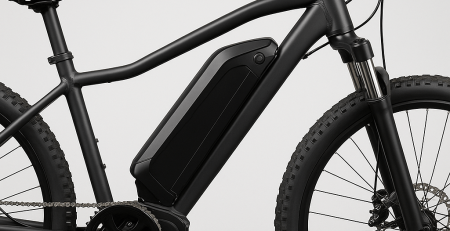
Downtube batteries mount along the main tube of the bicycle frame.
They are common on conversion bikes because the downtube often provides a strong and convenient mounting location.
Integrated or In-Frame Batteries
Integrated batteries sit partly or fully inside the bicycle frame.
This creates a clean appearance and can protect the battery from some external impacts. The downside is that replacement batteries often need to match the frame very closely.
Rear-Rack Batteries
Rear-rack batteries mount above the rear wheel.
They can be useful when there is not enough room inside the main frame triangle. However, they place more battery weight toward the rear of the bicycle.
Triangle Batteries
Triangle batteries use a larger part of the main frame triangle.
They are popular on some DIY and higher-capacity builds because the larger available space can hold more cells.
Compact and Bottle-Style Batteries
Smaller batteries may use bottle-style or other compact cases.
These designs can work well when space and weight are important. Their smaller size usually limits how many cells can fit inside the pack.
4. Electric Bicycle Battery Types by Voltage
eBike batteries are also grouped by system voltage.
Common voltage classes include:
| Battery Class | Typical Li-ion Series Count |
|---|---|
| 36V | 10S |
| 48V | 13S |
| 52V | 14S |
| 72V | 20S |
Voltage is a useful way to describe a battery system, but a higher voltage is not automatically the right choice.
The battery must match the controller, motor and other electrical parts of the bike.
Energy Cells vs High-Discharge Cells
Another useful way to classify battery cells is by what they are designed to do.
Some cells focus on storing as much energy as possible. These are often called high-capacity or energy-focused cells.
Other cells are designed to supply higher current with less voltage drop under heavy load.
This difference matters because cell size alone does not tell you how a battery will perform.
For example, two 21700 cells may have the same physical dimensions but very different current ratings and capacities.
The complete battery pack also matters. Parallel cell count, electrical connections, BMS limits and pack construction all affect real performance.
Does Battery Type Determine Performance?
Battery type is important, but no single label tells the whole story.
A battery described as “52V lithium-ion with 21700 cells” still leaves many questions unanswered.
You would also need to know:
- which exact cells are used;
- how many cells are connected in parallel;
- the battery capacity;
- the current capability;
- the BMS limits;
- the quality of the electrical connections;
- the physical fit and mounting design.
This is why comparing batteries only by voltage, chemistry or cell size can be misleading.
Frequently Asked Questions
What is the most common type of eBike battery?
Modern eBikes mainly use lithium-ion battery packs. The exact chemistry, cell format and pack shape vary between models.
Are 21700 cells better than 18650 cells?
Not always. 21700 cells are larger and many modern models offer high capacity or strong current capability. However, performance depends on the exact cell, not just its size.
Is LiFePO4 better than regular lithium-ion?
It depends on the goal. LFP can offer long cycle life and good thermal stability, while many NMC and NCA cells provide higher energy density. There is no single chemistry that is best for every eBike.
What is the difference between a battery type and battery voltage?
Voltage is one way to classify a battery. Chemistry, cell format and case design are other types of classification.
Final Takeaway
There are several ways to describe electric bicycle battery types.
Chemistry tells you about the cell technology. Cell format describes the physical cells. Pack design determines how the battery fits the bike. Voltage describes the electrical system class.
No single category tells you everything about performance. The best way to understand a battery is to look at chemistry, cells, pack construction and electrical specifications together.








LEAVE A COMMENT