





How to Store Batteries Safely and Properly
Learning how to store batteries safely is essential for extending their lifespan and preventing fire hazards. To store batteries safely, keep them in a cool, dry place away from direct sunlight and metal objects. Ideally, use the original packaging or a non-conductive plastic container to prevent terminals from touching and causing a short circuit.
Implementing these safety precautions is more than just home organization—it is a critical practice. One afternoon, a faint smell of ozone and a burning hot screwdriver tip taught me the hard way. Whether you are seeking home solutions or seasonal tips, small adjustments to your battery health management can prevent significant fire hazards.
When considering where to store batteries, the environment must be climate-controlled. Whether at home or in a workshop, the best way to store batteries is in a specialized organizer box or a non-conductive container, keeping terminals isolated to eliminate any risk of accidental discharge or heat generation.
Knowing where to store batteries safely involves selecting a location that is isolated from flammable materials and temperature fluctuations. For long-term peace of mind, ensure your chosen spot is inaccessible to children and pets, maintaining a consistent climate-controlled environment.

Quick Storage Check
Are your batteries touching metal? Before reading further, ensure your loose batteries aren’t clashing with coins or tools. Safety first!
Long-Term Storage for Lithium-Ion Packs
Prioritizing lithium battery storage safety is non-negotiable for high-capacity packs. Beyond maintaining charge levels, we recommend using a Fire-rated LiPo Bag or a specialized Battery Safe Box. These assets act as a containment barrier, significantly reducing risks during unexpected thermal events while the battery remains idle.
Why Humidity and Temperature Matter
| Battery Type | Cell Chemistry | Ideal Temp & RH | Storage Charge |
|---|---|---|---|
| Alkaline | Zinc-Manganese | 15°C | < 50% RH | 100% (Full) |
| Lithium-Ion | NCM / NCA | 10°C – 20°C | 30-50% RH | 40% – 60% |
| LiFePO4 | LFP | 15°C – 25°C | Dry | 30% – 50% |
Expert Insight: While a cool environment is vital, maintaining proper humidity for battery storage is equally critical. Ideally, store your packs in an area with 30% to 50% relative humidity (RH). High humidity in areas like a refrigerator can cause condensation, leading to terminal corrosion and potential internal failure.
How to Store E-Bike Batteries
If you are an e-bike rider, you know that the battery is the most expensive part of your ride. When storing ebike batteries for the winter, never leave them on the bike in an unheated garage. Extreme cold can permanently reduce capacity. I always bring mine indoors during the off-season, keeping it in a fire-rated bag for extra lithium battery storage safety.
way closet. Avoid areas prone to temperature spikes, such as laundry rooms or garages.
VISUAL SUGGESTION: Fire-rated LiPo Bag Storage Setup
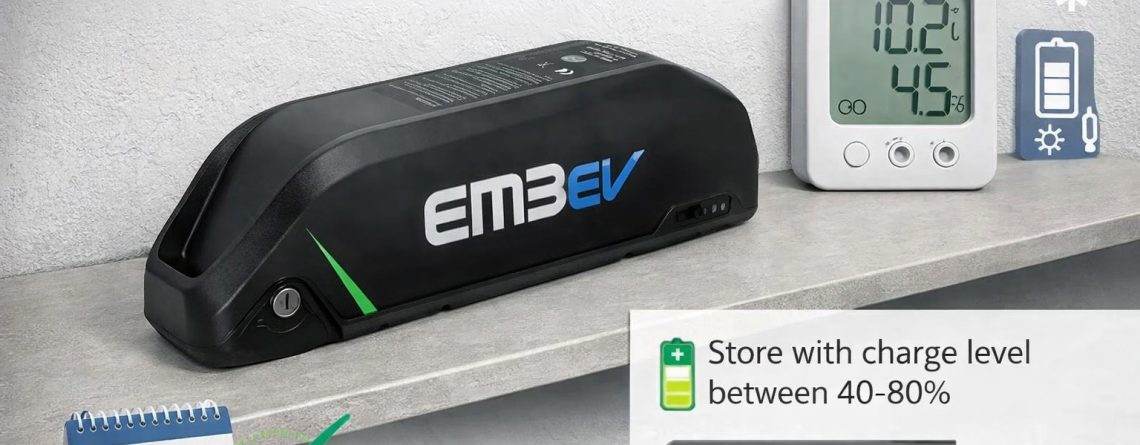
For enhanced lithium battery storage safety, we strongly recommend using a fire-rated LiPo bag. This creates a containment barrier in the rare event of thermal runaway. To easily maintain the recommended 50% charge level, consider using an EM3ev Smart Charger, which features a dedicated storage mode preset.
High-quality batteries like the EM3ev Super Shark require specific storage charge levels for longevity.
💡 Expert Insight: “In my experience with EM3ev packs, their robust casing provides excellent protection, but you still need to check the charge every 30 days to ensure the Smart BMS hasn’t dipped below the safety threshold during long-term storage.”
Recommended EM3ev Solutions for Storage & Performance

EM3ev Super Shark (48V)
Best for: Long-term reliability and smart monitoring.
- ✅ Authentic Panasonic/Samsung cells
- ✅ Advanced Smart BMS with thermal protection
- ✅ High-impact reinforced casing
EM3ev High-Capacity Pack(52V)
Best for: Long-distance touring and DIY builds.
- ✅ Massive Wh capacity for extended range
- ✅ Custom-built with high-current cell options
- ✅ Integrated fuse protection for safety
Maximizing Battery Lifespan and Compatibility
Understanding your battery lifespan is key to long-term performance. Storing an EM3ev battery at a specific 50% charge reduces chemical stress on the cells, preserving cycle life for years of service. Furthermore, our battery compatibility ensures that Super Shark and King Shark packs interface seamlessly with major mid-drive systems like Bafang and MAC, even after extended idle periods.
The difference in storage performance often stems from the internal cells used. High-grade 21700 cells generally exhibit lower internal resistance over time compared to older 18650 variants, making them superior for long-term dormancy. If you are looking for a battery upgrade, transitioning to a Smart BMS-equipped system allows for real-time monitoring of “Static Power Consumption,” preventing the cells from dipping into the “Permanent Failure Zone” during the off-season.
Ready for the Next Season?
Ensuring your EM3ev battery is stored at 50% charge will guarantee it’s ready to hit the trails as soon as the weather warms up. Proper care today means more power tomorrow!
Expert Battery Storage FAQ
Q: How to store rechargeable batteries safely?
A: Keep rechargeable batteries at a 50% state of charge (SoC) in a non-conductive bin. Avoid mixing chemistries or storing them with metallic tools to prevent short circuits.
Q: Is there a maintenance cycle for stored lithium batteries?
A: Yes. We recommend a “Health Check” every 3 months. Briefly charge the battery to maintain the 40-60% window, especially for packs with active Smart BMS systems that consume tiny amounts of power while idle.
Q: What is the long-term storage cost of neglect?
A: Neglecting storage protocols can reduce battery lifespan by up to 30% per season. Proper climate control is an investment that preserves your pack’s ROI and ensures maximum range for your next ride.
Pro Tip: Use a non-conductive bin and never mix battery chemistries.
References: Insights gathered from safety benchmarks and manufacturer storage guidelines for high-capacity cells. This guide is for informational purposes; always follow your specific device’s manual.











LEAVE A COMMENT