




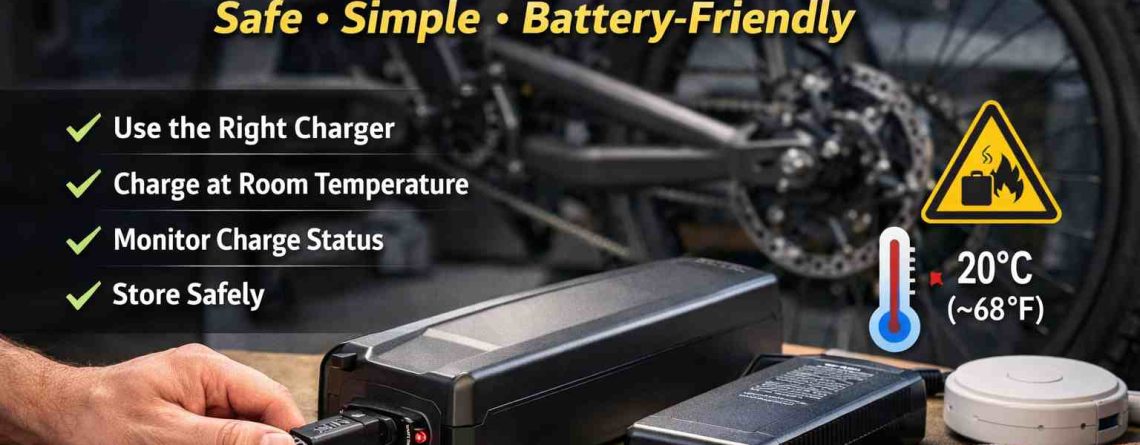
How to Charge an E-Bike Battery Safely
E-Bike Battery Charging: How to Charge, Store and Protect Battery Life
Safe e-bike battery charging starts with the instructions for the exact battery and charger. Use the supplied or explicitly approved charger, confirm output voltage, connector and polarity, charge in the permitted temperature range on a dry non-combustible surface, keep exits clear, and stop if the pack becomes unusually hot, swollen, noisy or gives off an unusual smell.
If you want longer battery life, avoid charging a frozen pack, avoid storing it at 100% for long periods, and use slower charging when time allows. This guide explains safe charging steps, charging time factors, approved charger compatibility, cold weather rules, and what to do when a pack looks full but still will not power the bike.
Quick Answer: Safe Charging at a Glance
- Match the charger: Use the supplied or explicitly approved charger; verify output voltage, connector, polarity and permitted charge current.
- Temperature matters: Charge only within the battery maker’s permitted range, and let a cold- or heat-soaked pack stabilize naturally before charging.
- Supervision: Stay nearby while charging and do not charge while sleeping. Never charge a pack that shows damage, swelling, unusual heat, noise, leakage or odour.
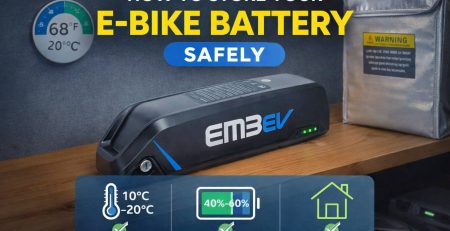
- Storage Mode: Store at 40-70% charge; top it up fully just before your next big ride.
- Troubleshoot First: If it won’t charge, check connectors and charger LEDs before assuming the pack is dead.
A charger LED that turns green immediately does not prove that the battery is healthy or fully charged. It may indicate a completed charge, a poor connection, a charger fault, BMS protection or another condition described in the product manual. Diagnose the symptom without bypassing the BMS or opening the pack.

Need a replacement charger or pack?
Check the exact battery and charger specifications before connecting them; a matching plug alone is not enough.
Safe e-bike battery charging basics
A safer routine uses the manufacturer-approved charger within the stated temperature range, on a stable non-combustible surface, with ventilation and a clear exit path. Stay nearby for the charge, not only the first few minutes. The U.S. Consumer Product Safety Commission’s micromobility charging guidance is a useful public-safety reference.
A BMS is a protection layer, not a substitute for supervision or temperature limits. If the pack has been in a very cold or hot location, move it to the permitted charging environment and allow its internal temperature to stabilize for as long as the manufacturer specifies before charging.
Should you only use the manufacturer-approved charger?
Yes—whenever possible, use the charger supplied by the battery maker or a verified replacement with the same output voltage, connector type, and polarity. A charger that looks similar is not automatically safe. A mismatch between charger voltage and battery voltage can damage the pack, trip the BMS, or create a real fire risk.
Quick rule: Match voltage first, then connector style, then pin polarity. For example, a 48V charger must never be used on a 36V battery, even if the plug appears to fit.
- Best choice: Original charger from the battery manufacturer.
- Safe replacement: Same voltage, same connector, same polarity, similar charging current.
- Avoid: Unknown chargers with vague labels, damaged cables, or overheating bricks.
Step-by-step safe charging routine
- Visual Inspection: Check the pack for cracks and ensure the charging port is free of debris or moisture.
- Environment Setup: Place the battery on a hard, flat, non-combustible surface (like a concrete floor or metal tray) in a ventilated area.
- Follow the specified connection sequence: Use the order stated by the battery and charger manufacturer. Make sure the charge port and plug are dry, clean, correctly aligned and fully seated; never force or modify a connector.
- Monitoring: Check the indicator and manual for the exact charger. LED colours are not universal; an unexpected pattern or abnormal heat requires disconnection if it is safe to do so.
- Completion: Follow the charger and battery instructions for disconnecting. Do not assume that a green LED has the same meaning on every charger.
Should you unplug an e-bike charger when charging is complete?
Follow the manufacturer’s instructions. A BMS helps protect the pack but is not a reason to leave it connected indefinitely. Disconnect using the specified sequence once the charger indicates completion, unless the manual explicitly states otherwise.
How should an e-bike battery be charged in a flat?
Use a working smoke alarm, a dry and ventilated non-flammable area, and keep exits clear. Do not charge a damaged pack or place the battery in a sealed container that can trap heat or pressure.
Charging time: what affects it and why slower charging can help battery life
Charging time depends on pack capacity, charger output, ambient temperature, and the final balancing phase near 100%. Faster charging reduces waiting time, but it can also create more heat. If speed is not critical, a slower charge is usually gentler on the cells and can help preserve long-term battery health.
| Factor | Impact on Charging Speed |
|---|---|
| Total Battery Capacity (Ah/Wh) | Larger packs generally take longer to charge at the same current and can provide more range per charge; size alone does not determine service life. |
| Charger Output (Amps) | Higher Amperage (e.g., 5A vs 2A) reduces time. |
| Ambient Temperature | Extreme cold or heat slows down the chemical reaction. |
| Pack Age & Health | Older cells may lose capacity over time, leading to longer balancing phases at the end of a cycle. |
| BMS Balancing Phase | The final stage is often slower when the charger tapers current or the BMS balances cell groups. |
| Power Source Quality | Stable AC voltage ensures the charger runs at peak efficiency. |
How to extend e-bike battery life
Battery life improves when charging habits reduce heat, stress, and long periods at extreme state of charge. The goal is not just to fill the pack—it is to keep the chemistry stable for more cycles.
For a deeper explanation of cycle life, storage and capacity loss, read how long an eBike battery lasts. For warning signs and risk reduction, see our eBike battery safety guide.
| Charging habit | Effect on battery life | Best practice |
|---|---|---|
| Using a slower charger when you have time | Usually lowers heat and reduces stress on the cells | Choose a moderate charge rate for routine home charging |
| Leaving the pack at 100% for days or weeks | Accelerates long-term capacity loss | Charge fully close to ride time, not far in advance |
| Deep discharging until the pack is nearly empty every ride | Increases wear over time | Prefer frequent shallow charging instead of repeated deep drains |
| Charging in freezing or very hot conditions | Can permanently damage cells or trigger BMS protection | Bring the battery to room temperature before charging |
| Long-term storage at full or empty charge | Shortens lifespan and increases imbalance risk | Store around 40% to 70% and recheck periodically |
Cold weather: can you charge an e-bike battery in the cold?
Do not charge a cold-soaked battery below the manufacturer’s minimum charging temperature. For many lithium-ion packs that limit is around 0°C/32°F. Move the pack to an approved environment and allow its internal temperature to rise before connecting the charger.
Riding in cold weather is one thing; charging in the cold is different. A battery can often discharge in winter, but charging it while frozen places much more stress on the cells. If the battery came from a cold garage, car trunk, or outdoor ride, let it rest inside first.
Can I charge an e-bike battery in the cold?
Not below the battery maker’s minimum charging temperature. Charging a cold-soaked lithium-ion pack can cause lithium plating and permanent damage. Let the pack warm naturally; do not apply direct heat.
Troubleshooting: pack won’t charge / full but not working
A battery that will not charge can have several causes: no AC power, a charger fault, damaged cable or port, poor connection, temperature protection, a fuse or BMS condition, cell imbalance or internal damage. Do not assume the cause without diagnosis.
If the pack shows full but the bike will not turn on, inspect only the accessible external connector and mount, then follow the manufacturer’s troubleshooting steps. Do not use an improvised ‘wake-up’ charge, bypass protection or open the pack; a qualified technician may need to test the charger, BMS and cell groups.
e-bike battery pack won’t charge: no-tools checklist
- Check the wall outlet: Test it with another device before blaming the battery.
- Check the charger LED: No light can mean a failed charger brick or bad AC cable.
- Inspect the charging port: Dirt, bent pins, or moisture can block a proper connection.
- Confirm charger compatibility: Wrong voltage, wrong polarity, or the wrong connector can stop charging immediately.
- Let the pack reach room temperature: A cold battery may refuse to charge even when nothing is broken.
- Watch for danger signs: Heat, swelling, sweet chemical smell, or smoke means stop and isolate the pack.
Safe Troubleshooting Method
Use a documented sequence that avoids opening the battery or bypassing protection:
- Record the symptom: Note the battery level, charger indicator pattern, temperature and whether the problem is intermittent.
- Check external power: Confirm the wall outlet and inspect the charger cable and plug. Electrical measurements should be performed only by a qualified person using the manufacturer’s procedure.
- Stabilize temperature: Keep the pack within the manufacturer’s permitted charging range and allow a cold- or heat-soaked pack to reach that range naturally.
- Inspect without opening: Stop if you see swelling, cracks, leakage, melted contacts or corrosion, or notice unusual heat, noise or odour.
- Use only documented resets: Follow the exact battery manual; reset methods and button times are model-specific.
- Escalate safely: Repeated cut-outs, abnormal heat or a pack that will not charge require professional testing. Do not repeat load tests on a suspicious battery.
Scenario Guide: What should you do?
Adjust charging to your actual route and the battery maker’s instructions. Daily riders may not need 100% after every short trip, while seasonal storage usually calls for a partial charge and periodic checks.
The Decision Box
- Daily commuter: Charge enough for the next ride with a reserve. Avoid repeated deep discharge and routine overnight unattended charging.
- Seasonal storage: Use the manufacturer’s target state of charge, temperature range and inspection interval. Recharge only with the approved charger and procedure.
- Damage or warning signs: Stop charging or using the pack. If it is smoking, hissing or rapidly heating, evacuate and contact emergency services; move it only if official guidance says it is safe to do so.
- Replacement charger: Match output voltage, connector, pin polarity and approved charge current. Use a manufacturer-approved replacement.
Need the right next step?
If your main goal is longer battery life, safer charging, or finding a verified replacement charger, use the shortcuts below before you move to a full battery upgrade.
Ready to Upgrade Your Power System?
If your current battery pack is showing signs of age or you need more range, choosing a replacement with a reliable BMS is essential for safety and performance.
Frequently Asked Questions
How often should I charge my e-bike battery pack?
Charge after rides that use a meaningful part of the pack. Lithium-ion batteries usually prefer shallow, regular charging over repeated deep discharges.
Is it OK to leave an e-bike battery on the charger overnight?
Do not make overnight unattended charging routine. Charge while awake and nearby, then disconnect according to the manufacturer’s instructions when charging is complete.
Should I only use the manufacturer-approved charger?
Use the supplied charger or a replacement explicitly approved for the exact battery. Output voltage, charge current, connector and pin polarity must all match; a plug that fits is not sufficient.
Does slower charging extend battery life?
A lower approved charge current often produces less heat and can reduce cell stress, but use only charge rates permitted for the exact battery and charger.
Should I store an e-bike battery fully charged or partially charged?
Follow the battery maker’s storage state-of-charge, temperature and inspection interval. Many makers specify a partial charge rather than prolonged storage near full or empty.
Can I charge an e-bike battery in the cold?
Do not charge below the battery maker’s minimum charging temperature. Let a cold-soaked pack warm naturally into the approved range; do not apply direct heat.
Why is my e-bike battery full but the bike will not turn on?
Several faults can cause this. Follow the manual, inspect only accessible external connections and stop if there is damage or abnormal heat. Repeated failure requires qualified diagnosis; do not bypass the BMS or open the pack.
What should I do if the pack will not charge at all?
Confirm the outlet, read the charger indicator in the manual and inspect accessible cables and the port without opening the pack. If it still will not charge, disconnect it and arrange qualified service.


LEAVE A COMMENT