




How to Choose a Safe High Voltage ebike Battery
A high voltage ebike battery is a battery-pack system—usually running at 48V, 52V, 60V, or 72V—that provides more power than standard setups. To work safely, it must match your controller limits, charger output, and BMS ratings. This prevents overheating, protects motor parts, and keeps your ride safe.
Quick Answer: Upgrading Your eBike Voltage
- Can you upgrade? Yes, but only if your controller and display can handle the extra voltage.
- What must match: Your controller voltage limit, BMS amp rating, charger type, and plug sizes.
- Risks of mismatch: A burnt controller, cut-off power during rides, or severe battery overheating.
- When an upgrade makes sense: When you want faster hill climbing, better speed, and less power drop under load.
- When to avoid it: If you have a closed brand-name bike system or do not know your parts’ limits.
To be honest, my interest in battery voltage started on a steep, two-mile hill near my house. I was riding my daily commuter bike with a heavy backpack. Halfway up the climb, my motor slowed to a crawl. The power felt weak, and my display showed a huge drop in battery power. When I got home, I asked the exact question every rider asks: Can I install a higher voltage electric bike battery to get more speed and stronger hill climbing?
In my case, I thought buying a new high voltage eBike battery pack would be an easy plug-and-play fix. Let’s be real—it isn’t. An electric bicycle battery pack is the heart of your bike. If you increase the power without checking if your other parts can handle it, you could ruin your ride. Whether you need a high voltage eBike replacement battery or want to upgrade for extra torque, knowing how parts match is the key to a safe bike.

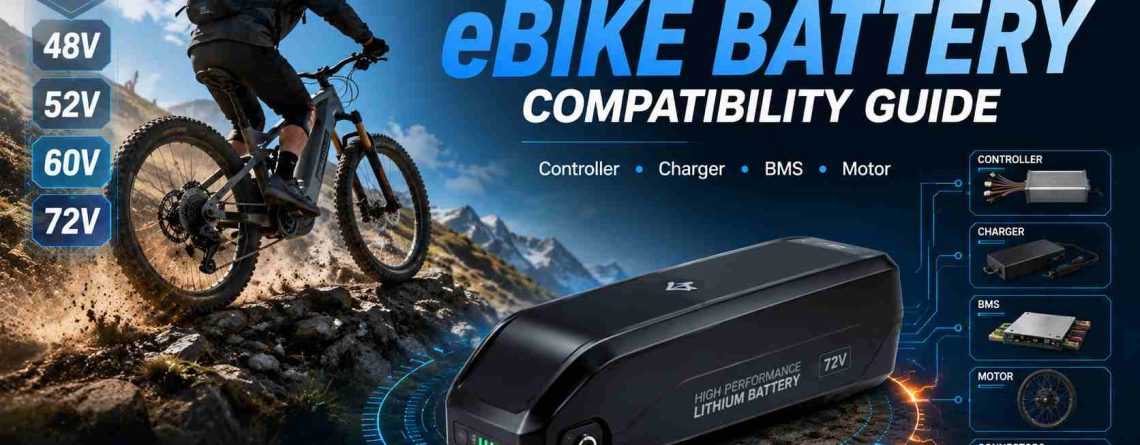
Description: A clean diagram showing a high voltage eBike battery pack with 48V, 52V, 60V, and 72V icons, linking to the controller, charger, and motor.
Need to Check Your Bike’s Limits?
Review your exact parts and voltage ratings before buying new gear to avoid costly damage.
What Is a High Voltage eBike Battery
A high-voltage eBike battery is a pack above your stock system voltage—often 52V, 60V, or 72V—that must strictly match your controller, charger, and BMS to work safely.
In the electric bike world, voltage is like water pressure in a pipe. While basic city bikes use 36V, stronger bikes use higher electrical pressure to push power through the motor. But getting a bigger battery pack for electric bike rides means making sure every part can handle the extra push.
36V, 48V, 52V, 60V, and 72V battery systems
Your battery voltage depends on how many cell groups are wired together inside the case. A basic 36V pack uses 10 groups. A 48V eBike battery pack uses 13 groups. For more power, riders move up to 52V, 60V, or 72V systems. Each step up gives your motor more energy to work with.
Nominal voltage vs full charge voltage
Many riders confuse average (nominal) voltage with full charge voltage. A 48V pack actually charges up to 54.6V. A 52V pack reaches 58.8V, and a 72V pack hits a huge 84V! If your controller can only handle 60V maximum, plugging in a fully charged 60V or 72V battery will instantly pop its parts.
Voltage, current, and motor demand
Power is a team effort between voltage (volts) and current (amps). When climbing a steep hill, a higher voltage battery for ebike systems lets your motor get the power it needs while drawing fewer amps. Less current means less heat in your wires and motor, which keeps your ride running smooth.
Why higher voltage is not automatically safer or better
Bigger numbers do not always mean a better bike. Higher voltage makes your motor spin faster, which adds stress to gears and bearings. If your wires are too thin or your BMS is cheap, adding higher battery voltage ebike parts can cause overheating instead of improving your ride—which is why understanding lithium battery thermal management and safety guidelines is critical before pushing more power through your stock setup.
Can I Put a Higher Voltage Battery on My eBike
You can safely install a higher-voltage battery only if your controller, motor, display, wiring, plugs, charger, and BMS are rated for the extra electrical power.
So, can I put a higher voltage battery on my ebike without breaking everything? Actually, it depends on your controller’s limits and your display settings. Here is a simple checklist to run through before you plug in a new pack:
- Confirm original battery voltage: Check your old battery label to see your starting numbers.
- Check controller voltage range: Ensure your controller’s max voltage limit is higher than your new battery’s *full charge* voltage.
- Confirm display support: Make sure your screen won’t flash error codes when it senses higher power.
- Match charger voltage: Always buy a new charger made for your upgraded voltage level.
- Check BMS current limits: Ensure the internal battery board can supply enough amps for your motor.
- Inspect wiring and plugs: Verify that your connectors (like XT60 or XT90) can handle the power without melting.
- Verify physical fitment: Measure your bike frame, as higher voltage packs are usually larger and heavier.
- Avoid forcing parts: Never cut wires or bypass safety rules to force a new battery onto an incompatible bike.
High Voltage eBike Battery Compatibility Table
Upgrading your battery voltage changes how much heat your bike makes, requires a new charger, and increases compatibility risks across your motor parts.
To help you see how different setups compare, check out this simple breakdown. Notice how the risk goes up quickly once you move past standard 48V systems:
| Battery Voltage | Typical Use Case | Compatibility Risk |
|---|---|---|
| 36V | City commuters, folding bikes, and light weekend rides. | Low: Standard setup for basic bikes; modest climbing power. |
| 48V | Standard cargo bikes, daily commuters, and trail riding. | Low to Medium: Very common; works with most standard replacement kits. |
| 52V | A popular upgrade for 48V bikes to get extra hill power. | Medium: Needs a 60V-rated controller; some battery displays may read wrong. |
| 60V | Fast off-road bikes, heavy hill climbing, and custom builds. | High: Will not work on standard bikes; needs dedicated high-voltage parts. |
| 72V | Extreme speed builds, electric dirt bikes, and racing rigs. | Very High: Demands special heavy-duty controllers, thick wires, and top safety gear. |
| Custom Pack | Unique frame shapes, ultra-long-range bikes, and DIY projects. | Variable: Requires careful math for cell layout and custom mounting boxes. |
What Changes When You Upgrade to a Higher Voltage eBike Battery
Stepping up to a higher voltage can improve your top speed and hill climbing, but it also creates more system heat and demands stricter safety limits.
When I upgraded my project bike to a high quality eBike battery pack, the power boost was amazing. But how your bike acts will change in several ways:
Speed and controller limits
Electric motors spin faster when you feed them more volts. This gives you a higher top speed. However, real speed depends on battery voltage, Wh capacity, BMS current ratings, controller limits, motor size, rider weight, and hills. If your controller cannot handle the extra speed, it will shut down.
Hill climbing and current demand
On steep hills, weak batteries lose power fast. A higher voltage upgrade keeps power delivery strong without pulling too many amps. This gives you steady torque on long climbs and keeps your motor running cooler.
Range expectations and Wh planning
Does higher voltage give you more range? Not always. Total riding distance depends on Watt-hours (Wh), which is volts multiplied by amp-hours (Ah). To ride further on a single charge, your new eBike lithium battery must have a larger total Wh number than your old one.
Heat, wiring, and BMS protection
Pushing more power through your bike can cause heat spikes during hard acceleration. Your battery must have a smart BMS to monitor temperatures and stop electrical surges before they melt your wires or plugs.
Charger and storage requirements
You must use a matching charger for your new voltage level. A 52V eBike battery upgrade needs a 58.8V charger. Also, store your high-voltage batteries in a dry, cool room, and keep them around 50% charged during winter to protect the cells.
Experience Validation Workflow: How to Check Compatibility
Use these simple, real-world steps to prove if a voltage upgrade is safe for your bike before spending money:
- Write down your current specs: Note your original voltage, Ah, total Wh, charger output, controller label limits, plug type, and motor watts.
- Check the controller label: Look at your controller box to confirm its maximum voltage rating before picking a bigger battery.
- Inspect your bike parts: Check your display manual, wire thickness, fuses, and measure the empty space inside your bike frame.
- Estimate your riding needs: Think about your local hills, how much weight you carry, your normal speed, and how far you ride each day.
- Pick matched parts: Choose a battery and charger that fit within your controller’s safety limits. *Stop and ask a bike tech if any numbers look unclear!*
How to Choose a High Voltage eBike Replacement Battery
Choosing a replacement battery must start with strict system compatibility, rather than just buying the highest voltage or biggest battery case you can find.
When your old battery dies, picking a new one is a big deal. A friend of mine once bought a huge battery online, only to realize the case was three inches too long for his frame! Beyond physical size, selecting a high voltage eBike replacement battery means matching your power goals to what your bike can handle. Use these rules to choose wisely:
Replacement & Upgrade Decision Rules
- Choose 48V if your bike came with a 48V system and you want a simple, reliable swap without changing other parts.
- Choose 52V only if you checked your controller and charger to make sure they support a 58.8V full charge.
- Choose 60V or 72V only for custom speed projects or off-road bikes built specifically for high-voltage power.
- Choose higher Wh if riding longer distances between charges is your main goal.
- Choose higher current capability only if your motor and controller need high burst power for heavy loads.
- Do not upgrade voltage if you cannot find the voltage limits for your controller, display, or charger.
Description: A visual guide comparing battery sizes, mounts, and plugs for 48V, 52V, 60V, and 72V eBike systems.
High Voltage eBike Battery Product Selection Support
Safe product selection means verifying your nominal voltage, BMS amp output, charger plug, and frame fitment before you buy.
To help you find the right power pack, it helps to look at proven performance setups. When browsing reliable shops like EM3ev for your next build, focusing on these two core upgrade levels ensures you get the best match for your riding style and frame:

52V eBike Battery Pack Upgrade
The best enthusiast upgrade for compatible 48V bikes looking for extra hill-climbing torque and less power drop.
- Nominal Voltage: 52V (14S layout)
- Full Charge Peak: 58.8V
- Best For: Stronger hill climbs and steady speed
- Support: EM3ev eBike battery replacement navigation
72V High Voltage eBike Battery Pack
The top choice for extreme power, built for off-road dirt bikes and custom high-speed track machines.
- Nominal Voltage: 72V (20S layout)
- Full Charge Peak: 84.0V
- Best For: Off-road racing and high-amp custom builds
- Support: EM3ev high voltage battery support
Ready to Upgrade Your Bike Safely?
Make sure your controller limits, plugs, and charger match completely before ordering your new battery.
Frequently Asked Questions
Clear answers to common questions about high-voltage eBike upgrades, battery safety, chargers, and speed gains.
What is considered a high voltage eBike battery?
A high voltage ebike battery is any pack operating above standard 36V or 48V levels—most often 52V, 60V, or 72V systems. These packs deliver extra power to compatible motors, helping you climb hills easier and ride at steady speeds while keeping wiring cooler.
Can I put a higher voltage battery on my eBike?
Yes, but only if your controller, display, and wires are rated for the higher voltage. Using a higher voltage electric bike battery on a stock bike without checking its limits can ruin your controller or cause sudden power shutoffs.
Is a 52V battery safe on a 48V eBike?
A 52V eBike battery upgrade is usually safe on a 48V bike if the controller parts can handle at least 60V (since a full 52V battery hits 58.8V). While many aftermarket controllers work great, stock brand-name displays might flash error codes.
Can I use a 60V or 72V battery on a regular eBike?
No, you cannot plug a 60V or 72V pack into a standard 36V or 48V bike. These powerful batteries charge up to 67.2V or 84V, which will instantly burn out standard controllers and damage regular bike displays.
Does higher voltage increase eBike speed?
Higher voltage can increase your top speed because electric motors spin faster when fed more volts. However, your true speed also depends on battery voltage, Wh capacity, BMS limits, rider weight, tire pressure, and wind resistance.
Does higher voltage increase range?
Not on its own. Total range comes from Watt-hours (Wh), which is volts multiplied by amp-hours (Ah). An upgraded battery voltage ebike pack will only take you further if its total Wh rating is higher than your old battery.
Do I need a different charger for a high voltage eBike battery?
Yes, you must use a charger made specifically for your battery’s voltage. For example, a 52V pack needs a 58.8V charger, while a 72V pack needs an 84V charger. Using the wrong charger is a major fire hazard.
What should I check before buying a high voltage eBike replacement battery?
Before buying a high voltage eBike replacement battery, check your controller’s max voltage limit, motor watts, BMS amp ratings, plug types (like XT60), charger compatibility, and the physical space in your frame triangle.
Summary: Making a Safe and Powerful Upgrade
Upgrading your battery is the best way to improve bike power, as long as you respect component limits and prioritize electrical safety.
Whether you need a simple replacement or want to build a fast trail bike, knowing how your battery works with your other parts is key. A high voltage ebike battery offers great benefits—like stronger hill climbing and higher top speeds—but it requires careful planning. Always verify your controller limits, make sure your BMS amp rating matches your motor, and use the correct charger.
Remember to check Watt-hours (Wh) if you want longer range, and always measure your bike frame before buying. By following simple safety rules and choosing compatible parts, you can build a reliable, fun electric bike that performs safely on every ride.



LEAVE A COMMENT